Dividend Allowance Cuts — What It Means for Company Directors
If you're a company director who pays yourself through dividends, you've watched the dividend allowance shrink from a reasonably generous £2,000 to a frankly miserly £500 in the space of just two years. That's a 75% cut, and it has real consequences for how much tax you pay and how you structure your remuneration.
In this article, we'll look at what the reduced dividend allowance means in practice, how much more tax you might be paying, and what strategies are still available to help you keep more of what your company earns.
The Dividend Allowance — A Quick Recap
The dividend allowance is the amount of dividend income you can receive each tax year without paying any tax on it. It was introduced in April 2016 at £5,000, reduced to £2,000 in 2018/19, then cut sharply:
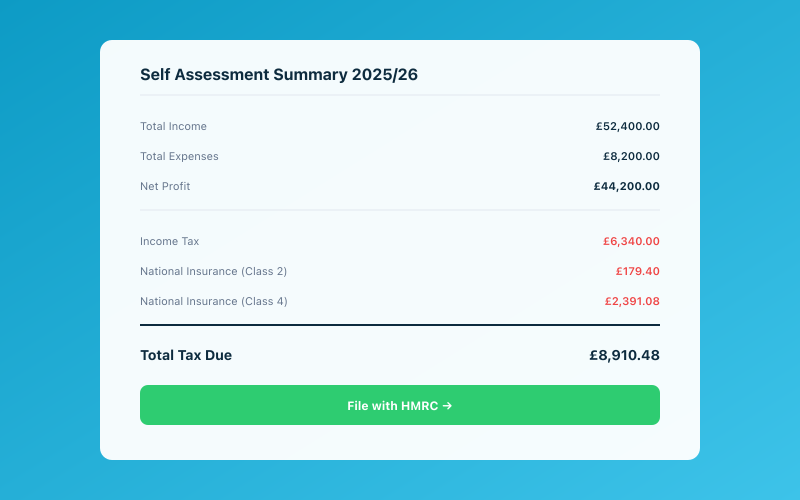 Your Accounted dashboard shows your real-time tax position
| Tax year | Dividend allowance | |----------|-------------------| | 2022/23 | £2,000 | | 2023/24 | £1,000 | | 2024/25 onwards | £500 |
The allowance applies to all dividend income, regardless of your tax band. But once you exceed it, dividends are taxed at these rates:
| Tax band | Dividend tax rate | |----------|-----------------| | Basic rate | 8.75% | | Higher rate | 33.75% | | Additional rate | 39.35% |
These rates are lower than the equivalent rates on employment income (20%, 40%, and 45%), which is why paying yourself through dividends has traditionally been more tax-efficient than taking a large salary. But the gap is narrowing, and the reduced allowance is part of that squeeze.
How Much More Tax Are You Paying?
Let's look at the numbers.
Scenario: A basic rate taxpayer director
If you take £20,000 in dividends:
- Under the old £2,000 allowance: £18,000 taxable at 8.75% = £1,575 in dividend tax
- Under the current £500 allowance: £19,500 taxable at 8.75% = £1,706.25 in dividend tax
- Additional cost: £131.25 per year
Scenario: A higher rate taxpayer director
If you take £40,000 in dividends:
- Under the old £2,000 allowance: £38,000 taxable at 33.75% = £12,825 in dividend tax
- Under the current £500 allowance: £39,500 taxable at 33.75% = £13,331.25 in dividend tax
- Additional cost: £506.25 per year
These amounts might not seem enormous in isolation, but when you add them to the other changes — frozen Income Tax thresholds, reduced Capital Gains Tax exemptions, and increased employer NICs — the cumulative effect is significant. For a higher rate taxpayer, the combination of fiscal drag and allowance cuts could easily amount to £2,000 or more in additional annual tax.
The Salary-Dividend Balance in 2026/27
Most director-shareholders of small limited companies pay themselves using a combination of a small salary and dividends. The optimal split depends on several factors, including:
- Corporation Tax rates
- Employer and employee NIC thresholds
- Income Tax bands
- The dividend allowance
- The Employment Allowance (if applicable)
For 2026/27, the conventional wisdom remains broadly similar to recent years:
The salary element: Many directors set their salary at or around the NIC primary threshold (£12,570), which means no Income Tax and no employee NICs are due. If the company is the director's only employment and qualifies for the Employment Allowance (£10,500 in 2025/26 — check whether this has changed for 2026/27), it may be worth paying a slightly higher salary, as the employer NICs would be offset by the Employment Allowance.
The dividend element: Once the salary is set, remaining profits can be extracted as dividends. Even with the reduced allowance and corporation tax already paid on those profits, dividends are still typically more tax-efficient than additional salary — at least for basic and higher rate taxpayers.
However, the margins are tightening. With the dividend allowance at just £500 and employer NICs having increased, the gap between salary and dividend taxation is narrower than it has been in years.
For a detailed comparison of the two approaches, our guide on salary vs dividends for directors runs through the sums.
Strategies to Manage the Impact
While you can't change the allowance itself, there are legitimate strategies to manage its impact:
1. Use your spouse's dividend allowance. If your spouse or civil partner is a shareholder in the company, they have their own £500 dividend allowance. If they're a basic rate or non-taxpayer, their dividend tax rates may be lower than yours. Paying dividends to them (provided they genuinely hold shares) can reduce the overall family tax bill.
Be careful here, though. The "settlements" legislation (sometimes called the "Arctic Systems" rules) can apply if shares were transferred specifically to gain a tax advantage. Ideally, your spouse should have held their shares from the outset or have a genuine commercial role in the business. Take professional advice before restructuring shareholdings.
2. Make pension contributions from the company. Employer pension contributions are a corporation tax-deductible expense, and they don't attract NICs. Instead of extracting more profit as dividends and paying dividend tax, the company can contribute directly to your pension. The money grows tax-free within the pension, and you can access it from age 57 (rising to 57 from 2028).
The Annual Allowance for pension contributions is £60,000 (or 100% of your earnings, whichever is lower), and you can carry forward unused allowance from the previous three years. For directors with healthy company profits, this is one of the most powerful tax planning tools available.
3. Consider the timing of dividends. If your income fluctuates between tax years, you might be able to time dividend payments to stay within a lower tax band in certain years. For example, if you know next year will be a lower-income year, deferring some dividends could mean they're taxed at the basic rate (8.75%) rather than the higher rate (33.75%).
This requires careful planning and good financial records. If you're using Accounted for your company's bookkeeping, Penny can give you a clear picture of where you stand at any point during the year, making these decisions easier.
4. Use your ISA allowance. Once dividends land in your personal account, investing them within an ISA means any further growth is tax-free. The annual ISA allowance is £20,000, and using it consistently can build up a significant tax-efficient pot over time. This doesn't help with the initial dividend tax, but it prevents the after-tax proceeds from generating further taxable income.
5. Consider alternative extraction methods. In some circumstances, other methods of extracting value from your company may be more efficient:
- Rent: If the company uses space in your home, paying a market-rate rent to yourself is a deductible expense for the company. The rental income is taxable personally, but it doesn't attract NICs.
- Interest on director's loans: If you've lent money to your company, charging interest is a corporation tax-deductible expense. The interest is taxable personally but covered by your Personal Savings Allowance (£1,000 for basic rate taxpayers, £500 for higher rate).
- Capital distribution on winding up: If you're closing the company, distributions treated as capital rather than income may qualify for CGT treatment (at lower rates), though Business Asset Disposal Relief has its own limits and conditions.
The Interaction With Corporation Tax
It's worth remembering that dividends are paid from post-corporation-tax profits. The company has already paid corporation tax (25% for profits over £250,000, or 19%–25% for profits between £50,000 and £250,000 due to marginal relief) before the dividend reaches you.
When you add corporation tax and dividend tax together, the combined effective tax rate on company profits extracted as dividends can be surprisingly high:
| Scenario | Corp tax | Dividend tax | Combined rate | |----------|----------|-------------|--------------| | Small profits (19% CT), basic rate dividend | 19% | 8.75% | 25.9% | | Small profits (19% CT), higher rate dividend | 19% | 33.75% | 46.3% | | Main rate (25% CT), basic rate dividend | 25% | 8.75% | 31.6% | | Main rate (25% CT), higher rate dividend | 25% | 33.75% | 50.3% |
At the higher end, you're keeping less than half of every pound your company earns. That makes pension contributions — which avoid both corporation tax and dividend tax — look even more attractive.
Should You Reconsider Your Company Structure?
The cumulative effect of reduced dividend allowances, increased employer NICs, higher corporation tax rates, and frozen thresholds has led some commentators to question whether operating through a limited company is still as advantageous as it once was.
The answer depends on your specific circumstances. For many directors, the limited company structure still offers meaningful tax advantages, asset protection, and credibility benefits. But the margin of advantage has narrowed, and for lower-income directors, the administrative burden (annual accounts, confirmation statements, corporation tax returns) may no longer justify the saving.
If you're questioning whether your structure is still optimal, it's worth discussing with an accountant who understands your full financial picture. Our article on dividend vs salary for director pay provides a good starting point for the conversation.
Keeping Track of It All
With allowances shrinking and tax rules becoming more complex, keeping accurate, up-to-date financial records isn't just good practice — it's essential for making informed decisions about how and when to pay yourself.
Accounted helps company directors and sole traders alike stay on top of their finances. With Penny handling the day-to-day categorisation and bookkeeping, you can focus on running your business with the confidence that your numbers are always current and accurate.
Related reading:
- Salary vs Dividends for Directors
- Dividend vs Salary — Director Pay
- Personal Allowance — How to Use It Effectively
Accounted helps UK sole traders stay on top of their bookkeeping and tax. Start your free 30-day trial at getaccounted.co.uk
Related Reading
Start your free trial and let Penny handle your bookkeeping automatically.
Penny, your AI bookkeeper, tracks your tax position in real time and flags opportunities to reduce your bill. Meet Penny →
Tax & Compliance Specialists
Our tax specialists have decades of combined experience in UK sole trader and small business taxation, MTD compliance, and HMRC submissions. All content is reviewed against current HMRC guidance before publication and updated quarterly to reflect legislative changes.
Ready to try Accounted?
Join UK sole traders who are simplifying their bookkeeping and tax.
Start your 14-day free trial