How to Use Your Personal Allowance Effectively
The personal allowance is one of the most fundamental parts of the UK tax system — the amount you can earn each year before paying a penny of income tax. For the 2025/26 tax year, it sits at £12,570, and it's been frozen at this level since 2021/22 (with the freeze set to continue until at least April 2028).
On the surface, it seems simple enough: earn up to £12,570 tax-free, pay tax on anything above that. But dig a little deeper and you'll find there are several smart ways to make sure you're squeezing every last drop of value from your personal allowance — and some costly traps that can reduce or eliminate it entirely.
Whether you're a sole trader, employed, or a bit of both, this guide will help you use your personal allowance as effectively as possible.
How the Personal Allowance Works
Everyone who is a UK tax resident gets a personal allowance. It's automatically applied to your income before tax is calculated. For most people, this means:
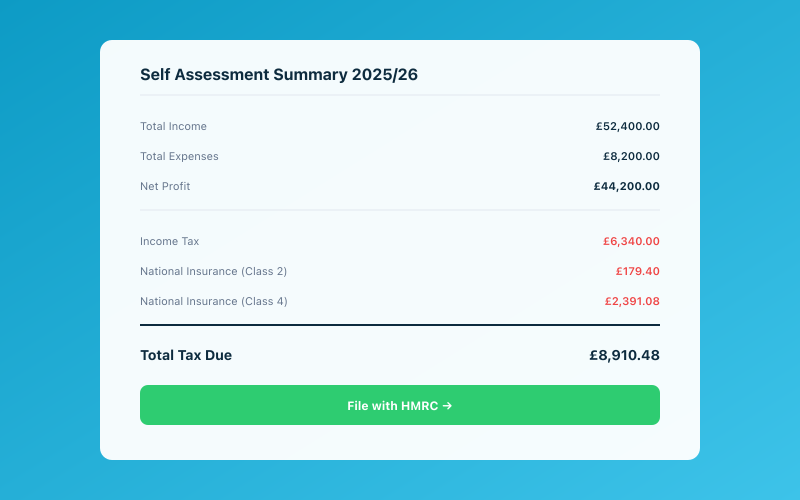 Your Accounted dashboard shows your real-time tax position
- The first £12,570 of income: 0% tax
- Income from £12,571 to £50,270: 20% tax (basic rate)
- Income from £50,271 to £125,140: 40% tax (higher rate)
- Income above £125,140: 45% tax (additional rate)
If you're employed, your employer applies the personal allowance through PAYE, so you see the benefit in every payslip. If you're self-employed, it's factored into your Self Assessment calculation.
The Personal Allowance Trap for Higher Earners
Here's something that catches people out: once your income exceeds £100,000, your personal allowance starts to shrink. It reduces by £1 for every £2 of income above £100,000, which means it disappears entirely at £125,140.
The practical effect is brutal. On income between £100,000 and £125,140, your effective marginal tax rate is 60% — because you're paying 40% income tax plus losing £1 of allowance (worth 40p in tax) for every additional £2 earned. That's a 60p tax charge on every extra pound.
If your income is in this range, reducing it below £100,000 through pension contributions, Gift Aid donations, or other allowable deductions can save you a significant amount of tax. We'll come back to this strategy shortly.
Making Sure You Don't Waste Your Allowance
Your personal allowance can only be used against your own income. You can't carry it forward to future years, and in most cases, you can't transfer it to someone else (with one exception we'll cover below). If you don't use it, you lose it.
The Marriage Allowance Transfer
If your income is below £12,570 — meaning you're not using your full personal allowance — you can transfer £1,257 (10% of the allowance) to your spouse or civil partner, provided they're a basic rate taxpayer. This saves the receiving partner up to £251.40 per year.
It's not a huge amount, but it's free money. You can apply online and backdate the claim by up to four years. For more detail on this and other couple-based strategies, see our guide to how married couples can save tax.
Using Your Allowance Across Multiple Income Sources
If you have income from multiple sources — say, self-employment income plus a part-time job, or rental income alongside your business — your personal allowance covers all of them. HMRC applies it to your total income, so you don't get a separate allowance for each source.
This is important for tax planning. If your combined income from all sources exceeds £12,570, you'll start paying tax. If one source is taxed through PAYE and another through Self Assessment, make sure your tax code is correct — otherwise you might end up paying too much or too little tax during the year.
Strategies to Protect Your Personal Allowance
If your income is near or above £100,000, protecting your personal allowance should be a top priority. Here are the most effective strategies.
Pension Contributions
Pension contributions are deducted from your income for tax purposes, which can bring you back below the £100,000 threshold and restore your personal allowance. In 2025/26, the annual allowance is £60,000 (or 100% of your earnings, whichever is lower).
Example: Alex earns £110,000. Without any planning, they lose £5,000 of their personal allowance (half the £10,000 excess over £100,000). By making a £10,000 pension contribution, their adjusted net income drops to £100,000, their full personal allowance is restored, and they save:
- £4,000 in income tax relief on the pension contribution (at 40%)
- £2,000 from restored personal allowance (£5,000 x 40%)
- Total tax benefit: £6,000 on a £10,000 pension contribution
That's an effective tax relief rate of 60%, making pension contributions in this income range incredibly powerful. For more on this, read our guide to pension contributions before April.
Gift Aid Donations
Charitable donations made through Gift Aid also reduce your adjusted net income. If you already give to charity, making sure those donations are Gift Aid eligible can help protect your personal allowance.
Trading Losses
If your self-employment produces a loss in a particular year, you can usually set that loss against your other income, reducing your total income and potentially protecting your personal allowance. This is particularly relevant in the early years of a business when start-up costs might exceed income.
The Savings and Dividend Allowances
Your personal allowance isn't the only tax-free amount available to you. Understanding how it interacts with other allowances can help you plan your overall tax position.
Personal Savings Allowance
On top of your personal allowance, you get a Personal Savings Allowance for bank interest:
- Basic rate taxpayers: £1,000 of interest tax-free
- Higher rate taxpayers: £500 of interest tax-free
- Additional rate taxpayers: £0 — no savings allowance
If you're setting money aside for your tax bill in a savings account (which you should be if you're self-employed), the interest is likely covered by this allowance.
Dividend Allowance
You also get a dividend allowance of £500 in 2025/26. This is particularly relevant if you receive dividends from investments held outside an ISA. Dividends above the allowance are taxed at 8.75% (basic rate), 33.75% (higher rate), or 39.35% (additional rate).
The Starting Rate for Savings
There's also a £5,000 starting rate band for savings income, taxed at 0%. This is available if your non-savings income (such as employment or self-employment income) is below £17,570 (£12,570 personal allowance + £5,000 starting rate band). It's mainly useful for people with very low earned income but some savings or investment income.
Practical Tips for Sole Traders
If you're self-employed, here are some specific ways to use your personal allowance effectively:
Claim All Allowable Expenses
Every legitimate expense you claim reduces your taxable profit. If your gross income is, say, £18,000 and you have £6,000 in allowable expenses, your taxable profit is £12,000 — entirely within your personal allowance. Without those expense claims, you'd pay tax on £5,430.
Common expenses sole traders forget to claim include:
- A proportion of home office costs (heating, lighting, broadband)
- Professional subscriptions and memberships
- Business mileage at HMRC approved rates
- Accountancy fees and bookkeeping software
- Business insurance premiums
Use the Trading Allowance
If your self-employment income is low (under £1,000 per year), the trading allowance lets you earn up to £1,000 tax-free without needing to register as self-employed or file a tax return. This is separate from your personal allowance and particularly useful for people with small side hustles alongside employed income.
Time Your Income and Expenses
If your income fluctuates from year to year, try to ensure you use your full personal allowance in each tax year. If you're on the cash basis of accounting, you have some control over when income is recognised (by timing when you invoice and receive payment) and when expenses are incurred.
This doesn't mean artificially manipulating your accounts — but where you have genuine commercial flexibility, it makes sense to consider the tax implications. For example, if you know next year will be quieter, you might delay a large expense to ensure you have enough deductions when you need them most.
What Happens If You Don't Use Your Full Allowance
If your income is below £12,570, the unused portion of your personal allowance is simply lost — it doesn't carry forward to future years and it can't be transferred to anyone else (except the Marriage Allowance portion mentioned earlier).
This is why it's worth thinking about your personal allowance as a "use it or lose it" benefit. If you're in a position to control the timing of income — perhaps you have a seasonal business or you're winding down towards retirement — try to ensure you receive at least £12,570 of taxable income each year to fully utilise it.
Keeping Track Throughout the Year
The best way to use your personal allowance effectively is to keep a clear, up-to-date picture of your income and expenses throughout the year. If you wait until January to tally everything up, you've missed the window to make adjustments.
Accounted makes this easy for sole traders. Penny — the AI assistant built into Accounted — tracks your income and expenses in real time and gives you a running estimate of your tax position. That means you can see exactly where you stand relative to your personal allowance and other thresholds at any point in the year, giving you time to plan rather than react.
As the tax year end approaches in April, take a few minutes to review your position. Are you using your full personal allowance? Could a pension contribution protect it? Is there an expense you've been meaning to make? A little planning goes a long way.
Accounted helps UK sole traders stay on top of their bookkeeping and tax. Start your free 30-day trial at getaccounted.co.uk
Related reading:
- How to Pay Less Tax Legally in the UK
- How to Reduce Your Tax Bill as a Sole Trader
- Tax Year-End Planning Guide
Related Reading
- What Is the High Income Child Benefit Charge?
- Frozen Tax Thresholds — How Fiscal Drag Is Costing You More
Start your free trial and let Penny handle your bookkeeping automatically.
Penny, your AI bookkeeper, tracks your tax position in real time and flags opportunities to reduce your bill. Meet Penny →
Tax & Compliance Specialists
Our tax specialists have decades of combined experience in UK sole trader and small business taxation, MTD compliance, and HMRC submissions. All content is reviewed against current HMRC guidance before publication and updated quarterly to reflect legislative changes.
Ready to try Accounted?
Join UK sole traders who are simplifying their bookkeeping and tax.
Start your 14-day free trial