Tax Planning for Seasonal Businesses
Running a seasonal business has its charms — wedding photographers, ice cream vans, Christmas market stallholders, holiday let owners, festival caterers, and ski instructors all know the thrill of a busy season and the quiet that follows. But when it comes to tax planning, seasonality throws up some unique challenges that year-round businesses simply don't face.
The feast-and-famine nature of seasonal income means cash flow management isn't just important — it's everything. Get it wrong, and you could find yourself staring at a hefty tax bill in January with nothing in the bank to pay it. Get it right, and you'll sail through the quiet months with confidence.
In this guide, we'll look at practical tax planning strategies tailored to seasonal businesses in the 2025/26 tax year, helping you smooth out the bumps and keep HMRC happy.
Understanding How Tax Works with Irregular Income
One of the biggest misconceptions seasonal business owners have is that HMRC taxes you differently because your income is irregular. They don't. Whether you earn £40,000 spread evenly across 12 months or £40,000 crammed into four months of summer, the tax calculation is exactly the same.
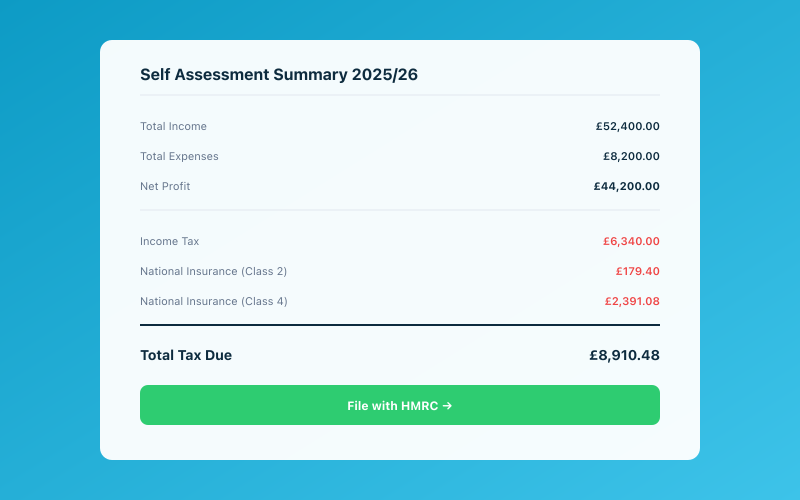 Your Accounted dashboard shows your real-time tax position
Your income tax is based on your total taxable profit for the tax year (6 April to 5 April), after deducting allowable expenses and your personal allowance of £12,570. In 2025/26, you'll pay:
- 0% on the first £12,570 (personal allowance)
- 20% on income between £12,571 and £50,270 (basic rate)
- 40% on income between £50,271 and £125,140 (higher rate)
- 45% on income above £125,140 (additional rate)
The challenge isn't the rate — it's the timing. All that income arrives in a short window, but the tax bill doesn't come due until 31 January following the end of the tax year (and potentially 31 July for payments on account). By the time you need to pay, the money might be long gone if you haven't planned ahead.
Setting Aside Money for Tax During Peak Season
This is the single most important habit for any seasonal business owner. When the money is flowing in, it's tempting to feel wealthy and spend accordingly. But a significant chunk of that income belongs to HMRC, and you need to ring-fence it immediately.
The Percentage Method
A simple approach is to transfer a fixed percentage of every payment you receive into a separate savings account. The right percentage depends on your total annual income:
- If your annual profit is below £50,270: set aside 25–30% (covering income tax at 20% plus Class 4 National Insurance at 6%).
- If your annual profit pushes into the higher rate band: set aside 35–40% for the portion above £50,270.
- If you're not sure: 30% is a reasonable middle ground for most sole traders.
Automating the Process
The best time to set money aside is the moment it arrives. Set up a standing order or automatic transfer from your business account to a dedicated tax savings account. That way, the money is out of sight and out of mind before you're tempted to spend it.
With Accounted, Penny can give you a real-time estimate of your tax liability as your income comes in, so you know exactly how much to squirrel away. It takes the guesswork out of a process that otherwise relies on discipline alone.
Timing Your Expenses Wisely
Seasonal businesses often have the flexibility to choose when they incur certain expenses. This is a powerful tax planning tool if you use it deliberately.
Bringing Expenses Forward
If you've had a particularly profitable season and you know your tax bill is going to be high, consider bringing forward any planned purchases into the current tax year. For example:
- Equipment and tools: If you need new equipment for next season, buying it before 5 April means you can claim the expense (or capital allowances) against this year's higher income.
- Training and courses: Investing in professional development during the off-season is both productive and tax-deductible.
- Vehicle costs: If you use a vehicle for business, servicing or replacing it before the year end can bring forward deductible costs.
Deferring Income
In some cases, you might be able to defer income into the next tax year. For example, if you invoice in late March but the payment doesn't arrive until April, the income falls into the following tax year (assuming you use the cash basis of accounting, which most sole traders do).
Be careful with this — HMRC won't look kindly on artificial arrangements designed purely to delay tax. But where genuine commercial decisions happen to have a favourable tax impact, that's perfectly legitimate.
Making the Most of Your Quiet Season
The off-season isn't just downtime — it's an opportunity. Here's how to use it for tax planning.
Review and Organise Your Records
Use the quiet months to get your bookkeeping up to date. Chase any outstanding invoices, reconcile your accounts, and make sure all your expenses are properly recorded. This makes your Self Assessment return much easier to complete and reduces the risk of missing legitimate deductions.
If keeping on top of records during the busy season feels impossible, that's completely understandable. Many seasonal business owners find that a tool like Accounted makes a real difference — snap a photo of a receipt on your phone during the rush, and deal with the detail when things calm down.
Claim All Allowable Expenses
Seasonal businesses often have expenses that are easy to overlook:
- Storage costs for equipment during the off-season
- Insurance that covers the full year even though you only trade for part of it
- Marketing and advertising done during quiet months to prepare for the next season
- Vehicle costs for travelling to seasonal locations
- Maintenance and repairs on equipment between seasons
Every legitimate expense you claim reduces your taxable profit and therefore your tax bill.
Plan Pension Contributions
The off-season is also a good time to think about pension contributions. If you've had a strong season, making a pension contribution before the end of the tax year can significantly reduce your tax bill. You'll get tax relief at your marginal rate — 20%, 40%, or even 45% — and the money grows tax-free inside the pension.
The annual allowance for pension contributions is £60,000 in 2025/26 (or 100% of your earnings, whichever is lower). If you didn't use your full allowance in the previous three years, you may be able to carry it forward and make a larger contribution.
Payments on Account — The Seasonal Sting
Payments on account are advance payments towards next year's tax bill, each equal to half of the previous year's Self Assessment liability. For seasonal businesses, these can be particularly painful because they're based on last year's income, which might have been unusually high or low.
When Payments on Account Cause Problems
Imagine you had an exceptional season last year and your tax bill was £8,000. HMRC will ask you to make two payments on account of £4,000 each — one on 31 January and one on 31 July — on top of any balancing payment for the current year.
But what if this year's season was poor and your actual tax liability will be much lower? You'll be paying advances based on a bumper year when your income has dropped.
Reducing Your Payments on Account
You can apply to reduce your payments on account if you expect your income to be lower than the previous year. You do this through your Self Assessment return or by contacting HMRC. Just be cautious — if you reduce them too much and your actual liability turns out to be higher, HMRC will charge interest on the underpayment.
For a full explanation, see our guide to payments on account.
Choosing the Right Accounting Period
Most sole traders have an accounting year that matches the tax year (6 April to 5 April), but it's worth considering whether a different year end might suit your seasonal business better.
For example, if your busy season runs from June to September, having a year end of 30 September means you prepare your accounts shortly after the season ends, when everything is fresh in your mind and your records are most up to date.
Since the basis period reforms that took full effect from 2024/25, all sole traders are taxed on a tax year basis regardless of their accounting period. However, you can still choose an accounting period that makes practical sense for managing your records — you'll just need to apportion profits to the tax year.
Building a Cash Reserve
Beyond the immediate tax savings, the most important financial strategy for any seasonal business is building a cash reserve that sees you through the quiet months. Aim for:
- Enough to cover your tax bill — both the balancing payment and any payments on account.
- Three to six months of personal living expenses — because the off-season is real and bills don't stop.
- A buffer for unexpected costs — equipment breakdowns, vehicle repairs, or a season that starts late or ends early.
This might feel like a lot to save, especially after a single season of trading, but it gets easier over time as you build up the reserve and only need to top it up each year rather than starting from scratch.
A Year-Round Tax Calendar for Seasonal Businesses
Here's a suggested timeline to keep you on track:
- Peak season (whenever yours is): Set aside your tax percentage from every payment. Keep recording expenses, even if it's just photos of receipts.
- End of season: Review your income and expenses. Estimate your tax liability. Make any planned purchases before the tax year ends.
- October–December: Complete your Self Assessment return (don't leave it until January). Consider pension contributions.
- 31 January: Pay your tax bill and first payment on account. Review whether to reduce July's payment on account.
- February–March: Plan for the tax year end. Use any remaining pension or ISA allowances. Prepare for the next season.
The key is to treat tax planning as a year-round activity, not a January panic. With a bit of structure and the right tools, seasonal income doesn't have to mean seasonal stress.
Accounted helps UK sole traders stay on top of their bookkeeping and tax. Start your free 30-day trial at getaccounted.co.uk
Related reading:
- Payments on Account Explained
- How to Reduce Your Tax Bill as a Sole Trader
- Dealing with Financial Anxiety as a Sole Trader
Related Reading
- The Personal Savings Allowance — How It Works for Business Owners
- Voluntary National Insurance Contributions — When to Pay Extra
Start your free trial and let Penny handle your bookkeeping automatically.
Penny, your AI bookkeeper, tracks your tax position in real time and flags opportunities to reduce your bill. Meet Penny →
Tax & Compliance Specialists
Our tax specialists have decades of combined experience in UK sole trader and small business taxation, MTD compliance, and HMRC submissions. All content is reviewed against current HMRC guidance before publication and updated quarterly to reflect legislative changes.
Ready to try Accounted?
Join UK sole traders who are simplifying their bookkeeping and tax.
Start your 14-day free trial