The Personal Savings Allowance — How It Works for Business Owners
Interest rates have been meaningfully higher than the near-zero levels we got used to for over a decade, and that means savings accounts are actually generating noticeable returns again. Good news, right? Well, yes — but it also means you might owe tax on your savings interest for the first time in years.
If you're self-employed or run a small business, the Personal Savings Allowance (PSA) is something you need to understand. It determines how much interest you can earn tax-free, and it interacts with your business income in ways that might catch you out.
What Is the Personal Savings Allowance?
The Personal Savings Allowance was introduced in April 2016 and sets the amount of savings interest you can earn each tax year without paying tax on it. The allowance depends on your Income Tax band:
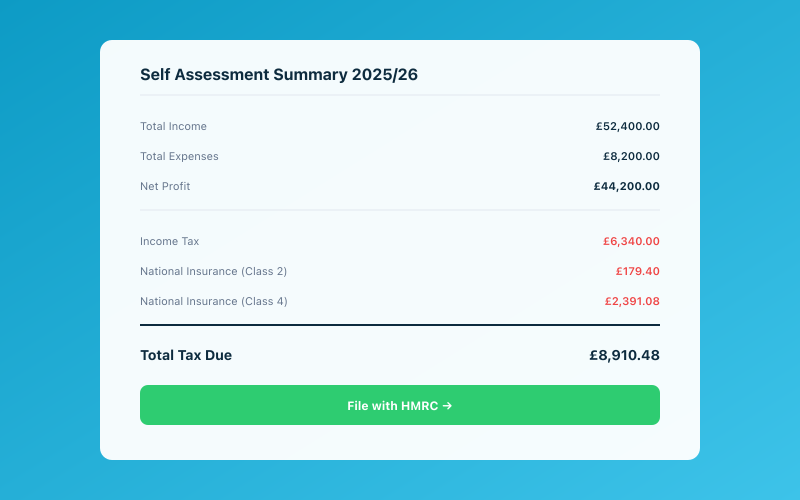 Your Accounted dashboard shows your real-time tax position
| Income Tax band | Personal Savings Allowance | |----------------|---------------------------| | Basic rate (20%) | £1,000 | | Higher rate (40%) | £500 | | Additional rate (45%) | £0 |
This means if you're a basic rate taxpayer, you can earn up to £1,000 in savings interest per year tax-free. If you're a higher rate taxpayer, that drops to £500. And if you're an additional rate taxpayer, you get no allowance at all — every penny of interest is taxable.
Crucially, the PSA sits on top of your personal allowance. It's a separate allowance specifically for savings interest. It doesn't reduce your personal allowance or affect how your other income is taxed.
Why Business Owners Need to Pay Attention
If you're employed on a fixed salary, your tax band is reasonably predictable, and your PSA is straightforward to plan around. But if you're self-employed or a company director, there are several wrinkles:
Your income fluctuates. A sole trader's profit can vary significantly from year to year. A good year might push you from the basic rate into the higher rate band, halving your PSA from £1,000 to £500. If you weren't expecting that, you might owe tax on interest you assumed was covered.
Your business profits determine your tax band. Your self-employment profit, combined with any other income, determines whether you're a basic, higher, or additional rate taxpayer — and therefore how much savings interest you can earn tax-free. This is your total income, not just your savings.
You might be sitting on cash reserves. Many self-employed people and business owners keep a cash buffer for tax bills, quiet periods, or future investments. If that buffer is earning interest in a savings account, the interest is potentially taxable.
The £100,000 trap. If your total income (including savings interest) exceeds £100,000, your personal allowance begins to taper. This can create an effective marginal tax rate of 60% on income between £100,000 and £125,140. Savings interest counts towards this total, so it can inadvertently push you into the taper zone.
How Savings Interest Is Taxed
Before the PSA was introduced, banks and building societies deducted basic rate tax from interest payments automatically. That system was scrapped in 2016. Now, interest is paid gross (without tax deducted), and you're responsible for declaring it and paying any tax owed.
Here's how it works in practice:
-
Add up all your savings interest for the tax year. This includes interest from bank accounts, building society accounts, NS&I products (some are tax-free — more on that below), peer-to-peer lending, and credit union accounts.
-
Subtract your PSA. If you're a basic rate taxpayer, subtract £1,000. If higher rate, subtract £500.
-
Any remaining interest is taxable at your marginal rate (20%, 40%, or 45%).
For example, if you're a basic rate taxpayer and you earn £1,300 in savings interest during the year, the first £1,000 is covered by your PSA. The remaining £300 is taxable at 20%, meaning you'd owe £60 in tax on your savings interest.
If you're self-employed and file a Self Assessment tax return, you'll declare your savings interest on that return. HMRC then calculates the tax owed as part of your overall bill. If you're not in Self Assessment (perhaps because you're a company director who's fully taxed through PAYE), HMRC may adjust your tax code to collect the tax.
Savings Interest and Your Business Bank Account
Here's something that trips up sole traders: interest earned in your business bank account is still personal savings interest for tax purposes. As a sole trader, there's no legal separation between you and your business — your business income and personal income are one and the same.
So if your business current account or savings account earns interest, that interest needs to be declared alongside any interest from your personal savings accounts. It all counts towards your PSA.
Most business current accounts pay little or no interest, so this is mainly relevant if you've got money in a business savings account, a notice account, or a money market account. But with rates higher than they've been in years, even modest balances can generate noticeable interest.
If you're using Accounted to manage your bookkeeping, Penny will pick up interest payments appearing in your bank feed and can help ensure they're recorded correctly. This is one of those details that's easy to overlook but can cause headaches if HMRC queries your return.
Tax-Free Savings Options
Some types of savings interest are completely outside the PSA and don't count towards it at all:
ISAs (Individual Savings Accounts). Interest earned within an ISA is entirely tax-free and doesn't count towards your PSA. The annual ISA allowance is £20,000, and for business owners looking to shelter savings from tax, maximising your ISA contributions is one of the most straightforward strategies available.
NS&I Premium Bonds. Any prizes you win are tax-free. Premium Bonds don't pay interest in the traditional sense — instead, your holdings are entered into a monthly prize draw. The effective "interest rate" varies, but all winnings are free of Income Tax and Capital Gains Tax.
NS&I Direct Saver and other tax-free NS&I products. Some NS&I accounts pay taxable interest, but others (like certain fixed-rate bonds in the past) have been tax-free. Check the specific terms of any NS&I product you hold.
The starting rate for savings. There's a separate 0% starting rate for savings that applies to the first £5,000 of savings income, but only if your non-savings income (employment, self-employment, pensions, etc.) is below £17,570. For most business owners, non-savings income will exceed this, so the starting rate won't apply — but if you've had a low-income year, it's worth checking.
Practical Strategies for Business Owners
Here's how to make the most of your PSA and minimise tax on savings interest:
1. Maximise your ISA allowance. Move as much of your savings as possible into ISAs. Cash ISAs, stocks and shares ISAs, and innovative finance ISAs all shelter your returns from tax. The £20,000 annual allowance is generous — use it.
2. Track your savings interest through the year. Don't wait until January to find out how much interest you've earned. Keep a running total so you can plan ahead. If you're approaching the PSA limit mid-year, you might choose to move excess savings into an ISA or make a pension contribution to reduce your taxable income.
3. Consider your tax band carefully. If you're close to the basic/higher rate boundary, remember that crossing it halves your PSA. If pension contributions or other allowable deductions could keep you in the basic rate band, the saving isn't just the tax rate difference on your income — it's also the preservation of the full £1,000 PSA instead of £500.
4. Use your spouse or civil partner's allowance. If your partner is a basic rate or non-taxpayer, they have their own PSA (and possibly access to the starting rate for savings). Holding savings in their name can shelter more interest from tax. This is legitimate tax planning, not avoidance — HMRC has no issue with it.
5. Keep business cash reserves efficient. If you're sitting on a large cash reserve for tax bills or future expenses, consider whether it's in the most tax-efficient place. A business savings account earning taxable interest might not be the best option if you've already used your PSA. Moving personal savings into an ISA and keeping business reserves where they're needed could be more efficient overall.
6. Don't forget to declare it. Banks report interest to HMRC automatically, so HMRC will likely know how much you've earned even if you forget to declare it. Including it on your Self Assessment return is straightforward — there's a dedicated section for savings income — but omitting it could trigger a query or penalty.
The PSA and Making Tax Digital
As Making Tax Digital for Income Tax rolls out, your savings interest will need to be included in your digital records and reported as part of your quarterly updates and final declaration. If you're using MTD-compatible software like Accounted, savings interest from your linked bank accounts should be captured automatically through your bank feeds.
This is one of the advantages of having your finances connected to a digital tool — nothing falls through the cracks, and you can see your full tax picture at any time rather than getting a surprise when you file your return.
In Summary
The Personal Savings Allowance is generous enough for many people, but if you're a business owner with fluctuating income, cash reserves earning interest, and multiple accounts to track, it's easy to exceed it without realising. The key is awareness and planning — know your tax band, track your interest, and make use of tax-free options like ISAs.
With interest rates higher than they've been in years, this is no longer a niche concern. It's a mainstream tax planning issue, and one that's well worth your attention.
Related reading:
- Personal Allowance — How to Use It Effectively
- New Tax Year April 2026 — What's Changing
- Dividend vs Salary — Director Pay
Accounted helps UK sole traders stay on top of their bookkeeping and tax. Start your free 30-day trial at getaccounted.co.uk
Related Reading
- What Is the High Income Child Benefit Charge?
- Frozen Tax Thresholds — How Fiscal Drag Is Costing You More
Start your free trial and let Penny handle your bookkeeping automatically.
Penny, your AI bookkeeper, tracks your tax position in real time and flags opportunities to reduce your bill. Meet Penny →
Tax & Compliance Specialists
Our tax specialists have decades of combined experience in UK sole trader and small business taxation, MTD compliance, and HMRC submissions. All content is reviewed against current HMRC guidance before publication and updated quarterly to reflect legislative changes.
Ready to try Accounted?
Join UK sole traders who are simplifying their bookkeeping and tax.
Start your 14-day free trial