Voluntary National Insurance Contributions — When to Pay Extra
Most people think of National Insurance as something that just disappears from their pay — a compulsory deduction they have no control over. But what many don't realise is that you can actually choose to pay more National Insurance than you owe. It sounds counterintuitive, but voluntary National Insurance contributions can be one of the smartest financial moves you ever make.
In this guide, we'll explain exactly when paying extra NI is worth it, how much it costs, and what you stand to gain.
What Are Voluntary National Insurance Contributions?
Voluntary National Insurance contributions are payments you choose to make to HMRC to fill gaps in your National Insurance record. These gaps might exist because you weren't working, were earning below the threshold, were living abroad, or simply didn't pay enough NI in a given tax year.
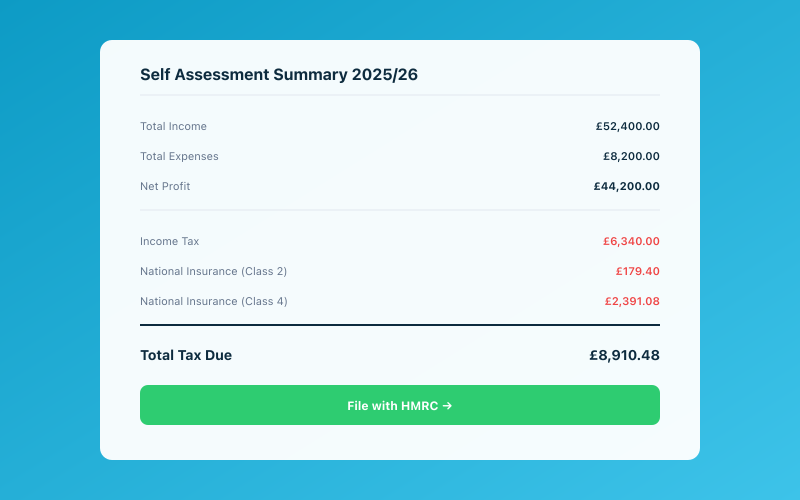 Your Accounted dashboard shows your real-time tax position
Your National Insurance record directly affects your entitlement to the state pension and certain benefits. To qualify for the full new state pension (currently £221.20 per week in 2025/26), you need 35 qualifying years. If you have fewer than 10 qualifying years, you won't receive any state pension at all.
Voluntary contributions come in two classes:
- Class 2 — available to self-employed people and costs just £3.45 per week (2025/26 rate)
- Class 3 — available to anyone and costs £17.75 per week (2025/26 rate)
The difference in cost is significant. If you're eligible for Class 2, you're looking at roughly £179.40 per year compared to £922 per year for Class 3. That makes Class 2 contributions extraordinary value — something we'll explore further below.
Why Would You Pay Voluntary NI?
The most common reason is to protect your state pension. Each qualifying year you add to your record increases your weekly state pension by around £6.32 (one thirty-fifth of the full amount). Over a typical retirement, that extra £6.32 per week adds up to thousands of pounds.
Let's put some numbers to it. If you pay Class 2 voluntary contributions at £3.45 per week (£179.40 per year) to buy one additional qualifying year, your state pension increases by roughly £6.32 per week — that's £328.64 per year. You'd recoup your investment in under seven months of receiving the pension. Over a 20-year retirement, that single year of voluntary contributions would return more than £6,500.
For Class 3 at £922 per year, the payback period is longer — around two years and ten months — but it's still a strong return by any investment standard.
Here are the main scenarios where voluntary contributions make sense:
- You have gaps in your NI record from periods of low earnings or unemployment
- You're self-employed with profits below the Small Profits Threshold (£6,845 in 2025/26) and aren't paying Class 2 automatically
- You've lived or worked abroad and missed UK contributions
- You're approaching retirement and need a few more qualifying years to reach the full state pension
- You took career breaks for caring responsibilities and didn't receive NI credits
How to Check Your National Insurance Record
Before paying anything, you need to know where you stand. The quickest way is through your Personal Tax Account on GOV.UK. This shows you:
- How many qualifying years you have
- Any gaps in your record
- Whether you can fill those gaps with voluntary contributions
- How much it would cost
You can also request a state pension forecast to see how your current record translates into a projected pension amount. If you're not sure how your National Insurance record feeds into your pension, our guide on how National Insurance affects your state pension forecast breaks it down step by step.
It's worth checking sooner rather than later. HMRC normally allows you to go back six years to fill gaps, but there's been a temporary extension allowing people to fill gaps going back to April 2006. This deadline has been extended several times and is currently set to 5 April 2025, so it's important to act quickly if older gaps need filling.
When Voluntary Contributions Aren't Worth It
Paying voluntary NI isn't always the right call. Here are some situations where you might want to hold off:
You already have 35 qualifying years. Once you've hit the magic number, additional years won't increase your state pension any further. Paying more would be throwing money away.
You're receiving NI credits. If you're claiming certain benefits — such as Universal Credit, Child Benefit for a child under 12, or Carer's Allowance — you may already be receiving National Insurance credits that count towards your qualifying years. Check before you pay. Our article on National Insurance credits and gaps explains which credits you might be entitled to.
You're a long way from retirement with plenty of working years ahead. If you're in your twenties with a full career ahead, you'll likely accumulate 35 qualifying years naturally. The gaps you have now may not matter.
The gap year is very old and the cost is high. Older tax years may be charged at a higher rate. Run the numbers to make sure the return still justifies the outlay.
How to Pay Voluntary Contributions
The process depends on which class you're paying:
For Class 2 voluntary contributions:
If you're self-employed, Class 2 NI is usually collected through your Self Assessment tax return. If your profits are below the Small Profits Threshold and you want to pay voluntarily, you can opt in through your tax return or contact HMRC directly. For more on how Class 2 works for the self-employed, see our guide to Class 2 and Class 4 NI.
For Class 3 voluntary contributions:
You can pay Class 3 contributions by contacting HMRC's National Insurance helpline or by setting up a direct debit. You can also make a lump-sum payment to cover multiple years at once.
Important deadlines:
As a general rule, you can only pay voluntary contributions for the previous six tax years. Beyond that, the opportunity is lost — with the exception of the current temporary extension for pre-2018 gaps mentioned above.
When you're tracking your self-employment income and working out your NI position, tools like Penny — the AI assistant built into Accounted — can help you keep tabs on where you stand throughout the year, rather than scrambling at tax return time.
Self-Employed? Class 2 Is Almost Always Worth It
If you're a sole trader, Class 2 National Insurance is one of the best deals in the tax system. At just £3.45 per week, it secures a qualifying year for your state pension and also maintains your eligibility for certain contributory benefits like the Employment and Support Allowance.
Even if your profits are below the Small Profits Threshold and you're not required to pay Class 2, you can still choose to pay it voluntarily. Given the cost — less than the price of a coffee per day — it's almost always worth doing.
If you're both employed and self-employed, the picture gets a bit more complicated. You might already be building qualifying years through your employment. Have a look at our article on National Insurance when you're employed and self-employed to understand how the two interact.
Planning Ahead: Making Voluntary NI Part of Your Strategy
Voluntary contributions shouldn't be an afterthought. They should be part of your broader financial planning, especially as you approach your fifties and sixties.
Here's a simple checklist:
- Check your NI record through your Personal Tax Account
- Get a state pension forecast to see your projected weekly amount
- Identify any gaps and find out the cost of filling them
- Prioritise the cheapest gaps first — Class 2 years are far cheaper than Class 3
- Factor in credits you might be entitled to before paying
- Set a reminder for key deadlines, especially the extended deadline for older gaps
If you're self-employed, keeping accurate records of your income throughout the year makes it much easier to plan your NI contributions. Accounted is designed to do exactly that — giving you a clear, real-time picture of your profits so you can make informed decisions about things like voluntary NI.
The Bottom Line
Voluntary National Insurance contributions are one of the few areas where paying more tax can genuinely be a good idea. The returns, particularly for Class 2 contributions, are hard to beat. But it's not a blanket recommendation — you need to check your record, understand your gaps, and do the maths.
If you're a sole trader trying to stay on top of your National Insurance alongside everything else, getting your bookkeeping right is the first step.
Accounted helps UK sole traders stay on top of their bookkeeping and tax. Start your free 30-day trial at getaccounted.co.uk.
Related Reading
- National Insurance Credits — Gaps You Might Not Know You Have
- Class 2 NI — The Cheapest Way to Protect Your State Pension
- How National Insurance Affects Your State Pension Forecast
- The Spring Budget — What Sole Traders Need to Know
Penny, your AI bookkeeper, tracks your tax position in real time and flags opportunities to reduce your bill. Meet Penny →
Tax & Compliance Specialists
Our tax specialists have decades of combined experience in UK sole trader and small business taxation, MTD compliance, and HMRC submissions. All content is reviewed against current HMRC guidance before publication and updated quarterly to reflect legislative changes.
Ready to try Accounted?
Join UK sole traders who are simplifying their bookkeeping and tax.
Start your 14-day free trial