Class 2 NI — The Cheapest Way to Protect Your State Pension
If someone offered you an investment that cost £179.40 a year and returned over £300 a year for the rest of your retirement, you'd probably bite their hand off. That investment exists — it's called Class 2 National Insurance, and it's arguably the best deal in the entire UK tax system.
Yet plenty of self-employed people either don't pay it, don't understand it, or actively try to avoid it. Let's change that.
What Is Class 2 National Insurance?
Class 2 NI is a flat-rate National Insurance contribution paid by self-employed people. In 2025/26, it costs £3.45 per week — that's £179.40 for the full year. It's collected through your Self Assessment tax return, so if you file a return as a sole trader, it's typically included in your overall tax bill.
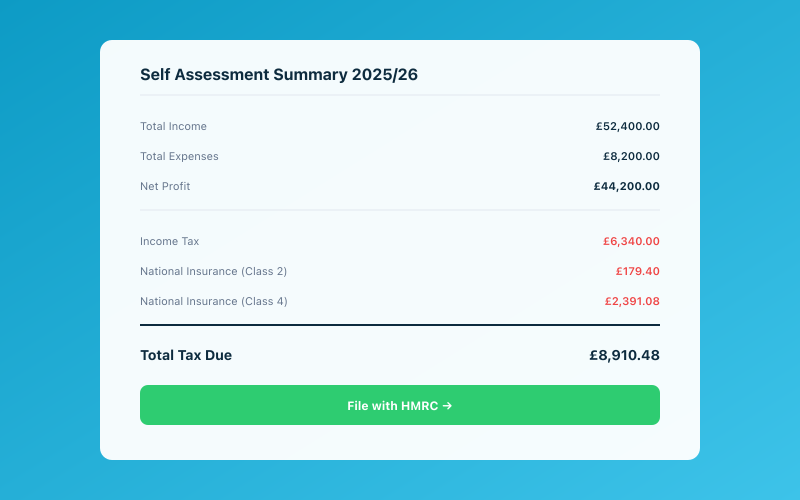 Your Accounted dashboard shows your real-time tax position
Class 2 is separate from Class 4 NI, which is the percentage-based contribution you pay on your trading profits (6% on profits between £12,570 and £50,270, and 2% on profits above £50,270 in 2025/26). Class 4 doesn't count towards your state pension — it's essentially just an extra tax. Class 2, on the other hand, does count. That's what makes it so valuable.
For a full breakdown of how both classes work, see our guide to Class 2 and Class 4 NI explained.
Why Class 2 Is Such Good Value
The maths is simple and compelling.
The full new state pension in 2025/26 is £221.20 per week. To qualify for the full amount, you need 35 qualifying years on your National Insurance record. Each qualifying year is therefore worth roughly £6.32 per week, or £328.64 per year.
One year of Class 2 contributions costs £179.40. One year of state pension gained is worth £328.64 per year for every year of your retirement.
That means you recoup your entire Class 2 investment in just over six months of drawing your pension. If you're retired for 20 years, that single year of Class 2 payments returns over £6,500. The return on investment is extraordinary.
Compare that to Class 3 voluntary contributions, which cost £17.75 per week (£922 per year) for the same pension benefit. Or compare it to private pension contributions, which — while valuable in their own right — can't match this kind of guaranteed, inflation-linked return.
Who Pays Class 2 NI?
Class 2 NI applies to self-employed people — sole traders and partners in business partnerships. You're liable to pay it if your self-employed profits are above the Small Profits Threshold, which is £6,845 in 2025/26.
Here's where it gets interesting:
- Profits above £6,845: You pay Class 2 automatically (it's included in your Self Assessment calculation)
- Profits between £0 and £6,845: You don't have to pay Class 2, but you can choose to pay it voluntarily
- Losses or no trading income: You can still choose to pay Class 2 voluntarily
If your profits are below the Small Profits Threshold and you don't actively choose to pay Class 2, that year won't count as a qualifying year for your state pension (unless you have qualifying NI contributions from employment or receive NI credits for another reason).
This is the trap that catches many part-time self-employed people and those in the early stages of building a business. Your profits are low, you're not required to pay Class 2, so you don't — and a gap appears on your NI record.
The Small Profits Threshold Explained
The Small Profits Threshold (SPT) is the level of self-employed profits below which Class 2 NI becomes voluntary rather than compulsory. At £6,845 for 2025/26, it catches more people than you might think.
Consider these scenarios:
- A freelance designer who's just starting out and earns £5,000 in their first year
- A sole trader who has a quiet year due to illness or caring responsibilities
- Someone with a side hustle alongside employment, where the self-employment income is modest
In all these cases, profits sit below the SPT. Without action, no Class 2 is paid, and a potential gap opens up.
The solution is straightforward: opt in to voluntary Class 2 contributions through your Self Assessment tax return. When you file your return, there's a section that asks whether you want to pay Class 2 voluntarily. Tick the box. At £3.45 a week, it's a no-brainer.
What If You're Employed and Self-Employed?
If you have a job and run a business on the side, your NI situation is a bit more complex. Your employment income will already be generating qualifying years through Class 1 NI (assuming you earn above the Lower Earnings Limit of £6,396 in 2025/26).
In this case, you might not need Class 2 contributions for pension purposes — your employment is already doing that work. But there are a few things to consider:
- You'll still pay Class 4 NI on your self-employed profits above £12,570
- If your employment income is low or sporadic, Class 2 from self-employment could be a useful safety net
- There are annual maximum contribution rules that prevent you from paying excessive NI across both employment and self-employment
Our guide to National Insurance when you're employed and self-employed covers the interactions in detail.
Class 2 and Your Benefits Entitlement
Class 2 NI doesn't just protect your state pension. It also maintains your eligibility for certain contributory benefits:
- Employment and Support Allowance (ESA) — the contribution-based version requires recent Class 1 or Class 2 NI payments
- Maternity Allowance — self-employed women need to have paid Class 2 NI for at least 13 of the 66 weeks before their due date to qualify
- Bereavement benefits — eligibility depends on the deceased partner's NI record
Maternity Allowance is particularly important. In 2025/26, it pays up to £184.03 per week for up to 39 weeks — that's over £7,000. Losing entitlement because you didn't pay £3.45 a week in Class 2 would be a costly oversight.
How Class 2 Appears on Your Tax Return
When you complete your Self Assessment tax return (whether that's on paper, through HMRC's online system, or through software like Accounted), Class 2 NI is calculated separately from your income tax and Class 4 NI.
If your profits are above the Small Profits Threshold, Class 2 is added to your bill automatically. If your profits are below the threshold, you'll see an option to pay voluntarily. Either way, it's collected as part of your 31 January (or 31 July) payment.
Keeping track of your profits throughout the year means you'll know well in advance whether you're above or below the SPT. With Accounted, your profit position updates as you record income and expenses, so there are no surprises at tax return time. And if you're not sure how Class 2 fits into your overall tax bill, Penny can walk you through it.
Common Questions About Class 2 NI
Can I pay Class 2 if I've already stopped trading?
No — Class 2 is only available while you're registered as self-employed. Once you deregister, your only option for voluntary contributions is Class 3 (at £17.75 per week). This is one reason to think carefully before closing down a side business, even if profits are minimal.
What if I forget to opt in for voluntary Class 2?
You can usually go back and pay for previous years, but there are time limits. Generally, you can pay for the last six tax years. Don't leave it too long.
Is there any reason not to pay Class 2?
Honestly, very few. If you already have 35 qualifying years on your NI record and don't need the benefits entitlement, you could skip it. But at £3.45 a week, even the administrative effort of checking might cost more than just paying it.
Does Class 2 count as a business expense?
No. National Insurance contributions are not deductible business expenses. They're a personal tax obligation, separate from your trading profit calculation.
How to Make Sure You're Paying Class 2
Here's your action plan:
- Check your NI record at GOV.UK to see if you have any gaps
- Review your Self Assessment return — make sure Class 2 is being included if your profits are above the SPT, or that you've opted in if they're below
- Set a reminder to check this each year when you file your return
- Consider your pension forecast — see how your current record translates to a pension amount with our guide on how NI affects your state pension forecast
The Bottom Line
Class 2 National Insurance at £3.45 per week is the cheapest way to secure a qualifying year on your NI record. For self-employed people, it's a straightforward, almost risk-free way to protect your state pension and maintain benefits eligibility. If you're a sole trader and you're not paying it, you should be.
Accounted helps UK sole traders stay on top of their bookkeeping and tax. Start your free 30-day trial at getaccounted.co.uk.
Related Reading
- What Is Class 2 and Class 4 NI?
- National Insurance for Sole Traders
- State Pension for the Self-Employed
- How to Claim Tax Relief on Charitable Donations Through Your Business
- 10 Tax Myths That Could Cost You Money
Penny, your AI bookkeeper, tracks your tax position in real time and flags opportunities to reduce your bill. Meet Penny →
Tax & Compliance Specialists
Our tax specialists have decades of combined experience in UK sole trader and small business taxation, MTD compliance, and HMRC submissions. All content is reviewed against current HMRC guidance before publication and updated quarterly to reflect legislative changes.
Ready to try Accounted?
Join UK sole traders who are simplifying their bookkeeping and tax.
Start your 14-day free trial