How to Claim Tax Relief on Charitable Donations Through Your Business
Doing Good and Saving Tax
Giving to charity is one of those rare things in life where doing the right thing and getting a financial benefit can go hand in hand. The UK tax system actively encourages charitable giving through several relief mechanisms, and as a sole trader or business owner, you have more options than you might realise.
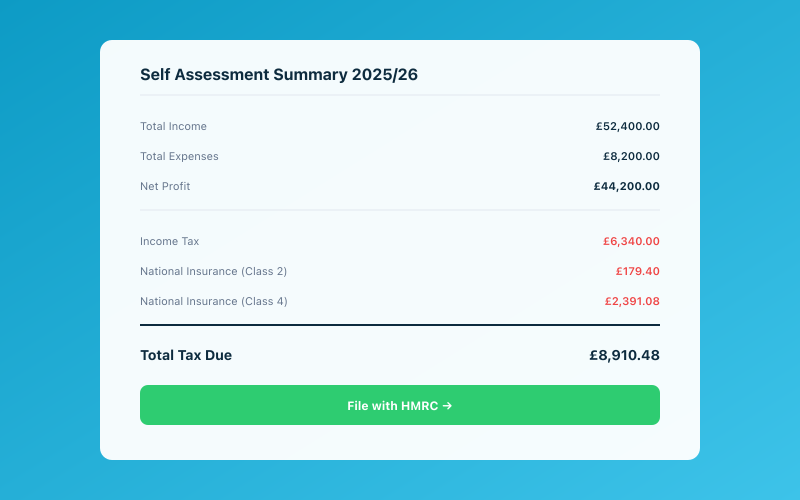 Your Accounted dashboard shows your real-time tax position
But the rules around charitable donations and tax relief can be surprisingly nuanced. What counts as a donation? What is actually sponsorship? Can you deduct it from your business profits? Let us untangle all of this.
Gift Aid — The Foundation of Charitable Tax Relief
Gift Aid is the most well-known form of charitable tax relief, and it works brilliantly for sole traders.
How Gift Aid Works
When you make a personal donation to a UK-registered charity and declare Gift Aid, the charity can reclaim the basic rate tax (20%) on your donation. On a £100 donation, the charity claims an extra £25 from HMRC, making your donation worth £125 at no extra cost to you.
Higher and Additional Rate Relief
Here is where it gets interesting for sole traders earning above the basic rate band. If you are a higher rate taxpayer (40% on income between £50,271 and £125,140), you can claim the difference between the higher rate and basic rate on your Self Assessment tax return.
On that same £100 donation, you would claim 20% additional relief — that is £25 back on your tax bill. So your £100 donation effectively costs you £75, and the charity received £125. Everyone wins.
For additional rate taxpayers (45% on income above £125,140), the relief is even more generous — 25% additional relief, making a £100 donation cost you just £68.75.
Extending Your Basic Rate Band
Gift Aid donations effectively extend your basic rate band. If your taxable income is £55,000, you are paying 40% on the portion above £50,270. But if you make £5,000 of Gift Aid donations, your basic rate band is extended by the gross value of those donations (£6,250 with the gross-up). This means less of your income is taxed at the higher rate.
This is particularly relevant if your income sits just above the higher rate threshold. Strategic charitable giving can bring you back into the basic rate band, or at least reduce the amount taxed at 40%.
Gift Aid and the Personal Allowance
If your income is above £100,000, your personal allowance starts being withdrawn at a rate of £1 for every £2 above £100,000. Gift Aid donations can help here too, as they effectively reduce your adjusted net income, potentially preserving some or all of your £12,570 personal allowance.
Sponsorship vs Donation — An Important Distinction
This is where many business owners get confused. If your business sponsors a charity event, a local sports team, or a community organisation, the payment may be treated as a business expense rather than a charitable donation — and the tax treatment is different.
When It Is Sponsorship
A payment is sponsorship (and therefore a deductible business expense) when your business receives something in return, such as:
- Your business name or logo displayed at an event
- Advertising space in a programme or on a website
- Naming rights for an event or award
- Social media mentions and promotion
Sponsorship payments are deducted from your business profits, reducing both your income tax and National Insurance liability. This is often more tax-efficient than a Gift Aid donation, particularly for basic rate taxpayers.
When It Is a Donation
A payment is a donation when you give money (or goods) to a charity without receiving anything substantial in return. A "thank you" on a newsletter or a small badge does not count as significant benefit — but prominent advertising certainly does.
Donations cannot be deducted from your business profits as a sole trader. They are treated as personal giving and receive tax relief through Gift Aid (if applicable) on your personal tax return.
Getting the Classification Right
The distinction matters because getting it wrong could mean either:
- Claiming a business expense deduction that HMRC disallows (if you call a donation a sponsorship)
- Missing out on a legitimate business expense (if you call a sponsorship a donation)
If you are unsure, look at what your business receives in return. Genuine, measurable promotional benefit = sponsorship. A warm feeling and a thank-you letter = donation.
Donating Stock and Equipment
If your business donates stock, equipment, or other assets to charity, there are specific rules:
Trading Stock
If you donate items from your trading stock (products you normally sell), you can treat the cost of those items as a business expense. You do not need to account for the output VAT that would normally apply on a sale, provided the donation is made to a registered charity.
Equipment and Assets
Donating a business asset like a computer, vehicle, or piece of machinery to charity can qualify for Gift Aid if done through a charity that accepts gifts in kind. The value for Gift Aid purposes is the market value at the time of donation.
However, you may need to consider capital allowances. If you previously claimed capital allowances on the asset, you may face a balancing charge — effectively reclaiming some of the tax relief you received when you bought it.
Gifts of Shares and Property
Gifts of listed shares, securities, and land or property to charity qualify for income tax relief without needing Gift Aid. The relief is based on the market value of the shares or property at the time of the gift, plus any incidental costs of making the gift. This relief is deducted from your total income.
Community Amateur Sports Clubs (CASCs)
Donations to registered Community Amateur Sports Clubs qualify for Gift Aid in the same way as donations to charities. If your business sponsors a local football club, cricket team, or running group that is registered as a CASC, you may be able to treat it as a business expense (if it is genuine sponsorship) or claim Gift Aid relief (if it is a donation).
Check whether the club is registered with HMRC as a CASC — not all sports clubs qualify.
Payroll Giving
If you have employees — or if you work through an umbrella company — payroll giving (also called Give As You Earn) lets you make charitable donations directly from your gross pay, before tax is calculated. This means you get immediate tax relief at your marginal rate.
For sole traders without employees, payroll giving is not directly relevant. But if you are considering taking on staff in the future, offering a payroll giving scheme is a nice benefit that costs you nothing as an employer.
Record-Keeping Requirements
HMRC expects you to keep clear records of all charitable donations and sponsorship payments. For each donation or sponsorship payment, keep:
- The receipt or acknowledgement from the charity
- The Gift Aid declaration (if applicable)
- Evidence of any promotional benefit received (for sponsorship)
- Bank statements showing the payment
- Correspondence confirming the donation
Penny, the AI bookkeeper within Accounted, can help you categorise charitable payments correctly, ensuring they are recorded as either sponsorship expenses or personal donations for Gift Aid purposes.
Limits and Restrictions
There are some guardrails around charitable tax relief:
The Benefit Rule
If you receive a benefit in return for your donation (beyond the value of a minimal token like a sticker or badge), Gift Aid may be restricted or unavailable. HMRC sets limits on the value of benefits you can receive relative to your donation:
- Donations up to £100: benefits up to 25% of the donation
- Donations of £101 to £1,000: benefits up to £25
- Donations over £1,000: benefits up to 5% of the donation (maximum £2,500)
You Must Pay Enough Tax
To claim Gift Aid, you must have paid at least as much income tax (and/or capital gains tax) in the tax year as the charity claims on your behalf. If your income is below the personal allowance of £12,570 and you pay no tax, making Gift Aid declarations creates a tax liability for you rather than saving you money.
Anti-Avoidance
HMRC has anti-avoidance rules to prevent artificial arrangements where donations are structured purely for tax benefit. Genuine charitable giving is always fine — but schemes designed primarily to reduce tax bills can be challenged.
Company Donations vs Personal Donations
If you are thinking about incorporating your business in the future, it is worth knowing that the rules differ for limited companies:
- Limited companies deduct charitable donations from their total profits before calculating corporation tax — it is a straightforward business expense
- Sole traders cannot deduct personal charitable donations from their business profits — relief comes through Gift Aid on the personal Self Assessment return
This is one of the minor tax advantages of operating through a limited company, though it is rarely a deciding factor on its own.
Making Your Giving Tax-Efficient
Here is a practical approach to maximising the tax efficiency of your charitable giving:
- Always declare Gift Aid on personal donations if you pay enough tax
- Structure genuine business promotions as sponsorship to get the business expense deduction
- Consider timing — making donations before the end of the tax year can help manage your tax position
- Keep immaculate records of every donation and sponsorship payment
- Check your adjusted net income if you are near the £100,000 threshold where personal allowance starts being withdrawn
- Review annually whether your giving aligns with your current tax position
Giving Back With Confidence
Charitable giving is a genuinely positive thing, and the tax system rewards it. Whether you are sponsoring a local team, donating to a national charity, or giving equipment to a community group, understanding the tax relief available ensures you can give generously without giving more to HMRC than you need to.
Accounted helps you keep track of your donations and sponsorship payments alongside your other business records, so you can claim every penny of relief you are entitled to. Because giving should feel good — not complicated.
Related reading
- Tax Deductions Every Sole Trader Should Know About
- Self Assessment Tax Return — Your Complete Guide
- Starting a Limited Company vs Sole Trader
Related Reading
- Tax Implications of Bartering and Contra Deals
- Tax-Efficient Childcare Options for Self-Employed Parents
Start your free trial and let Penny handle your bookkeeping automatically.
Penny, your AI bookkeeper, tracks your tax position in real time and flags opportunities to reduce your bill. Meet Penny →
Tax & Compliance Specialists
Our tax specialists have decades of combined experience in UK sole trader and small business taxation, MTD compliance, and HMRC submissions. All content is reviewed against current HMRC guidance before publication and updated quarterly to reflect legislative changes.
Ready to try Accounted?
Join UK sole traders who are simplifying their bookkeeping and tax.
Start your 14-day free trial