10 Tax Myths That Could Cost You Money
Tax is complicated enough without adding misinformation to the mix. Yet the UK is awash with tax myths — half-truths, outdated rules, and outright fabrications that get passed around as gospel. Some are harmless. Others could cost you hundreds or even thousands of pounds.
The problem is that many of these myths sound plausible. They are the kind of thing that "everyone knows" — except that everyone is wrong. And when you are a sole trader without a team of tax advisers to set you straight, it is alarmingly easy to base your financial decisions on information that is simply not true.
Let us set the record straight on ten of the most common — and most costly — tax myths in the UK.
Myth 1: "If I Earn Under £1,000, I Don't Need to Tell HMRC"
This one has a grain of truth, which makes it particularly dangerous. There is a trading allowance of £1,000, which means that if your total trading income is below this threshold, you do not need to report it. So far, so accurate.
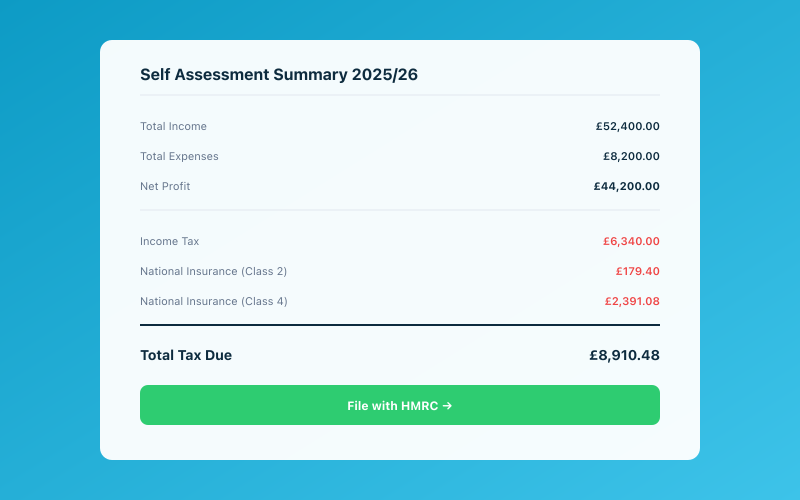 Your Accounted dashboard shows your real-time tax position
But here is where people go wrong: they assume this applies to their total income. It does not. The £1,000 allowance is specifically for trading income from self-employment or casual work. If you also have employment income, rental income, or other sources, those are assessed separately. And if your trading income exceeds £1,000 — even by a single pound — you need to register as self-employed and file a Self Assessment tax return.
The risk of getting this wrong is not just a tax bill. It is potential penalties for late registration and late filing, which can add up quickly.
Myth 2: "Cash-in-Hand Income Is Tax-Free"
This is perhaps the most persistent and most dangerous tax myth in the UK. The idea that if you are paid in cash, HMRC cannot track it and you do not need to declare it is simply, flatly, comprehensively wrong.
All income is taxable, regardless of how it is received. Cash, bank transfer, cryptocurrency, barter, payment in kind — it all counts. HMRC has sophisticated data-matching systems (including Connect, their powerful analytics tool) that can identify discrepancies between your declared income and your lifestyle or spending patterns.
Failing to declare cash income is not a grey area or a harmless oversight. It is tax evasion, which is a criminal offence. The penalties range from significant fines to prosecution and imprisonment.
If you have been operating under this misconception, it is not too late to put things right. HMRC's voluntary disclosure process allows you to correct past errors, usually with reduced penalties.
Myth 3: "I Can Claim All My Clothing as a Business Expense"
If only. This is one of the most common expense myths, and it catches people out every year. The rule is clear: clothing that could be worn in everyday life is not an allowable business expense, even if you bought it specifically for work and only ever wear it for work.
What is allowable? Protective clothing (steel-toed boots, hi-vis jackets), uniforms with a permanent logo, and costumes that are clearly not suitable for everyday wear (a mascot suit, theatrical costumes, and the like).
What is not allowable? A suit for client meetings. A smart dress for networking events. A warm coat for outdoor work. If it could plausibly be worn to a dinner party, HMRC will not accept it as a business expense.
Our complete list of sole trader expenses covers what you can and cannot claim in more detail.
Myth 4: "Expenses Are Free Money — They Come Off My Tax Bill Pound for Pound"
This misconception causes more financial confusion than almost any other. When people hear that something is "tax-deductible," they often assume it means the entire cost is refunded. It is not.
An allowable expense reduces your taxable profit, not your tax bill directly. If you are a basic rate taxpayer (20 per cent), a £100 expense saves you £20 in tax. You still spend £80 of your own money. At the higher rate (40 per cent), you save £40 — still a net cost of £60.
This means it never makes financial sense to spend money purely for the tax deduction. Buying a £2,000 laptop you do not need to save £400 in tax is not a smart financial move — you are still £1,600 worse off.
Expenses should be claimed when they are genuine, necessary business costs. The tax relief is a welcome bonus, not a reason to spend.
Myth 5: "I Don't Need to Register for Self Assessment Until I Start Making a Profit"
Wrong, and potentially costly. You need to register with HMRC as self-employed and file a Self Assessment return if you earn more than £1,000 from self-employment — regardless of whether you are making a profit.
In fact, registering when you are making a loss can actually work in your favour. Losses in the early years of a business can often be carried forward to offset against future profits, or in some cases set against other income. If you do not register and file, you miss the opportunity to claim these losses.
The deadline for registering is 5 October following the end of the tax year in which you started trading. Missing this deadline can result in penalties, so it is worth registering as soon as you begin any form of self-employed activity.
Myth 6: "HMRC Won't Notice Small Mistakes"
HMRC's Connect system processes data from a vast range of sources: banks, building societies, letting agents, overseas tax authorities, Companies House, the Land Registry, and increasingly, digital platforms like eBay, Etsy, and Airbnb. The system is designed to identify patterns and discrepancies, and it is remarkably good at it.
Small, genuine mistakes are unlikely to result in prosecution. But they can trigger enquiries, which are time-consuming, stressful, and potentially expensive if they uncover further issues. The best approach is to get things right from the start.
Using a tool like Accounted, with Penny categorising your transactions automatically, significantly reduces the risk of errors in your bookkeeping. It is much harder to make mistakes when your records are maintained in real time rather than reconstructed from memory and a pile of receipts at the end of the year.
Myth 7: "I Can Claim My Entire Phone Bill and Broadband"
If you use your phone and broadband for both business and personal purposes — which almost every sole trader does — you can only claim the business proportion, not the full amount.
HMRC expects you to make a reasonable apportionment. If you estimate that 60 per cent of your phone usage is for business, you can claim 60 per cent of the bill. The exact percentage will depend on your circumstances, and you should be prepared to justify your apportionment if asked.
Some sole traders use a separate business phone to simplify this, which allows them to claim the entire cost. But for most people, an honest apportionment of their personal phone bill is perfectly acceptable.
The same principle applies to broadband, home office costs, and any other expense that has both a business and personal element. Our guide to claiming home office expenses covers this in detail.
Myth 8: "If I'm VAT Registered, Everything I Buy Is 20 Per Cent Cheaper"
VAT registration allows you to reclaim the VAT you pay on business purchases. But it also requires you to charge VAT on your sales. For many sole traders — particularly those whose clients are consumers rather than VAT-registered businesses — this means effectively increasing your prices by 20 per cent or absorbing the cost yourself.
Whether VAT registration is beneficial depends on your specific circumstances: who your clients are, what your expenses look like, and whether you are above or approaching the registration threshold (currently £90,000).
The Flat Rate Scheme can simplify things for some businesses, but it is not always the most cost-effective option. If you are unsure, it is worth getting advice before registering voluntarily.
Myth 9: "I Have Until January to Sort Out My Tax"
Technically, you have until 31 January following the end of the tax year to file your Self Assessment return online. But using that as your target date is a recipe for stress, mistakes, and potentially penalties.
Filing early has significant advantages: you find out what you owe sooner (giving you more time to plan and save), you can spread payment if needed, you avoid the January rush, and you reduce your financial anxiety by removing the cloud of uncertainty.
With Making Tax Digital rolling out, the idea of leaving everything to the last minute is becoming less viable anyway. Quarterly updates mean you need to keep your records current throughout the year, not just at the end. Accounted is designed to make this seamless — your bookkeeping stays up to date in the background, so quarterly submissions and year-end filing become far less stressful.
Myth 10: "I Don't Earn Enough to Need an Accountant"
This is not so much a myth as a misconception. You do not need an accountant at any income level — there is no legal requirement. But the question is not whether you need one; it is whether it is worth having one.
A good accountant or a good accounting tool typically saves you more than it costs, through a combination of legitimate tax savings you would not have identified yourself, time saved on administration, penalties avoided, and peace of mind.
For sole traders at the earlier stages of their business, a full-service accountant might not be cost-effective. But a tool like Accounted — which handles bookkeeping, expense tracking, and tax calculations at a fraction of the cost of an accountant — fills the gap perfectly. You get professional-quality financial management without the professional-level fees.
And for the record, even if you use an accountant, you are still personally responsible for the accuracy of your tax return. What your accountant wishes you knew makes for sobering reading on this topic.
Knowledge Saves Money
Every one of these myths has cost real people real money. Some have led to underpayment of tax (and the penalties that follow). Others have led to overpayment — missing out on legitimate deductions because of a misunderstanding about how expenses work.
The antidote is not complicated. It is simply staying informed, keeping good records, and not taking tax advice from people in the pub.
Your tax obligations are manageable. They are not something to fear, avoid, or rely on folklore to navigate. With accurate information and the right tools, you can meet your obligations, claim everything you are entitled to, and sleep soundly knowing that your affairs are in order.
Accounted helps UK sole traders stay on top of their bookkeeping and tax. Start your free 30-day trial at getaccounted.co.uk.
Related reading:
- Sole Trader Expenses — The Complete List
- Financial Anxiety as a Sole Trader
- What Your Accountant Wishes You Knew
Related Reading
- The Personal Savings Allowance — How It Works for Business Owners
- The Trading Allowance (£1,000) — A Simple Explanation
Start your free trial and let Penny handle your bookkeeping automatically.
Penny, your AI bookkeeper, tracks your tax position in real time and flags opportunities to reduce your bill. Meet Penny →
Tax & Compliance Specialists
Our tax specialists have decades of combined experience in UK sole trader and small business taxation, MTD compliance, and HMRC submissions. All content is reviewed against current HMRC guidance before publication and updated quarterly to reflect legislative changes.
Ready to try Accounted?
Join UK sole traders who are simplifying their bookkeeping and tax.
Start your 14-day free trial