The Trading Allowance (£1,000) — A Simple Explanation
What Is the Trading Allowance?
The trading allowance is a flat £1,000 tax-free allowance for individuals with trading (self-employment) or miscellaneous income. If your gross income from these sources is £1,000 or less in a tax year, you don't need to declare it to HMRC, register for Self Assessment, or pay any tax on it.
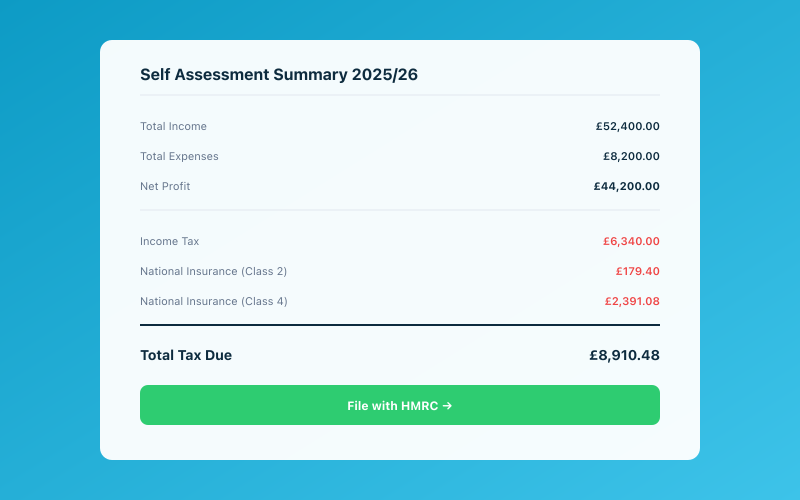 Your Accounted dashboard shows your real-time tax position
It was introduced in April 2017 to simplify things for people who earn small amounts from occasional work — selling things at craft fairs, doing a bit of freelance work on the side, walking dogs for neighbours, that sort of thing.
Simple enough, right? Well, mostly. But as with anything tax-related, there are nuances worth understanding. Let's break it all down.
Who Can Use the Trading Allowance?
The trading allowance is available to individuals — not companies, partnerships, or trusts. It applies to:
- Self-employment income — freelance work, side hustles, casual trading
- Miscellaneous income — occasional services, odd jobs, one-off gigs
- Casual selling — selling items you've made or bought with the intention of reselling
It doesn't matter whether you're already employed full-time. If you have a day job and earn a bit on the side from self-employment, the trading allowance still applies to your self-employment income.
Who Can't Use It?
There are a few exclusions:
- You can't use it if your trading income comes from a partnership
- You can't use it if the income comes from your employer or a company you're connected to (for example, if you do extra freelance work for your boss's spouse's company)
- It doesn't apply to income from a limited company you control
Full Relief vs Partial Relief
This is where it gets interesting. The trading allowance works in two ways:
Full Relief (Income £1,000 or Below)
If your total gross trading income is £1,000 or less, you get full relief. This means:
- No tax to pay
- No need to register for Self Assessment
- No need to report the income to HMRC
- No need to keep records (though we'd recommend you do anyway)
It's completely automatic. You don't need to claim it — you simply don't declare the income.
Partial Relief (Income Above £1,000)
If your gross trading income exceeds £1,000, you have a choice. You can either:
Option A: Deduct the £1,000 trading allowance from your gross income instead of claiming actual expenses
Option B: Claim your actual allowable expenses in the normal way
You'd choose Option A (partial relief) if your actual expenses are less than £1,000. You'd choose Option B if your expenses exceed £1,000.
A Quick Example
Let's say you earn £3,000 from freelance graphic design work in a tax year.
- Your actual expenses (software subscriptions, equipment, etc.) total £600
- Using partial relief: £3,000 - £1,000 allowance = £2,000 taxable profit
- Using actual expenses: £3,000 - £600 expenses = £2,400 taxable profit
In this case, partial relief gives you a lower taxable profit, so you'd choose that.
But if your expenses were £1,500:
- Using partial relief: £3,000 - £1,000 = £2,000 taxable profit
- Using actual expenses: £3,000 - £1,500 = £1,500 taxable profit
Now actual expenses give you a better result, so you'd claim those instead.
The key point: you can't use both. It's one or the other.
When Your Expenses Exceed £1,000
If you're running a proper business with significant costs — buying stock, paying for tools, renting workspace, travelling to clients — your expenses will almost certainly exceed £1,000. In that case, the trading allowance becomes irrelevant, and you should claim your actual allowable expenses instead.
This is the situation most full-time self-employed people find themselves in. The trading allowance is really designed for people with small, casual income rather than those running an established business.
That said, it's always worth doing the maths. Some service-based businesses (consultants, tutors, writers) have very low overheads, and the trading allowance might actually be more beneficial than claiming a handful of small expenses.
How It Interacts with Employment Income
The trading allowance is completely separate from your employment income. If you earn £40,000 from your PAYE job and £800 from weekend freelancing, the £800 is covered by the trading allowance and you don't need to declare it.
However, your employment income isn't affected. You'll still pay tax on your salary through PAYE as normal. The trading allowance only applies to the trading/self-employment portion of your income.
A Note on Tax Bands
If you do need to pay tax on trading income (because it exceeds £1,000 and you're filing a return), that income is added to your employment income to determine your tax rate. So if your salary puts you near the higher rate threshold (£50,270 in 2025/26), even a small amount of trading income could push you into the 40% bracket.
For example, if you earn £49,000 from employment and £5,000 from self-employment (after the trading allowance or expenses), that extra income is taxed at 40% because your combined income exceeds £50,270.
The Property Allowance — A Separate £1,000
Here's something many people don't realise: there's also a separate £1,000 property allowance that works in exactly the same way but for property income. If you earn up to £1,000 from renting out property (or part of your property), you don't need to declare it.
The two allowances are completely independent. You could earn £1,000 from trading and £1,000 from property — that's £2,000 of tax-free income in total, with no need to file a return for either.
The property allowance is particularly useful for people who rent out their driveway, a parking space, or storage space in their home. It also covers income from renting equipment or assets.
However, the property allowance can't be used alongside Rent-a-Room relief (which gives you up to £7,500 tax-free for letting out a furnished room in your home). You'd need to choose one or the other.
Multiple Small Income Sources
What if you have several different sources of trading income? Perhaps you sell crafts online, do some freelance writing, and occasionally walk dogs. Do you get a separate £1,000 allowance for each?
No. The £1,000 trading allowance applies to your total trading income from all sources combined. So if you earn £400 from crafts, £300 from writing, and £400 from dog walking, that's £1,100 in total — and you've exceeded the allowance.
This catches some people out, especially those with several small side hustles. Keep track of all your trading income, even if each individual source seems tiny.
When You Still Need to Register for Self Assessment
Even with the trading allowance, there are situations where you'll still need to register for Self Assessment:
- Trading income over £1,000 — you'll need to register and file a return, even if you use partial relief
- You want to claim actual expenses — you can only do this through a Self Assessment return
- You have other income that requires a return — high income (over £150,000), capital gains, foreign income, or the High Income Child Benefit Charge
- You want to pay voluntary Class 2 NI — to protect your State Pension entitlement
If you're earning consistently above £1,000, it's time to register for Self Assessment and start keeping proper records. Our step-by-step registration guide makes it painless, and with Making Tax Digital on the horizon, getting your digital record-keeping sorted now is a smart move.
Common Questions
Does the Trading Allowance Apply to eBay or Vinted Sales?
It depends. If you're selling personal belongings (clearing out your wardrobe), that's not trading income — it's a personal disposal, and it's not taxable anyway (unless individual items sell for over £6,000, which triggers CGT rules).
But if you're buying items specifically to resell at a profit, that is trading income, and the trading allowance applies.
Can I Use the Trading Allowance Alongside the Personal Allowance?
Yes. They're completely separate. The Personal Allowance (£12,570 in 2025/26) applies to your total income. The trading allowance is a deduction from your trading income specifically. You benefit from both.
What If I Make a Loss?
If your trading income is below £1,000 and you use full relief, there's no loss to claim — you simply don't declare the income. But if your expenses genuinely exceed your income, you might want to register for Self Assessment and claim those expenses, because trading losses can be set against other income or carried forward.
Do I Need to Keep Records If I'm Under £1,000?
Technically, no. But practically, yes. It's good practice to keep a simple record of your income so you can prove you were under the threshold if HMRC ever asks. A simple spreadsheet or a note in your phone is enough.
Making the Most of the Trading Allowance
The trading allowance is one of the simplest tax reliefs available. For anyone just starting out or earning a small amount on the side, it removes the burden of registration and filing entirely.
But if your income is growing — and you think it might keep growing — it's worth thinking ahead. Once you cross the £1,000 line, you'll need systems in place to track income and expenses. Accounted and Penny, our AI bookkeeper, can handle this from the very start, so the transition from casual earner to registered self-employed is seamless.
Whether you're earning £200 from a car boot sale or £20,000 from a full-time freelance career, understanding the trading allowance helps you make better decisions about how to structure and report your income.
Related Reading
- Tax Implications of Converting a Hobby to a Business
- Tax Deductions Every Sole Trader Should Know About
- How to File Your Self Assessment Tax Return
- Self-Employed in Scotland — What's Different About Scottish Tax?
Penny, your AI bookkeeper, tracks your tax position in real time and flags opportunities to reduce your bill. Meet Penny →
Tax & Compliance Specialists
Our tax specialists have decades of combined experience in UK sole trader and small business taxation, MTD compliance, and HMRC submissions. All content is reviewed against current HMRC guidance before publication and updated quarterly to reflect legislative changes.
Ready to try Accounted?
Join UK sole traders who are simplifying their bookkeeping and tax.
Start your 14-day free trial