National Insurance Credits — Gaps You Might Not Know You Have
Your National Insurance record is quietly building in the background, year after year. When everything's working smoothly, you barely notice it. But gaps can appear without you realising — and those gaps can cost you thousands of pounds in lost state pension over your lifetime.
The good news is that National Insurance credits exist to plug many of these holes, often automatically. The bad news is that not all credits are applied without you asking, and plenty of people miss out simply because they didn't know they were eligible.
Let's fix that.
What Are National Insurance Credits?
National Insurance credits are entries on your NI record that count towards your qualifying years, even though you haven't actually paid any National Insurance contributions. They're designed to protect people who can't work or earn enough to pay NI — whether that's because of illness, caring responsibilities, unemployment, or other circumstances.
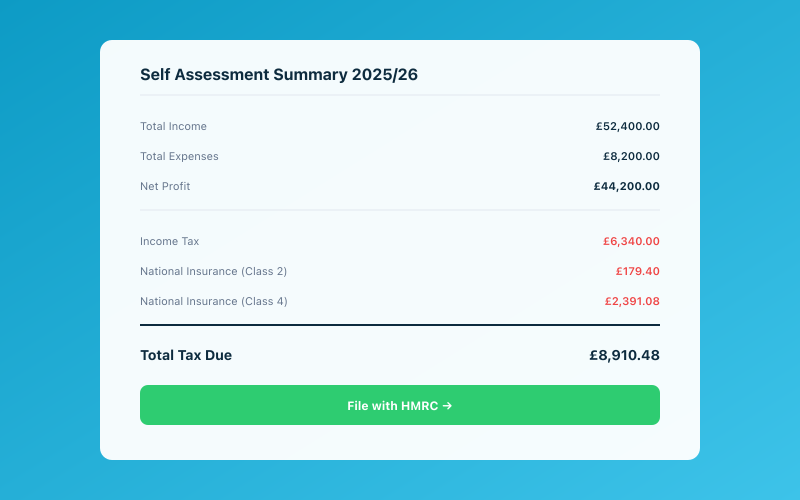 Your Accounted dashboard shows your real-time tax position
To qualify for the full new state pension of £221.20 per week (2025/26), you need 35 qualifying years on your record. You need at least 10 qualifying years to get anything at all. Each qualifying year is worth roughly £6.32 per week in pension — that's around £329 per year, every year of your retirement.
Credits help ensure that time spent outside paid employment doesn't leave a permanent dent in your pension entitlement.
Types of National Insurance Credits
There are two main categories:
Class 1 Credits
These are the most common and are often applied automatically. They protect your state pension and your entitlement to contributory benefits like Jobseeker's Allowance and Employment and Support Allowance.
You receive Class 1 credits if you're:
- Claiming Jobseeker's Allowance (JSA) — credits are applied automatically while you're on JSA
- Claiming Employment and Support Allowance (ESA) — again, automatic
- On Universal Credit — you'll receive credits if you have limited capability for work or are meeting work search requirements
- Receiving Carer's Allowance — automatic credits for the duration of your claim
- Claiming Child Benefit for a child under 12 — this is a big one that catches many people out (more on this below)
- On statutory sick pay, maternity pay, paternity pay, or adoption pay — credits cover any shortfall
- Doing jury service — yes, really
Class 3 Credits
These are less common and specifically protect your state pension (but not contributory benefits). You might receive Class 3 credits if you're:
- A foster carer approved by a local authority
- Caring for someone for 20+ hours per week but not qualifying for Carer's Allowance
- On a government-approved training course
- Wrongly imprisoned — a niche situation, but the provision exists
The Child Benefit Trap
This deserves its own section because it catches so many families out. If you or your partner claims Child Benefit for a child under 12, the person who claims it receives National Insurance credits automatically. But here's the problem: it's only the claimant who gets the credit, not both parents.
In many households, the higher earner continues working and paying NI through employment, while the lower earner stays home or works part-time. If the higher earner is the one claiming Child Benefit (perhaps because they handle the household admin), the lower earner misses out on the NI credit — even though they're the one who actually needs it.
If this applies to you, there are two options:
- Transfer the Child Benefit claim to the parent who isn't working or is earning below the NI threshold
- Apply for NI credits directly using form CF411A — the non-claimant parent can receive what's called "Specified Adult Childcare Credits"
This is particularly relevant if you've opted out of receiving Child Benefit payments because of the High Income Child Benefit Charge. Even if you don't want the payments, you should still register for Child Benefit to get the NI credits. You can register and then opt out of payments — you'll still get the credits.
How Gaps Appear Without You Noticing
Gaps don't always come from obvious life events. Here are some common ways they sneak in:
Earning below the Lower Earnings Limit. In 2025/26, you start paying employee NI at £12,570 per year, but you only get a qualifying year credited if you earn above the Lower Earnings Limit of £6,396. If you earn between these thresholds, you're in a strange middle ground — you don't pay NI, and you might not get a qualifying year either (though in some cases you're treated as having paid).
Part-time or gig work. If you work part-time across multiple jobs and none of them individually pushes you above the threshold, you might not be building qualifying years at all. This is increasingly common in the gig economy.
Self-employment with low profits. If you're self-employed with profits below the Small Profits Threshold (£6,845 in 2025/26), you won't pay Class 2 NI automatically. That means no qualifying year — unless you choose to pay Class 2 voluntarily at £3.45 per week. For more on this, see our guide to Class 2 NI and your state pension.
Time abroad. If you lived or worked overseas, you almost certainly have gaps. Some countries have reciprocal agreements with the UK that may help, but don't assume — check.
Simply not knowing. HMRC doesn't send you an annual statement. If you don't proactively check your record, gaps can accumulate for years before you spot them.
How to Check for Gaps
The simplest way is through your Personal Tax Account on GOV.UK. Once logged in, you can see:
- Every tax year on your record
- Whether each year is a full qualifying year, a partial year, or a gap
- What (if anything) you can do about each gap
- The cost of filling gaps with voluntary contributions
You can also call the Future Pension Centre on 0800 731 0175 to get a state pension forecast, which shows how your current record translates into a projected weekly pension. Our article on how National Insurance affects your state pension forecast walks you through interpreting those numbers.
Filling Gaps: Credits vs Voluntary Contributions
If you have gaps, the first thing to check is whether you're entitled to credits you haven't claimed. Free is always better than paying.
If credits don't cover the gap, you can pay voluntary National Insurance contributions. The cost depends on which class:
- Class 2 (if you're self-employed): £3.45 per week / roughly £179.40 per year
- Class 3 (available to anyone): £17.75 per week / roughly £922 per year
The return on investment is excellent in most cases, but it's worth doing the maths for your specific situation. If you're already on track for 35 qualifying years by the time you reach state pension age, paying to fill old gaps may not add anything.
Keeping Track of Your NI Position
If you're self-employed, your NI position is closely tied to your trading profits. Class 2 NI at £3.45 per week is collected through your Self Assessment tax return, and Class 4 NI (charged at 6% on profits between £12,570 and £50,270, and 2% above that in 2025/26) is calculated based on your annual profits.
Keeping accurate, up-to-date records of your income and expenses throughout the year isn't just good practice for tax — it's essential for understanding your NI position. If your profits hover around the Small Profits Threshold, knowing where you stand before the end of the tax year gives you time to make voluntary contributions if needed.
Accounted makes this straightforward by giving you a real-time view of your trading profits. And if you're not sure how something affects your NI, you can ask Penny — the AI assistant built into Accounted — for a plain-English explanation.
What to Do If You've Missed Credits
If you think you should have received NI credits but they're not showing on your record, you can:
- Contact HMRC — call the National Insurance helpline on 0300 200 3500
- Apply retrospectively — some credits can be backdated, particularly Specified Adult Childcare Credits
- Gather evidence — if you were caring for someone or claiming benefits, have dates and reference numbers ready
Don't assume HMRC has everything right. Records do contain errors, and it's your responsibility to check and challenge them.
The Bottom Line
National Insurance credits are one of the most valuable — and most overlooked — parts of the UK tax system. They can protect your state pension without costing you a penny, but only if you know about them and claim them when they're not applied automatically.
Take 10 minutes to check your NI record. It could be worth thousands in retirement.
Accounted helps UK sole traders stay on top of their bookkeeping and tax. Start your free 30-day trial at getaccounted.co.uk.
Related Reading
- Voluntary National Insurance Contributions — When to Pay Extra
- National Insurance for Sole Traders
- State Pension and National Insurance Gaps
- The Tax Benefits of Working from a Garden Office
- Trust Taxation Basics — When Trusts Pay Tax
Penny, your AI bookkeeper, tracks your tax position in real time and flags opportunities to reduce your bill. Meet Penny →
Tax & Compliance Specialists
Our tax specialists have decades of combined experience in UK sole trader and small business taxation, MTD compliance, and HMRC submissions. All content is reviewed against current HMRC guidance before publication and updated quarterly to reflect legislative changes.
Ready to try Accounted?
Join UK sole traders who are simplifying their bookkeeping and tax.
Start your 14-day free trial