Claiming Tax Relief on Electric Vehicles — The 2026 Guide
If you've been thinking about switching to an electric vehicle for your business, the tax incentives have never been more compelling. The UK government continues to reward greener transport choices, and for sole traders, that means there's real money to be saved. But how exactly does EV tax relief work, and what can you actually claim? Let's break it down.
Why the Government Wants You to Go Electric
The UK has committed to ending the sale of new petrol and diesel cars by 2035, and the tax system has been gradually nudging businesses in the direction of electric vehicles for years. The logic is straightforward: if the government wants businesses to make greener choices, it needs to make those choices financially attractive. And for the most part, it has.
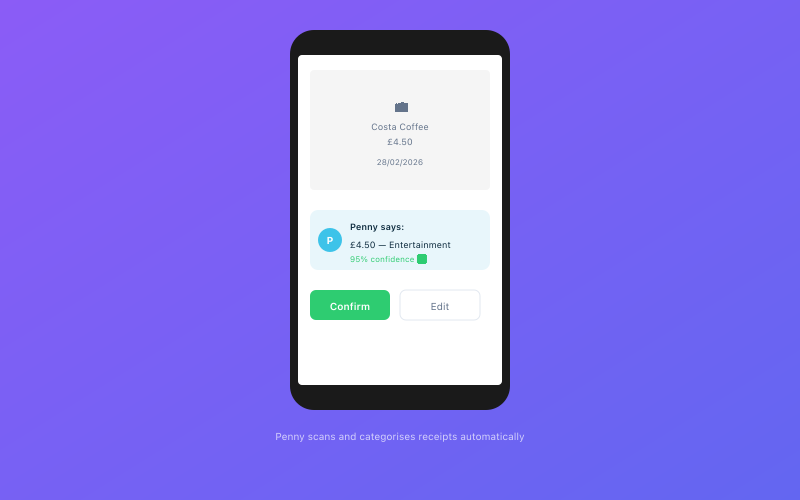 Penny scans and categorises your receipts automatically via WhatsApp
For sole traders, this translates into generous capital allowances, lower benefit-in-kind rates (if you're operating through a limited company), and savings on fuel and running costs. Even if the upfront cost of an EV is higher than a petrol equivalent, the tax relief can make a significant difference over the life of the vehicle.
First-Year Allowances and the 100% Deduction
The headline incentive for electric vehicles is the first-year allowance (FYA). Under current rules, brand-new, zero-emission cars qualify for 100% first-year capital allowances. In practical terms, this means you can deduct the entire cost of the vehicle from your taxable profits in the year you buy it.
Let's say you purchase a new electric van for £35,000. Rather than spreading the deduction over several years through writing-down allowances, you can claim the full £35,000 against your profits in the tax year you make the purchase. That's a substantial reduction in your tax bill.
It's worth noting that this applies to new vehicles only. Second-hand electric vehicles don't qualify for the 100% FYA, although they can still be claimed through the annual investment allowance or writing-down allowances. For a deeper look at how capital allowances work more broadly, have a read of our guide on capital allowances and the annual investment allowance.
What Counts as a Zero-Emission Vehicle?
HMRC's definition is fairly strict here. To qualify for the 100% first-year allowance, the vehicle must produce zero CO2 emissions. That means fully electric vehicles qualify, but plug-in hybrids do not — even if they have a very low emission rating. If your car has a combustion engine of any sort, it won't meet the zero-emission threshold.
Hydrogen fuel cell vehicles also qualify, although these are far less common on UK roads. For the vast majority of sole traders, we're talking about battery electric vehicles (BEVs) — the Teslas, Nissan Leafs, and MG4s of the world.
Using Simplified Expenses vs. Actual Costs
As a sole trader, you have a choice when it comes to claiming vehicle expenses. You can either use HMRC's simplified expenses (the flat-rate mileage method) or claim the actual costs of running the vehicle.
With simplified expenses, you claim 45p per mile for the first 10,000 business miles, then 25p per mile after that. This rate is the same regardless of whether you drive a petrol car, a diesel, or an electric vehicle. The advantage is simplicity — you just log your business mileage and multiply.
However, if you want to claim the 100% first-year allowance on an electric vehicle, you need to use the actual costs method. This means claiming the purchase price (via capital allowances), plus the actual running costs: electricity for charging, insurance, road tax, servicing, and so on. You'll need to work out the business-use percentage if you also use the vehicle personally.
For many EV owners, the actual costs method works out better, especially in the first year when you can claim the full purchase price. But it does require more detailed record-keeping. Tools like Accounted make this much easier — Penny can help you categorise your vehicle expenses and keep track of your business mileage throughout the year, so you're not scrambling at tax time.
Charging Costs — What Can You Claim?
One of the most common questions we hear is about claiming for electricity used to charge an EV at home. The good news is that you can claim it, but you'll need to be able to demonstrate the cost.
If you charge at home, the simplest approach is to use a dedicated EV charger with its own meter or smart tracking, so you can show exactly how much electricity goes into the car. You then apportion the cost based on your business-use percentage. If 60% of your mileage is for business, you can claim 60% of the charging costs.
Public charging is more straightforward — keep the receipts, and claim the business-use proportion. If you charge at a client's premises or a commercial charging point, those costs are clearly identifiable.
You can also claim for the installation of a home charging point. The Electric Vehicle Homecharge Scheme (EVHS) has offered grants towards installation costs in the past, and any amount you pay over and above the grant may be claimable as a business expense, provided the charger is used for business purposes. For a full rundown of what expenses you can and can't claim, check out our complete list of sole trader expenses.
Road Tax, Insurance, and Running Costs
Electric vehicles currently benefit from zero road tax (Vehicle Excise Duty), which is a saving in itself. However, this is changing — from April 2025, new EVs are subject to the lowest first-year rate, and from the second year onwards, they'll pay the standard rate. It's still cheaper than most petrol or diesel vehicles, but the free ride (pun intended) is coming to an end.
Insurance for electric vehicles can be higher than for equivalent petrol cars, largely because repair costs tend to be more expensive due to battery technology. However, servicing costs are typically lower — no oil changes, fewer brake pad replacements (thanks to regenerative braking), and generally fewer moving parts to go wrong.
All of these running costs — road tax, insurance, servicing, tyres, breakdown cover — can be claimed as business expenses, proportioned to your business use. The key is keeping accurate records throughout the year rather than trying to piece things together in January.
Leasing vs. Buying — Tax Implications
If buying an electric vehicle outright isn't realistic, leasing is worth considering. Lease payments on a zero-emission vehicle are fully deductible against your business profits, with no restriction. For cars with CO2 emissions above 50g/km, there's a 15% disallowance on lease payments, but for fully electric vehicles, you can claim 100% of the lease cost (again, proportioned for business use).
Buying on hire purchase is another option. With HP, you can claim the capital allowances on the full price of the vehicle (including the 100% FYA for new EVs), and you can also claim the interest on the finance as a business expense. Personal contract purchase (PCP) is trickier — since you don't own the vehicle unless you make the final balloon payment, the tax treatment is more akin to leasing.
The right choice depends on your cash flow, how many miles you do, and how long you plan to keep the vehicle. It's worth running the numbers for your specific situation. If you're using Accounted, you can see how different approaches affect your projected tax bill, which makes the decision a lot clearer.
What About Electric Bikes and Scooters?
It's not just cars and vans. Electric bicycles and e-scooters used for business purposes can also be claimed as expenses, though the rules are slightly different. An electric bike used for business deliveries, for example, would qualify for capital allowances. The cost is typically much lower than a car, so the annual investment allowance will usually cover it in full.
E-scooters are in a slightly grey area legally — they're not currently legal to use on public roads in the UK except in designated trial areas — so claiming one as a business expense might raise an eyebrow at HMRC. Stick to e-bikes if two-wheeled electric transport is your thing.
Keeping Records for HMRC
Whatever vehicle you use and however you claim, record-keeping is essential. HMRC expects you to be able to justify your claims, and that means keeping:
- A mileage log showing business journeys (date, destination, purpose, miles)
- Receipts for charging, servicing, insurance, and other running costs
- Evidence of the purchase price or lease agreement
- A record of the business-use percentage and how you calculated it
This might sound like a lot of admin, but it's the kind of thing that Penny handles brilliantly. Snap a photo of your charging receipt, and it gets categorised automatically. Log your mileage through the app, and it's all there when you need it. For more on claiming vehicle-related expenses, have a look at our guide on claiming your laptop as a business expense — the principles of capital allowances are very similar.
Making the Switch
Electric vehicles are one of those rare cases where doing the right thing environmentally also makes strong financial sense. The tax relief is generous, the running costs are lower, and the government is clearly signalling that the incentives for EVs will continue — even as some of the freebies (like zero road tax) start to phase out.
If you're a sole trader considering an EV, now is a good time to make the move. The 100% first-year allowance is still available, charging infrastructure is improving rapidly, and the range of affordable electric vehicles is growing every year.
Accounted helps UK sole traders stay on top of their bookkeeping and tax. Start your free 30-day trial at getaccounted.co.uk
Related reading:
- Capital Allowances and the Annual Investment Allowance
- Sole Trader Expenses — The Complete List
- Can You Claim a Laptop as a Business Expense?
Related Reading
Start your free trial and let Penny handle your bookkeeping automatically.
Accounted categorises your expenses automatically using AI, with confidence scores on every transaction. See how expenses work →
Tax & Compliance Specialists
Our tax specialists have decades of combined experience in UK sole trader and small business taxation, MTD compliance, and HMRC submissions. All content is reviewed against current HMRC guidance before publication and updated quarterly to reflect legislative changes.
Ready to try Accounted?
Join UK sole traders who are simplifying their bookkeeping and tax.
Start your 14-day free trial