Business Use of Home Calculation — The Two Methods
If you work from home — whether full-time or a few days a week — you can claim a proportion of your household running costs as a business expense. But how do you actually work out the amount? HMRC gives you two options: the actual cost method and the simplified expenses flat rate. Each has its advantages, and the right choice depends on your circumstances.
In this guide, we'll walk you through both methods step by step, show you worked examples, and help you decide which approach will give you the better result.
Method 1: Actual Costs (Proportional Calculation)
The actual cost method involves working out the business proportion of your real household expenses. It requires more record-keeping but usually gives a higher deduction than the flat rate, especially if you work from home regularly.
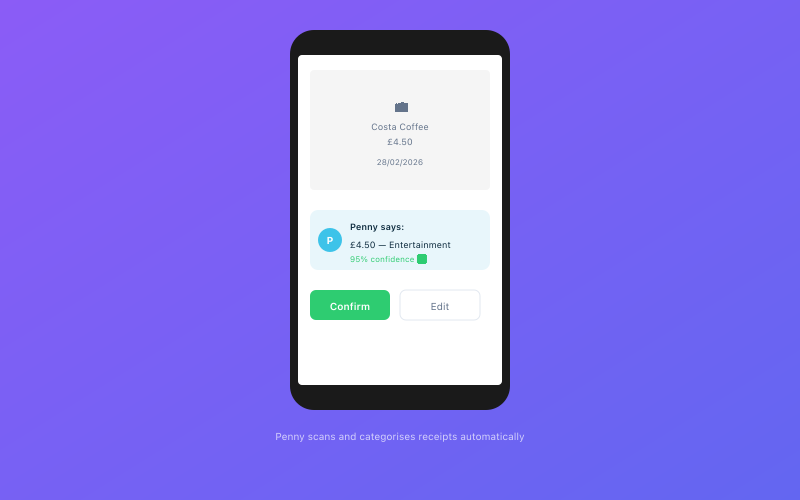 Penny scans and categorises your receipts automatically via WhatsApp
Step 1: Identify Your Allowable Household Costs
You can include the following household expenses in your calculation:
- Gas and electricity (or other heating fuel)
- Water rates (metered or unmetered)
- Council tax
- Rent (if you're a tenant)
- Mortgage interest (not the capital repayment portion — only the interest)
- Home insurance (buildings and contents)
- Broadband and telephone line rental
- General repairs and maintenance to the property
You cannot include:
- Mortgage capital repayments
- The purchase price of your home
- Home improvements (e.g., a new kitchen) unless directly related to business use
- Food and general living costs
Step 2: Calculate the Business Proportion
There are two common approaches to calculating the proportion, and HMRC accepts both.
Room-Based Calculation
Count the number of rooms in your home (excluding bathrooms, hallways, and landings) and identify how many are used for business.
Business proportion = Number of business rooms ÷ Total number of rooms
For example, if your home has five rooms and you use one as a dedicated office:
Business proportion = 1 ÷ 5 = 20%
Area-Based Calculation
Measure the floor area of your home and the floor area used for business.
Business proportion = Business area (m²) ÷ Total area (m²)
For example, if your home is 90m² and your office is 12m²:
Business proportion = 12 ÷ 90 = 13.3%
The room-based method is simpler. The area-based method is more precise and can give a different result, especially if rooms are very different sizes. Choose whichever method gives a fair representation of your business use.
Step 3: Adjust for Time
If you don't use the room for business all day, every day, you should adjust the proportion to reflect the actual hours of business use.
For example, if your office doubles as a guest bedroom and you only use it for work during business hours (say, 8 hours out of 24), a time adjustment might reduce the proportion by two-thirds.
Alternatively, if the room is exclusively used as an office (no personal use at all), you don't need a time adjustment. However, exclusive business use has a potential downside for capital gains tax, which we'll discuss later.
Worked Example
Sarah is a freelance copywriter who works from home five days a week. Her home has six rooms (kitchen, lounge, three bedrooms, and a study). She uses the study exclusively as her office.
Her annual household costs:
| Expense | Annual cost | |---------|------------| | Electricity and gas | £1,800 | | Water | £480 | | Council tax | £1,600 | | Broadband | £360 | | Home insurance | £320 | | Rent | £9,600 | | Total | £14,160 |
Business proportion (room method): 1 room ÷ 6 rooms = 16.7%
Claimable amount: £14,160 × 16.7% = £2,365 per year
That's a significant deduction — far more than the flat rate would give her.
What If You Share a Room?
Many sole traders don't have a dedicated office. Perhaps you work from the kitchen table or a corner of the living room. You can still claim, but you'll need to factor in the shared use.
A common approach is to calculate the room-based proportion and then reduce it by a time factor. If you use the living room for work 8 hours a day and it's also used as a family room the rest of the time, you might claim one-third of that room's proportion (8 hours out of 24).
There's no single "correct" formula — HMRC expects a reasonable estimate that reflects reality.
Method 2: Simplified Expenses (Flat Rate)
The simplified expenses method lets you claim a flat monthly amount based on the hours you work from home. No need to track actual household costs or calculate proportions.
The Flat Rates
| Hours worked from home per month | Monthly amount | |---------------------------------|---------------| | 25 to 50 hours | £10 | | 51 to 100 hours | £18 | | 101 hours or more | £26 |
If you work from home fewer than 25 hours in a month, you can't claim for that month.
Worked Example
Tom works from home roughly 35 hours a week, which is approximately 150 hours per month.
Monthly claim: £26 Annual claim: £26 × 12 = £312
Compare this with Sarah's actual cost claim of £2,365. The difference is striking — and it's why the actual cost method is usually more beneficial for anyone who works from home regularly.
When Does the Flat Rate Win?
The flat rate can be better if:
- You work from home only occasionally (e.g., one or two days a week), so your actual business proportion is very small
- Your household costs are unusually low (perhaps you have very low rent or no rent, minimal energy bills)
- You want to avoid the record-keeping burden of tracking actual costs
- You're concerned about capital gains tax implications (more on this below)
For most full-time home workers, the actual cost method is significantly more generous.
Capital Gains Tax Consideration
There's one important wrinkle that makes some people hesitate before claiming actual costs: the potential impact on capital gains tax (CGT) if you later sell your home.
When you sell your main residence, you normally benefit from principal private residence (PPR) relief, which exempts the gain from CGT entirely. However, if part of your home has been used exclusively for business, HMRC could argue that portion isn't covered by PPR relief.
In practice, this is only a risk if:
- You have a room that is used exclusively for business (no personal use whatsoever)
- Your home increases significantly in value
- You sell the home
If the room has any personal use — even occasional — HMRC cannot restrict PPR relief. This is why many accountants advise keeping some personal element in your home office. A bookshelf with personal books, a TV used occasionally in the evenings, or a sofa bed for guests can all demonstrate that the room isn't exclusively for business.
The flat-rate method avoids this issue entirely. Because you're not claiming a proportion of actual household costs, there's no argument that a specific room was used exclusively for business. This is a genuine advantage of the flat rate for homeowners concerned about future CGT.
If you're a renter, CGT on your home isn't relevant, so this consideration doesn't apply.
Additional Considerations
Phone and broadband costs are slightly different from other household expenses because you can claim them under either method.
If you use the flat-rate method for general household costs, you can still claim the business proportion of your phone and broadband bills on top. The flat rate is meant to cover heat, light, power, and general wear and tear — it doesn't cover communications.
So even if you opt for the simplified method, make sure you're also claiming business use of:
- Your mobile phone bill
- Your broadband subscription
- Any landline costs
For more details, see our guide on claiming phone bill expenses.
How Accounted Handles Home Office Claims
When you set up your home office claim in Accounted, Penny walks you through both methods and helps you compare the results. You enter your household costs, the number of rooms (or floor area), and your working hours, and Penny calculates the claim under both methods side by side.
This makes it easy to choose the right approach without needing to build your own spreadsheet. You can update the figures each year as your costs change, and Penny will automatically adjust your claim on your Self Assessment return.
If you're not sure which method to use, start by entering your actual costs. If the actual cost method gives you more than £312 (which it almost certainly will for regular home workers), that's your answer.
Practical Tips
Keep Utility Bills
If you're using the actual cost method, you need evidence of your household costs. Keep copies of your energy bills, council tax statement, insurance documents, and rent agreement or mortgage statement. Digital copies are fine — HMRC doesn't require paper originals.
Be Consistent
Pick a method and stick with it for the tax year. You can't switch between methods mid-year. However, you can change methods from one tax year to the next if your circumstances change.
Document Your Working Pattern
Keep a simple record of your working hours and where you work. This supports both the flat-rate claim (which is based on hours) and the actual cost claim (which may involve a time adjustment). A sentence in your diary or a note in Accounted is sufficient.
Review Annually
Your household costs change from year to year — energy prices, rent, council tax. Review your home office claim annually to make sure you're claiming the right amount. A rise in energy bills, for example, directly increases your actual cost claim.
The Bottom Line
For most sole traders who work from home regularly, the actual cost method gives a significantly higher tax deduction than the flat rate. The flat rate is simpler and avoids CGT complications, but at a maximum of £312 per year, it leaves a lot of money on the table for full-time home workers.
Whichever method you choose, make sure you're claiming. Working from home is a legitimate business cost, and the tax relief is there to reflect the fact that you're using your home to generate income.
For more on simplified expenses generally, see our guide on the simplified expenses method. And for a broader view of everything you can claim, check out the complete guide to sole trader expenses.
Related Reading
Start your free trial and let Penny handle your bookkeeping automatically.
Accounted helps UK sole traders stay on top of their bookkeeping and tax. Start your free 30-day trial at getaccounted.co.uk
Accounted categorises your expenses automatically using AI, with confidence scores on every transaction. See how expenses work →
Tax & Compliance Specialists
Our tax specialists have decades of combined experience in UK sole trader and small business taxation, MTD compliance, and HMRC submissions. All content is reviewed against current HMRC guidance before publication and updated quarterly to reflect legislative changes.
Ready to try Accounted?
Join UK sole traders who are simplifying their bookkeeping and tax.
Start your 14-day free trial