Books, Courses, and Subscriptions — What's Deductible?
As a sole trader or freelancer, staying sharp is part of the job. You buy books to deepen your expertise. You take online courses to learn new techniques. You subscribe to industry publications, software tools, and professional bodies. All of this costs money — and the natural question is whether any of it can be claimed against your tax bill.
The answer is: it depends. Some learning and subscription costs are fully deductible, some are partially deductible, and some aren't deductible at all. The distinction comes down to a principle that HMRC applies rigorously: the expense must be incurred "wholly and exclusively" for the purposes of your trade.
That sounds simple enough, but in practice the line between what qualifies and what doesn't can be surprisingly blurry. This guide will help you understand where that line sits.
The Golden Rule: Updating vs. Acquiring Skills
This is the single most important distinction when it comes to training and learning expenses. HMRC draws a clear line between:
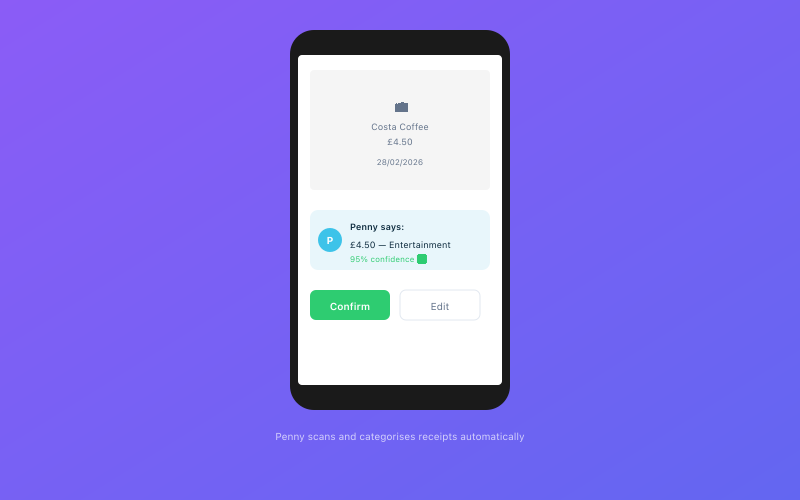 Penny scans and categorises your receipts automatically via WhatsApp
- Updating or maintaining existing skills — Deductible
- Acquiring new skills for a new trade or profession — Not deductible
If you're a web developer who takes a course on the latest JavaScript framework, that's updating your existing skills. It's deductible. If you're a web developer who takes a course on becoming a qualified plumber, that's acquiring new skills for a different trade. It's not deductible.
The reasoning is that maintaining your current skills is a cost of running your existing business, while learning an entirely new set of skills is capital expenditure — you're investing in a new capability rather than maintaining an existing one.
In practice, this means:
- A freelance copywriter buying a book on SEO writing techniques — deductible
- A personal trainer taking a nutrition certification course — deductible (it's closely related to their existing profession)
- A graphic designer taking a photography course — likely deductible (photography is a natural extension of design work)
- An accountant taking a course on becoming a yoga teacher — not deductible (entirely different profession)
The grey areas are the interesting ones. If you're a marketing consultant who takes a course on data analytics, is that updating existing skills or acquiring new ones? It depends on the specifics. If data analysis is already part of your service offering and you're deepening that knowledge, it's deductible. If you've never offered data services and you're branching into an entirely new area, HMRC might argue it's not.
When in doubt, keep a record of why the training is relevant to your existing business. A brief note explaining the connection is usually sufficient.
For a deeper look at HMRC's rules on training, see our guide to whether training courses are tax deductible.
Books and Publications
Books related to your profession or trade are generally deductible. This includes:
- Technical and professional books — Reference manuals, textbooks, and guides related to your field
- Business books — Books on marketing, sales, management, productivity, and other aspects of running a business
- Industry publications — Trade magazines, journals, and newsletters
The test is whether the book is genuinely relevant to your business. A freelance journalist buying a book on investigative reporting techniques? Clearly deductible. The same journalist buying a novel for pleasure? Not deductible, even if they review books as part of their work (unless it's specifically for a review commission).
E-books and audiobooks are treated the same as physical books. The format doesn't matter — it's the content and purpose that determine deductibility.
Kindle Unlimited and similar subscriptions can be deductible if you use them primarily for business reading. If it's a mix of business and personal, you'd technically need to apportion the cost. In practice, most sole traders claim the full subscription cost if business reading is the primary reason they have it, and HMRC is unlikely to challenge a £10/month subscription.
Newspapers are trickier. A general newspaper like The Times or The Guardian is typically not deductible because it's general information, not specific to your trade. However, a specialist publication like The Law Gazette, Accountancy Age, or Construction News is directly relevant to your profession and therefore deductible.
Online Courses and Training Programmes
Online learning has exploded in recent years, and sole traders spend significant amounts on platforms like Udemy, Coursera, LinkedIn Learning, Skillshare, and industry-specific training providers. The deductibility rules are the same as for in-person training.
Deductible courses include:
- Courses that update your existing professional knowledge
- Courses that teach you new techniques within your current field
- Mandatory CPD (Continuing Professional Development) requirements
- Courses on business skills that directly support your trade — bookkeeping, marketing, client management
Potentially non-deductible courses include:
- Courses in an entirely different field that you don't currently work in
- Hobby courses disguised as business training
- University degrees (these are generally treated as capital expenditure, not revenue)
Platform subscriptions — If you subscribe to LinkedIn Learning or Skillshare primarily for professional development, the subscription cost is deductible. If you use it mostly for personal interest courses with the occasional business-related one thrown in, you should only claim the business proportion.
Conferences and events are also deductible if they're relevant to your trade. This includes the ticket price, travel, accommodation, and meals while attending. Industry conferences are a clear yes. A motivational event with no specific relevance to your business is a harder sell.
Professional Subscriptions and Memberships
Annual subscriptions to professional bodies and industry organisations are deductible, provided they're relevant to your business.
Common examples include:
- Professional bodies — ICAEW, RICS, RIBA, CIM, CIPD, and hundreds of others
- Trade associations — Federation of Small Businesses, relevant trade guilds, local business chambers
- Regulatory bodies — SRA, FCA, HCPC, and similar regulatory registration fees
- Industry networks — Professional networking groups and communities
HMRC actually publishes a list (List 3) of professional bodies and learned societies whose subscriptions are tax-deductible. If your body is on the list, you can claim with confidence. If it's not on the list, it may still be deductible if it's genuinely relevant to your trade — the list isn't exhaustive.
Software Subscriptions
In the modern world, software subscriptions are a significant expense for many sole traders. The good news is that most business software is fully deductible.
Commonly claimed software subscriptions:
- Accounting and bookkeeping software (like Accounted)
- Project management tools (Trello, Asana, Monday)
- Design software (Adobe Creative Cloud, Canva Pro, Figma)
- Communication tools (Zoom, Slack, Microsoft Teams)
- Email marketing platforms (Mailchimp, ConvertKit)
- CRM systems (HubSpot, Salesforce)
- Website builders and hosting (WordPress, Squarespace, Wix)
- Cloud storage (Google Workspace, Dropbox, OneDrive)
- Industry-specific software
If the software is used exclusively for business, claim the full cost. If it's mixed-use (for example, a Microsoft 365 subscription that you also use for personal documents), claim the business proportion.
One-off software purchases are also deductible. If you buy software outright rather than subscribing, it's either claimed as a revenue expense (if it's relatively low-cost and has a limited useful life) or through capital allowances (if it's more expensive and has a longer useful life). For most software, the cost is low enough to be treated as a straightforward expense.
Streaming Services and News Subscriptions
This is where people sometimes get creative — and where HMRC draws the line quite firmly.
Netflix, Disney+, Amazon Prime Video — Not deductible for the vast majority of people. Even if you work in media or entertainment, a general streaming subscription is personal entertainment, not a business expense. The only exception would be if you could demonstrate that specific content was watched exclusively for professional purposes — and that's a very hard argument to make.
Spotify or Apple Music — Generally not deductible unless you're a music professional who genuinely uses the platform for work (studying arrangements, researching competitors, etc.).
News subscriptions — A subscription to the Financial Times might be deductible if you work in finance. A subscription to The Athletic is deductible if you're a sports journalist. The key is direct relevance to your trade, not general interest.
Research databases — Subscriptions to research databases, academic journals, or specialist information services are deductible if they're used for your business. LexisNexis for a legal consultant, IBIS World for a business analyst, or a specialist medical database for a healthcare professional would all qualify.
How Penny Helps With Tracking
One of the challenges with subscription expenses is that they're small, regular, and easy to forget about. You might have ten or fifteen subscriptions, each costing between £5 and £50 per month. Individually, they seem insignificant. Collectively, they could add up to £200-£500 per month — £2,400-£6,000 per year.
When you connect your bank account to Accounted, Penny identifies recurring subscription payments automatically and categorises them as business expenses. This means nothing falls through the cracks. At the end of the year, you have a complete record of every subscription you've paid for, properly categorised and ready for your tax return.
It also helps you spot subscriptions you've forgotten about. Many sole traders discover they're paying for tools they no longer use when Penny highlights recurring payments they don't recognise. That's not just a tax benefit — it's a direct saving on wasted spending.
Record-Keeping Tips
For books, courses, and subscriptions, your record-keeping needs are relatively straightforward:
- Keep receipts or confirmation emails for books and course purchases
- Keep subscription confirmations showing the cost and what you're subscribing to
- Note the business purpose — A brief record of why each purchase is relevant to your business
- For mixed-use subscriptions, note the percentage you're claiming and how you determined it
Digital records are perfectly acceptable. A folder in your email or cloud storage containing receipts and confirmations is all you need. If you're using Accounted, most of this is handled automatically through bank transaction categorisation.
Remember, HMRC requires you to keep records for at least five years after the 31 January submission deadline for the relevant tax year. For a full rundown of what you can claim, see our complete list of sole trader expenses.
Claim What You're Entitled To
The tax system isn't designed to punish you for investing in your professional development. Books, courses, and subscriptions that genuinely help you do your job better are legitimate business expenses, and you should claim them without hesitation.
The key is honesty. If an expense is genuinely for business purposes, claim it. If it's for personal enjoyment, don't dress it up as something it's not. The line between the two is usually obvious — and in the rare cases where it's genuinely ambiguous, a reasonable judgement call backed up by a brief note of your reasoning will serve you well.
Accounted helps UK sole traders stay on top of their bookkeeping and tax. Start your free 30-day trial at getaccounted.co.uk.
Related reading:
- Are Training Courses Tax Deductible?
- The Complete List of Sole Trader Expenses
- Can I Claim Working From Home Expenses?
Related Reading
- Accountancy Fees — Are They Tax Deductible? (Yes)
- Pre-Trading Expenses — What You Can Claim Before You Start
Start your free trial and let Penny handle your bookkeeping automatically.
Accounted categorises your expenses automatically using AI, with confidence scores on every transaction. See how expenses work →
Tax & Compliance Specialists
Our tax specialists have decades of combined experience in UK sole trader and small business taxation, MTD compliance, and HMRC submissions. All content is reviewed against current HMRC guidance before publication and updated quarterly to reflect legislative changes.
Ready to try Accounted?
Join UK sole traders who are simplifying their bookkeeping and tax.
Start your 14-day free trial