Pre-Trading Expenses — What You Can Claim Before You Start
Starting a business doesn't happen overnight. Before you officially open for business, there are all sorts of costs: building a website, buying equipment, registering a domain name, attending courses, printing business cards, perhaps even travelling to meet potential clients or suppliers. These pre-trading expenses can add up quickly — and the good news is that many of them are tax deductible.
In this guide, we'll explain the rules for claiming pre-trading expenses, what qualifies, the time limits you need to know about, and how to include them on your first tax return.
What Are Pre-Trading Expenses?
Pre-trading expenses are costs you incur before you officially start trading that relate to getting your business up and running. HMRC recognises that businesses don't spring into existence fully formed — there's always a preparation phase, and the costs incurred during that phase can be legitimate business expenses.
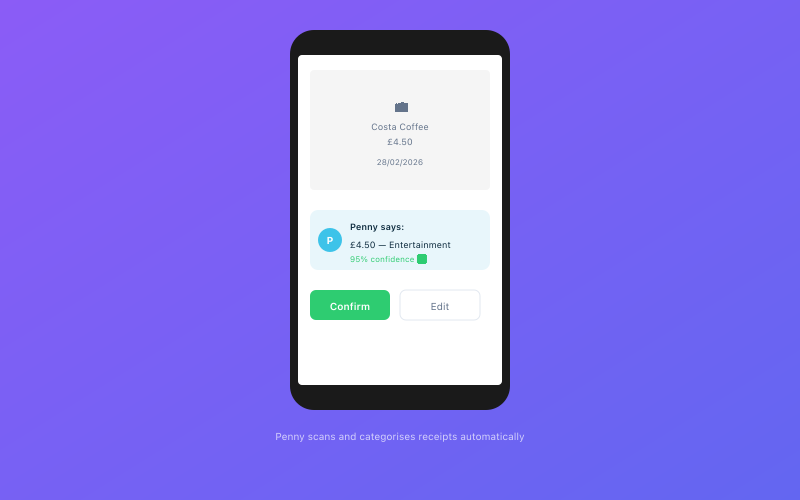 Penny scans and categorises your receipts automatically via WhatsApp
The legislation (ITTOIA 2005, s.57) allows you to treat qualifying pre-trading expenditure as if it were incurred on the first day of trading. In other words, the expenses are backdated to your start date and included in your first period of accounts.
This means you don't lose out on tax relief just because you spent money before your business was officially live. Everything gets rolled into your first year's expenses.
The Time Limit: Seven Years
There's a time limit on how far back you can go. You can claim pre-trading expenses incurred up to seven years before your start date.
For most new sole traders, this is more than enough. Most pre-trading expenditure happens in the weeks or months before launch. But the seven-year window is useful if you've been planning your business for a longer period — perhaps buying equipment gradually, completing a multi-year training programme, or developing a product over several years before going to market.
Any expenses incurred more than seven years before your start date are not claimable, regardless of how directly they relate to the business.
What Qualifies as a Pre-Trading Expense?
The rules for pre-trading expenses are the same as for regular trading expenses: the cost must have been incurred wholly and exclusively for the purposes of the trade. The only difference is that the expense happened before the trade officially began.
Here are common examples of pre-trading expenses that sole traders can typically claim:
Setting Up Your Business
- Domain name registration and website hosting — even if the site was under construction
- Website design and development costs
- Business cards, stationery, and branding — logo design, printed materials
- Legal fees — drafting terms of service, contracts, or partnership agreements
- Accountancy fees — advice on business structure, registration, initial setup
- Business registration costs — though registering as a sole trader is free, you might pay for other registrations (ICO data protection fee, for example)
Equipment and Tools
- Computers and technology — laptops, tablets, phones purchased for the business
- Tools and equipment — anything you need to deliver your service or make your product
- Office furniture — desks, chairs, shelving
These items may qualify as capital expenditure, in which case they're claimed through capital allowances (specifically the Annual Investment Allowance, currently £1,000,000) rather than as revenue expenses. The pre-trading rules still apply — they're treated as purchased on your first day of trading.
For more on capital allowances, see our guide on the Annual Investment Allowance.
Marketing and Research
- Market research costs — surveys, focus groups, competitor analysis
- Advertising and marketing — early promotional campaigns, social media advertising, leaflets
- Attending trade shows and exhibitions — entry fees, travel, accommodation
- Sample products — prototypes, test products, samples sent to potential clients
Training and Development
- Training courses relevant to your trade — but remember the rule about updating vs. acquiring skills. If the training is for a trade you're about to start, there's a good argument it's a pre-trading expense for that trade. However, if it's an initial professional qualification, HMRC may argue it's capital expenditure. See our guide on when training courses are tax deductible.
- Professional membership fees — joining a professional body before you start trading
- Books and resources — reference materials for your trade
Travel
- Travel to meet potential clients or suppliers — mileage, train fares, parking
- Travel to view premises — if you're looking for a workshop, studio, or office
- Travel to training courses — fare costs and mileage
For details on claiming travel expenses generally, see our guide on travel expenses for the self-employed.
Administrative Costs
- Insurance — business insurance, professional indemnity cover
- Software subscriptions — accounting software, project management tools, design software
- Phone and broadband — business use proportion of bills incurred before trading
What Doesn't Qualify?
Not everything you spend before starting a business is claimable. The "wholly and exclusively" test still applies, so you can't claim:
- Personal expenses that happen to coincide with your preparation period
- Costs that have no connection to the trade — a holiday that included one meeting with a potential supplier is still primarily a holiday
- The cost of acquiring a trade itself — if you buy an existing business (goodwill, customer lists), this is treated differently from normal expenses
- Training for a completely new profession — if you're retraining from scratch, the initial qualification is generally capital expenditure (though this is a grey area)
Recording and Claiming Pre-Trading Expenses
Even though you might not have been keeping formal business records before you started trading, you need evidence of your pre-trading expenses. Dig out any receipts, invoices, bank statements, or email confirmations that show what you paid and when.
HMRC's standard requirement is that you keep records for at least five years after the 31 January submission deadline for the relevant tax year. For pre-trading expenses included in your first tax return, this means keeping the records for at least five years after you submit that return.
When you set up your Accounted account, you can enter pre-trading expenses as part of your initial setup. Penny will walk you through the process, asking about expenses you incurred before your start date and helping you categorise them correctly. It's much easier to do this when the information is fresh, rather than trying to reconstruct everything months or years later.
Claiming on Your Tax Return
Pre-trading expenses are included on your Self Assessment tax return for the first accounting period. Because they're treated as incurred on day one of trading, they appear alongside your regular expenses for that period.
If you're completing the self-employment pages (SA103) of your tax return, your pre-trading expenses are simply added to the relevant expense categories. For example:
- A pre-trading laptop goes into capital allowances
- Pre-trading marketing costs go into advertising expenses
- Pre-trading travel costs go into travel expenses
There's no separate box or form for pre-trading expenses. They merge into your first year's figures.
A Note on Losses
If your pre-trading expenses (combined with your other first-year costs) exceed your first-year income, you'll make a trading loss. This loss can be:
- Carried forward to set against future profits from the same trade
- Set against other income in the same tax year (e.g., employment income if you had a job while starting your business)
- Carried back to the previous tax year under certain conditions
Making a loss in your first year isn't unusual and doesn't raise any red flags with HMRC. Many businesses invest more than they earn in the early stages. The key is that the expenses are genuine and relate to the trade.
Common Mistakes to Avoid
Not Keeping Receipts
The most common mistake is not keeping proof of pre-trading expenses. Before you start a business, you might not think of yourself as a "business" yet, so you don't save the receipt for that website hosting payment or domain registration. Get into the habit of saving everything business-related from the moment you start planning.
Missing the Seven-Year Window
If you've been incubating your business idea for a long time, check the dates on your earliest expenses. Anything over seven years old on the day you start trading can't be claimed.
Claiming Personal Costs
Be honest about what's genuinely a business expense. That fancy notebook from Smythson might look like a business cost, but if you also use it as a personal diary, the "wholly and exclusively" test may not be met. Stick to expenses that are clearly and directly related to setting up and running your trade.
Forgetting Capital Items
Equipment purchased before trading started is still subject to capital allowances rules. A £2,000 laptop bought three months before your start date should be claimed through the AIA, not as a revenue expense. The good news is that the AIA gives you 100% relief in year one anyway, so the tax outcome is usually the same — but the categorisation matters for your records.
The Bottom Line
Pre-trading expenses are a valuable but often overlooked area of tax relief for new sole traders. If you spent money preparing to start your business — whether that's building a website, buying equipment, attending training, or marketing your services — there's a good chance you can claim those costs.
The key rules are simple: the expense must be incurred wholly and exclusively for the trade, within seven years of your start date, and you need to have evidence to support it. Everything gets rolled into your first year's accounts as if it were spent on day one.
Don't leave money on the table. Gather your pre-trading receipts, record them properly, and make sure they're included in your first tax return. For a complete overview of what you can claim as a sole trader, check out our complete guide to sole trader expenses.
Related Reading
Accounted helps UK sole traders stay on top of their bookkeeping and tax. Start your free 30-day trial at getaccounted.co.uk
Related reading: Business Mileage Claims: 45p Rate and Actual Costs.
Related reading: Simplified Expenses: Flat Rate for Vehicles and Home.
For step-by-step guidance, see our article on How to Handle Mixed-Use Expenses as a Sole Trader.
For step-by-step guidance, see our article on How to Track Business Miles for HMRC.
See our detailed comparison: Working from Home Allowance: Flat Rate vs Actual Costs.
Related reading: Capital Allowances: Claiming for Equipment and Tools.
Related reading: Client Entertainment Expenses: What You Can Claim.
For more on this topic, read Clothing and Uniform Tax Relief: What Qualifies.
For more on this topic, read Home Office Tax Relief: Both Methods Compared.
You may also find our Insurance Premiums as Business Expenses: Guide helpful.
For more on this topic, read Phone and Broadband Tax Deductions: Self-Employed.
For more on this topic, read Training and Professional Development Tax Relief.
Start your free trial and let Penny handle your bookkeeping automatically.
Accounted categorises your expenses automatically using AI, with confidence scores on every transaction. See how expenses work →
Tax & Compliance Specialists
Our tax specialists have decades of combined experience in UK sole trader and small business taxation, MTD compliance, and HMRC submissions. All content is reviewed against current HMRC guidance before publication and updated quarterly to reflect legislative changes.
Ready to try Accounted?
Join UK sole traders who are simplifying their bookkeeping and tax.
Start your 14-day free trial