Green Business Expenses — What Eco-Friendly Costs Are Deductible
Running a greener business doesn't have to mean spending more. In fact, many eco-friendly choices are not only good for the planet — they're also tax-deductible. If you're a sole trader trying to reduce your environmental footprint, understanding which green expenses HMRC lets you claim can make sustainability a genuinely smart financial move.
Let's walk through the key areas where eco-friendly costs and tax savings overlap.
The Basic Rule: "Wholly and Exclusively" Still Applies
Before we dive into specific green expenses, it's worth remembering the golden rule of tax deductions for sole traders. An expense must be incurred "wholly and exclusively" for the purposes of your trade to be deductible. HMRC doesn't have a special category for eco-friendly expenses — they're assessed using the same criteria as any other business cost.
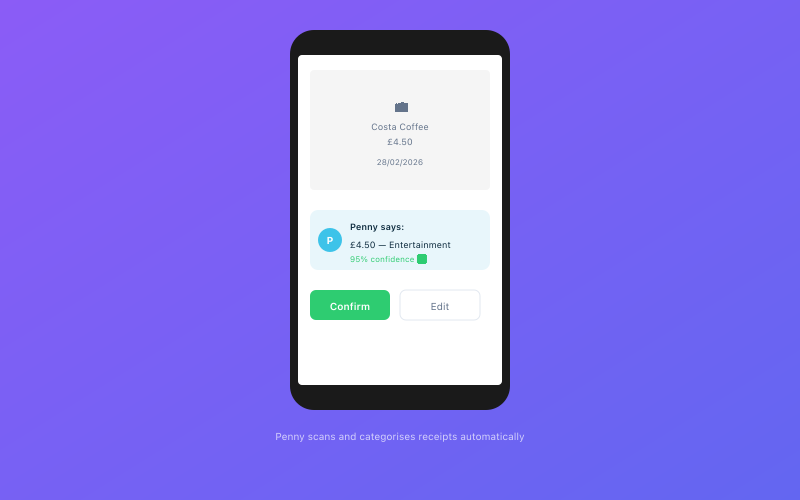 Penny scans and categorises your receipts automatically via WhatsApp
The good news is that many green choices naturally fall within this test. If you switch to recycled paper for your printing, that's a stationery expense. If you install energy-efficient lighting in your workshop, that's a premises cost. The environmental motivation behind the purchase doesn't change its deductibility — what matters is whether it's a legitimate business expense.
For a complete overview of what sole traders can and can't claim, our complete list of sole trader expenses is a useful starting point.
Energy-Efficient Equipment and Upgrades
One of the most impactful green investments a sole trader can make is upgrading to energy-efficient equipment. This covers a broad range, from LED lighting and energy-efficient computers to A-rated fridges (if you run a food business) and modern heating systems.
These items typically qualify as capital expenditure, meaning you claim them through capital allowances rather than as a straightforward expense. The annual investment allowance (AIA) lets most sole traders deduct the full cost of qualifying equipment in the year of purchase, up to the current £1 million threshold. So if you spend £800 on an energy-efficient laptop to replace your old power-hungry machine, you can claim the full £800 against your profits.
Energy-efficient items that form part of an integral feature of a building — such as heating, ventilation, or air conditioning systems — may qualify for enhanced capital allowances. It's worth checking HMRC's energy technology list to see if your specific purchase qualifies.
If you work from home, you can also claim a proportion of your household energy bills as a business expense. Switching to a green energy tariff doesn't change the amount you can claim, but it does mean your business is powered by renewable energy at no extra tax cost. Our guide on capital allowances and the annual investment allowance explains how these deductions work in detail.
Sustainable Office Supplies and Materials
The everyday materials you use in your business are deductible, and choosing sustainable alternatives doesn't cost you anything extra from a tax perspective. Recycled paper, biodegradable packaging, refillable ink cartridges, compostable cups — if you'd be buying a conventional version anyway, the eco-friendly alternative is claimable in exactly the same way.
Some sustainable alternatives are more expensive than their conventional counterparts. Biodegradable mailer bags, for instance, often cost more than standard plastic ones. The higher cost is still fully deductible — you're simply claiming a larger expense. Over time, as demand for sustainable products grows and prices come down, this gap is narrowing.
If you make products and sell them, your materials costs (including sustainable or ethically sourced materials) are part of your cost of goods sold and are deductible accordingly. A candle maker using soy wax instead of paraffin, or a jeweller using recycled silver, can claim these material costs just as they would any other.
Green Transport and Travel
Transport is often one of the biggest carbon contributors for small businesses, and there are genuine tax incentives for making greener choices.
Electric vehicles are the headline act here. New zero-emission cars and vans qualify for 100% first-year capital allowances, meaning you can deduct the entire purchase price from your profits in year one. The running costs — electricity, insurance, servicing — are also claimable, proportioned to business use.
But it's not just about cars. If you cycle to client meetings, you can claim the cost of a bicycle used for business as a capital allowance. Public transport costs for business journeys are deductible too, and choosing the train over a domestic flight doesn't just reduce your carbon footprint — rail tickets are often cheaper, saving you money before tax relief even enters the picture.
For sole traders who use the simplified mileage rate (45p per mile for the first 10,000 business miles), the rate is the same regardless of fuel type. But if you're driving an electric vehicle, switching to the actual costs method often works out better, particularly in the first year when you can claim the full vehicle cost.
Renewable Energy Installations
If you operate from your own business premises, installing renewable energy equipment — solar panels, small wind turbines, or heat pumps — can qualify for capital allowances. These are significant investments, but the tax relief helps to offset the upfront cost, and the ongoing energy savings reduce your bills.
Solar panels on a commercial building, for instance, would typically qualify for the AIA, allowing you to deduct the full installation cost in the year it's completed. You may also be able to sell excess electricity back to the grid under the Smart Export Guarantee (SEG), which creates a small additional income stream — though this income would be taxable.
For home-based sole traders, the position is more nuanced. If you install solar panels on your home and use some of the electricity for business, you can claim a proportion of the running costs, but claiming the installation cost itself as a business expense would be difficult unless you can demonstrate it's wholly and exclusively for business use — which is hard to argue when it's on your house.
Waste Reduction and Recycling Costs
If your business generates waste, the costs of responsible disposal are deductible. This includes:
- Commercial waste collection and recycling services
- Skip hire for business waste
- Hazardous waste disposal (for trades that produce it)
- Composting services for food businesses
Investing in equipment that reduces waste — such as a water filter to eliminate bottled water, reusable containers for a catering business, or a repair station if you run a tech workshop — counts as a business expense or capital allowance depending on the cost and nature of the item.
Some sole traders have found that switching to zero-waste practices actually reduces their costs. A cleaning business that uses refillable concentrate bottles, for example, spends less on packaging over time. The initial outlay on refillable equipment is deductible, and the ongoing savings go straight to your bottom line.
Eco-Friendly Marketing and Packaging
If you sell physical products, your packaging costs are a business expense — and that includes sustainable packaging. Compostable mailers, recycled cardboard boxes, paper tape instead of plastic, and soy-based inks for printing are all deductible.
The same goes for marketing materials. If you print business cards on recycled stock, order branded tote bags made from organic cotton, or use FSC-certified paper for brochures, these costs are claimed just like any other marketing expense.
Going digital with your marketing is perhaps the greenest option of all, and it's often cheaper too. Email marketing, social media, and digital invoicing eliminate paper entirely. Using Accounted for your invoicing, for instance, means everything is digital by default — no printing, no posting, and Penny keeps track of it all without a single sheet of paper.
Green Certifications and Memberships
If you decide to pursue environmental certifications or memberships — such as registering with a green business network, obtaining ISO 14001 certification, or joining an industry-specific sustainability scheme — the costs are generally deductible as professional fees or subscriptions.
Training courses related to sustainability are also claimable, provided they're relevant to your existing trade. A course on sustainable building practices for a self-employed builder, or a workshop on eco-friendly hairdressing products for a mobile hairdresser, would both qualify. A course on environmental science taken purely out of personal interest would not.
The distinction HMRC draws is between updating your existing skills (deductible) and acquiring new skills that take you into a different trade (not deductible). As long as the green training relates to what you already do, you should be fine.
Carbon Offsetting — A Quick Note
Carbon offsetting is a slightly trickier area. If you pay to offset your business's carbon emissions — perhaps through a tree-planting scheme or a verified carbon offset programme — the deductibility depends on whether HMRC considers it a legitimate business expense. We've written a separate, detailed article on this topic, as it deserves a thorough treatment. The short version: it can be deductible, but the way you frame it and the type of scheme you use both matter.
Keeping Track of Green Expenses
One of the challenges with eco-friendly expenses is that they're spread across multiple categories. Your sustainable packaging sits under materials, your electric vehicle costs are in transport, your green energy is in utilities, and your recycling costs are in overheads. There's no single "green" line on your tax return.
This is where good bookkeeping habits make a real difference. Using Accounted, you can tag expenses however you like, making it easy to see your total green spending at a glance while still having everything correctly categorised for HMRC. Penny will suggest the right category for each expense, and you can add your own tags for internal tracking.
For more on keeping your expenses organised, have a look at our guide on tax-efficient investments for the self-employed — the principles of tracking and categorising tax-advantaged spending apply just as well to green expenses.
The Bottom Line
Going green as a sole trader doesn't mean sacrificing your bottom line. Most eco-friendly business expenses are deductible under the same rules as their conventional equivalents, and in some cases — like electric vehicles — the tax relief is actually more generous for the greener option.
The key is treating green expenses the same way you'd treat any business cost: keep records, claim what you're entitled to, and make sure everything passes the "wholly and exclusively" test. And if you're unsure whether a particular eco-friendly purchase is claimable, it's always worth checking before you spend.
Accounted helps UK sole traders stay on top of their bookkeeping and tax. Start your free 30-day trial at getaccounted.co.uk
Related reading:
- Sole Trader Expenses — The Complete List
- Capital Allowances and the Annual Investment Allowance
- Tax-Efficient Investments for the Self-Employed
Related Reading
- Carbon Offsetting — Can You Claim It as a Business Expense?
- Co-Living and Co-Working Spaces — Can You Claim the Costs?
Start your free trial and let Penny handle your bookkeeping automatically.
Accounted categorises your expenses automatically using AI, with confidence scores on every transaction. See how expenses work →
Tax & Compliance Specialists
Our tax specialists have decades of combined experience in UK sole trader and small business taxation, MTD compliance, and HMRC submissions. All content is reviewed against current HMRC guidance before publication and updated quarterly to reflect legislative changes.
Ready to try Accounted?
Join UK sole traders who are simplifying their bookkeeping and tax.
Start your 14-day free trial