Carbon Offsetting — Can You Claim It as a Business Expense?
Carbon offsetting has become increasingly popular among businesses of all sizes. Whether it's planting trees, investing in renewable energy projects, or purchasing verified carbon credits, the idea of neutralising your business's environmental impact is appealing. But if you're a UK sole trader, there's a practical question that sits alongside the ethical one: can you actually claim carbon offsetting as a tax-deductible business expense?
The answer isn't a simple yes or no. It depends on how the offsetting relates to your business, how you structure the payment, and whether HMRC considers it a legitimate business cost. Let's unpack it properly.
What Is Carbon Offsetting?
Before we get into the tax side, let's make sure we're on the same page about what carbon offsetting actually involves. Carbon offsetting means compensating for the greenhouse gas emissions your business produces by funding projects that reduce or remove an equivalent amount of CO2 from the atmosphere.
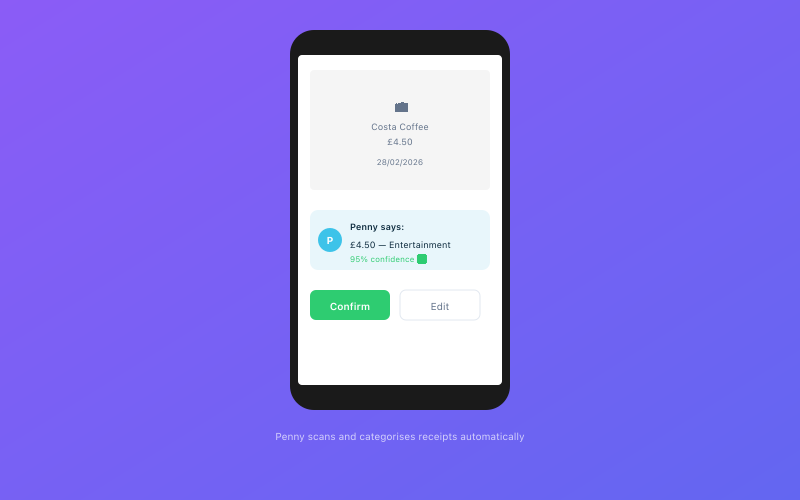 Penny scans and categorises your receipts automatically via WhatsApp
Common offset projects include:
- Tree planting and reforestation
- Renewable energy projects (wind, solar, hydro) in developing countries
- Methane capture from landfill sites
- Energy efficiency programmes in communities
- Direct air carbon capture technology
You typically purchase carbon credits through a certified scheme, where each credit represents one tonne of CO2 equivalent that has been reduced or removed. The price per tonne varies enormously — from a few pounds for basic forestry credits to over £100 for high-quality, verified schemes.
The "Wholly and Exclusively" Test
The fundamental question HMRC asks about any business expense is whether it was incurred "wholly and exclusively for the purposes of the trade." This is the test that every deductible expense must pass, and it's where carbon offsetting gets interesting.
If you offset your business emissions purely because you believe it's the right thing to do — an ethical or charitable motivation — HMRC could argue that the expense has a personal, non-business element. Charitable donations by sole traders are generally not deductible against trading profits (they're handled separately through Gift Aid on your personal tax return).
However, if the carbon offsetting serves a genuine business purpose, the position is much stronger. And for many sole traders, it does.
When Carbon Offsetting Is Likely Deductible
There are several scenarios where carbon offsetting clearly serves a business purpose:
Client or contract requirements. If your clients require you to demonstrate carbon neutrality as a condition of doing business — increasingly common in supply chains — then offsetting costs are a direct cost of winning and keeping contracts. This is a strong business purpose.
Marketing and brand positioning. If you market your business as carbon-neutral or environmentally responsible, and offsetting is part of delivering on that promise, the cost is connected to generating sales. It's analogous to other marketing expenses that build your brand's reputation.
Industry standards and certifications. Some industries and certifications require participants to offset their emissions. If offsetting is necessary to maintain a professional accreditation or industry membership, it's a cost of operating in your trade.
Regulatory compliance. While most sole traders aren't subject to mandatory carbon reporting, if your business falls under a scheme that requires offsetting, it's clearly a business expense.
Contractual obligations. If you've committed to carbon neutrality in your terms and conditions, contracts, or business policies, the offsetting costs are incurred to fulfil those obligations.
In all these cases, the connection between the expense and the trade is clear, and a deduction should be supportable.
When It Gets Trickier
The grey area emerges when you offset your emissions voluntarily, without a clear commercial driver. Let's say you're a freelance graphic designer who feels strongly about climate change and decides to offset your business's carbon footprint. There's no client requirement, no marketing angle, and no contractual obligation. You're just doing it because you think it's right.
In this scenario, HMRC might view the cost as a personal choice rather than a business necessity. It's similar to the distinction between charitable donations (generally not deductible for sole traders) and sponsorship (potentially deductible if there's a commercial benefit).
The safest approach is to ensure there's a documented business reason for the offsetting. This doesn't need to be elaborate — a note in your records explaining that you offset emissions as part of your brand positioning, client commitments, or sustainability policy is usually sufficient. If you mention your carbon-neutral status on your website, in proposals, or on social media, that's evidence of a commercial purpose.
How to Structure the Payment
The way you pay for carbon offsetting can also affect its deductibility.
Direct purchase of carbon credits through a commercial offsetting provider is the most straightforward approach. You're buying a product — carbon credits — for a business purpose. This is treated as a normal business expense, similar to buying any other service.
Donations to environmental charities that happen to fund carbon reduction projects are a different matter. Charitable donations by sole traders are not deductible against trading profits. If you donate to the Woodland Trust and they plant trees, that's wonderful, but it's a donation, not a business expense. You may be able to claim Gift Aid on your personal tax return, but it won't reduce your trading profit.
Subscription to a carbon offset scheme — such as a monthly plan with a provider like Ecologi, Mossy Earth, or Gold Standard — is generally treated as a business subscription, provided there's a commercial purpose.
The key distinction is between buying a service (deductible) and making a charitable donation (not deductible against trading profits). Choose providers that sell carbon credits as a commercial service rather than framing the payment as a donation.
Record-Keeping for Carbon Offset Claims
If you're going to claim carbon offsetting as a business expense, proper records are essential. HMRC won't take your word for it — you need to be able to show:
- Invoices or receipts from the offsetting provider, showing the amount paid, the number of credits purchased, and the date
- A business justification — why the offsetting was done for business purposes (a brief note is fine)
- Evidence of commercial use — screenshots of your website mentioning carbon neutrality, copies of client proposals, or marketing materials
- Certificates from the offsetting provider, if they issue them (most reputable schemes do)
Using Accounted, you can store receipts digitally and categorise them appropriately. Penny will suggest a category for the expense — most likely "professional fees" or "subscriptions" — and you can add a note explaining the business purpose. This kind of documentation makes life much easier if HMRC ever asks questions.
Which Offset Schemes Are Most Credible?
From a tax perspective, HMRC doesn't specify which offsetting schemes are acceptable. But using a reputable, verified scheme strengthens your position, because it demonstrates that you've made a genuine commercial purchase rather than a vague goodwill gesture.
Look for schemes certified by recognised standards:
- Gold Standard — founded by WWF, widely regarded as one of the most rigorous
- Verified Carbon Standard (Verra) — the most widely used voluntary carbon credit standard globally
- Plan Vivo — focuses on community-based projects in developing countries
- Woodland Carbon Code — the UK government-backed standard for woodland carbon projects
Avoid uncertified schemes or those that don't provide clear evidence of the emissions reductions they claim. Apart from the environmental risk of supporting ineffective projects, HMRC is more likely to question an expense that looks vague or poorly documented.
How Much Can You Claim?
There's no specific cap on how much you can claim for carbon offsetting, as long as the amount is reasonable and proportionate to your business activity. If you're a sole trader earning £40,000 a year and you spend £50 on offsetting, nobody is going to question it. If you spend £5,000, HMRC might want to understand the commercial rationale.
A useful benchmark is to calculate your approximate business emissions and offset them at a reasonable per-tonne rate. A typical sole trader working from home might have annual business emissions of 2-5 tonnes of CO2, which would cost £20-£500 to offset depending on the scheme. If you travel extensively or run energy-intensive equipment, your emissions (and therefore your offsetting costs) would be higher.
The point is that the expense should be proportionate to the emissions your business actually produces. Offsetting ten times your estimated emissions would look like a donation rather than a business expense.
Carbon Offsetting vs. Carbon Reduction
It's worth noting that HMRC (and common sense) would generally view direct carbon reduction — investing in energy efficiency, switching to an electric vehicle, using renewable energy — more favourably than offsetting. Reduction removes the emissions at source, while offsetting compensates for them after the fact.
From a tax perspective, direct carbon reduction measures are often more clearly deductible. Energy-efficient equipment qualifies for capital allowances. Electric vehicles get 100% first-year allowances. Renewable energy installations can be claimed through the annual investment allowance. For more on these deductions, our complete list of sole trader expenses covers what you can claim across all categories.
Offsetting works best as part of a broader sustainability strategy — reduce what you can, then offset the remainder. This approach is also more credible from a marketing perspective and is less likely to attract accusations of greenwashing.
A Practical Approach
Here's what we'd suggest for sole traders who want to offset their business carbon emissions and claim the cost:
- Calculate your business emissions using a free online carbon calculator
- Choose a verified offset scheme with a recognised certification
- Document the business purpose — even a paragraph in your records explaining why you're offsetting
- Reference your carbon-neutral status in your marketing, website, or client communications
- Keep all receipts and certificates from the offset provider
- Record the expense properly in your bookkeeping — Accounted makes this straightforward with Penny categorising it for you
- Claim it as a business expense on your self-assessment, categorised under the most appropriate heading
This approach gives you the strongest possible position if HMRC ever queries the deduction, while also ensuring your offsetting is genuine and effective.
For more on managing your expenses and maximising your deductions, take a look at our guide on tax-efficient investments for the self-employed.
The Verdict
Can you claim carbon offsetting as a business expense? Yes — in most cases, provided there's a genuine business purpose and you use a commercial offsetting provider rather than making a charitable donation. The key is documentation: make sure you can explain why the offsetting serves your trade, keep your receipts, and ensure the amount is proportionate to your business activity.
As more businesses adopt sustainability commitments, HMRC's approach to these expenses is likely to become clearer. For now, the "wholly and exclusively" test is your guide, and most sole traders who offset sensibly and document their reasons will be on solid ground.
Accounted helps UK sole traders stay on top of their bookkeeping and tax. Start your free 30-day trial at getaccounted.co.uk
Related reading:
- Sole Trader Expenses — The Complete List
- Tax-Efficient Investments for the Self-Employed
- Capital Allowances and the Annual Investment Allowance
Related Reading
Start your free trial and let Penny handle your bookkeeping automatically.
Accounted categorises your expenses automatically using AI, with confidence scores on every transaction. See how expenses work →
Tax & Compliance Specialists
Our tax specialists have decades of combined experience in UK sole trader and small business taxation, MTD compliance, and HMRC submissions. All content is reviewed against current HMRC guidance before publication and updated quarterly to reflect legislative changes.
Ready to try Accounted?
Join UK sole traders who are simplifying their bookkeeping and tax.
Start your 14-day free trial