Can I Claim My Broadband as a Business Expense?
If you work from home — and millions of UK sole traders and freelancers do — your broadband connection isn't just for streaming box sets and scrolling social media. It's a business tool. You use it to email clients, send invoices, join video calls, upload files, run your website, and manage your bookkeeping. So can you claim it as a business expense?
The short answer is yes. The longer answer involves a bit of maths and an understanding of what HMRC considers reasonable. Let's walk through it properly.
The Basic Rule: Business Proportion Only
HMRC's fundamental rule for expenses is that they must be incurred "wholly and exclusively" for business purposes. Your broadband connection, however, is almost certainly used for both business and personal purposes — you're not running a separate line just for work (and if you are, you can claim the whole thing).
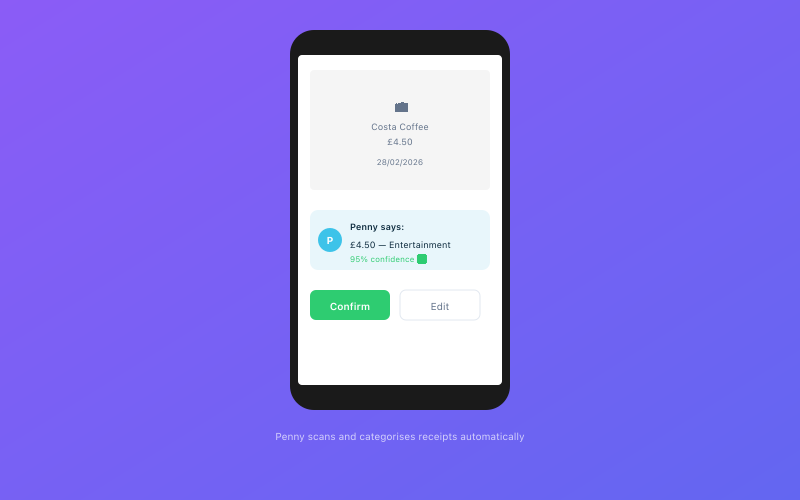 Penny scans and categorises your receipts automatically via WhatsApp
Because your broadband has a dual purpose, you can only claim the business proportion of the cost. The challenge is working out what that proportion is.
There's no single approved method for calculating this split, and HMRC doesn't prescribe a specific formula. What they do expect is that your calculation is reasonable and that you can justify it if asked.
Here are the most common approaches:
Time-based calculation. Work out how many hours per week you use your broadband for business versus personal use. If your broadband is active roughly 16 hours a day (assuming you're not downloading in your sleep) and you use it for business for 8 hours on weekdays, your business use is roughly 35-40% of total usage.
Room-based calculation. If you have a dedicated home office, you could argue that one room out of, say, five rooms in your house is used for business, making 20% of your broadband a business expense. This is simpler but potentially less generous than a time-based approach.
Reasonable estimate. Some sole traders simply claim 50% of their broadband costs on the basis that it's used roughly equally for work and personal purposes. HMRC generally accepts this if it's a fair reflection of reality. Claiming 90% would raise eyebrows unless you can genuinely demonstrate that level of business use.
Whatever method you choose, be consistent and keep a note of how you arrived at your figure. You don't need to submit your calculation to HMRC with your tax return, but you should be able to explain it if they ever ask.
How Much Can You Actually Save?
Let's put some numbers on this. The average UK broadband package costs around £30-£40 per month, or £360-£480 per year. If you claim 40% as a business expense, that's £144-£192 per year.
On its own, that might not seem like much. But expenses are cumulative. Your broadband claim, combined with your phone, electricity, heating, and other home office costs, can add up to a meaningful reduction in your tax bill. If you're a basic rate taxpayer, every £100 of allowable expenses saves you £20 in Income Tax plus National Insurance. At the higher rate, the saving is £40 per £100.
The point isn't that any single expense will transform your finances. It's that claiming everything you're entitled to, consistently, across the whole year, makes a genuine difference.
The Simplified Expenses Alternative
If calculating the business proportion of individual bills sounds like too much hassle, HMRC offers an alternative: simplified expenses (also known as flat rate deductions) for working from home.
Under this method, instead of working out the actual cost of each bill, you claim a flat monthly rate based on how many hours you work from home:
- 25-50 hours per month: £10
- 51-100 hours per month: £18
- 101+ hours per month: £26
This flat rate is meant to cover all your home working costs — broadband, electricity, heating, and so on. The advantage is simplicity: no calculations, no receipts for individual bills, no worrying about proportions.
The disadvantage is that it's usually less generous than claiming actual costs. If your monthly broadband, electricity, gas, water, and council tax bills add up to £300 and you use 25% for business, your actual claim would be £75 per month — nearly three times the maximum simplified rate of £26.
For most sole traders who work from home regularly, claiming actual costs is more tax-efficient. The simplified method makes more sense if you work from home only occasionally or if your home bills are very low.
You can't mix and match. If you use simplified expenses for home working, you claim the flat rate for everything — you can't add broadband on top. It's one method or the other.
What If You Have a Separate Business Broadband Line?
If you have a dedicated broadband connection used exclusively for business — perhaps because you need a faster or more reliable connection than your household one — you can claim the entire cost as a business expense. There's no need to apportion because there's no personal use.
This is more common than you might think. Some sole traders who work from home full-time install a separate business broadband line so they can claim 100% of the cost without any HMRC complications. It also means that if your household broadband goes down because someone's downloading a massive game update, your work connection is unaffected.
Whether this makes financial sense depends on the cost of a second line versus the tax saving. If a second line costs £30 per month and you'd otherwise claim 40% of a £35 household connection (£14/month), you're paying an extra £16 per month for the convenience. But you are getting a dedicated, potentially faster connection — so there might be practical benefits beyond the tax saving.
Mobile Data and Hotspots
If you use your mobile phone as a hotspot for business — perhaps when working from a client's site, a coffee shop, or while travelling — the data costs can also be claimed as a business expense. The same "business proportion" rule applies.
If you have a separate business mobile contract, the business-use proportion of the entire bill (including data) is claimable. If you use a personal phone for business, you'll need to estimate the split between business and personal data usage.
Some sole traders carry a separate mobile device purely for business. If you do, the entire contract cost is deductible because there's no personal use. The cost of the handset itself can also be claimed — either in full if it costs less than £1,000, or through capital allowances if it's more expensive (though a phone costing more than £1,000 is quite the statement).
What About Broadband Installation Costs?
If you move house or have a new broadband line installed, the installation fee can also be claimed — but only the business proportion. If you're installing a dedicated business line, the full installation cost is deductible.
The same applies to any router or equipment you buy. If it's exclusively for business use, claim the full amount. If it's shared, claim the business proportion.
How Penny and Accounted Help
One of the things Penny does well is helping you track recurring expenses like broadband. When you connect your bank account to Accounted, Penny spots the monthly broadband payment automatically and can categorise it as a business expense at whatever proportion you've determined is appropriate.
This means you don't have to remember to log your broadband cost every month — it happens automatically. At the end of the tax year, your total broadband claim is already calculated and sitting in your accounts, ready for your Self Assessment return.
It sounds like a small thing, but it's exactly these small, recurring expenses that people forget to claim when they're doing their bookkeeping manually. Over a year, forgetting to claim your broadband every month could cost you £40-£80 in unnecessary tax. Over five years, that's £200-£400. And that's just one expense.
Record-Keeping for Broadband Claims
HMRC doesn't usually ask to see evidence of broadband claims unless they open an enquiry into your tax return. But if they do, you'll need to be able to show:
- Your broadband bills — Keep copies of your monthly statements or annual contract summary.
- Your calculation method — A brief note explaining how you arrived at your business-use percentage.
- Consistency — Evidence that you've applied the same method throughout the year.
Digital records are perfectly acceptable. A folder on your computer (or in your Accounted account) containing PDFs of your bills and a note of your calculation method is all you need.
If you're claiming through simplified expenses, you'll need a record of the hours you work from home each month. A simple log or diary entry is sufficient.
For more on working from home expenses, including how to claim electricity, heating, and other costs alongside your broadband, check out our detailed guide.
The Bottom Line
Yes, you can claim your broadband as a business expense. The business proportion is deductible whether you calculate actual costs or use simplified expenses. It's one of those expenses that's easy to overlook but genuinely worth claiming — especially when combined with all your other home working costs.
The key is to pick a reasonable calculation method, apply it consistently, and keep a record of your approach. Penny in Accounted handles much of this automatically, so there's really no excuse for leaving money on the table.
Accounted helps UK sole traders stay on top of their bookkeeping and tax. Start your free 30-day trial at getaccounted.co.uk.
Related reading:
- Can I Claim Working From Home Expenses?
- Simplified Expenses Method Explained
- The Complete List of Sole Trader Expenses
Related Reading
- Accountancy Fees — Are They Tax Deductible? (Yes)
- Pre-Trading Expenses — What You Can Claim Before You Start
Start your free trial and let Penny handle your bookkeeping automatically.
Accounted categorises your expenses automatically using AI, with confidence scores on every transaction. See how expenses work →
Tax & Compliance Specialists
Our tax specialists have decades of combined experience in UK sole trader and small business taxation, MTD compliance, and HMRC submissions. All content is reviewed against current HMRC guidance before publication and updated quarterly to reflect legislative changes.
Ready to try Accounted?
Join UK sole traders who are simplifying their bookkeeping and tax.
Start your 14-day free trial