Can I Claim Working from Home Expenses? 2025/26 Rules
Who Can Claim Working from Home Expenses?
If you are self-employed and use part of your home for business, you can claim a portion of your household running costs as a business expense. This reduces your taxable profit and, therefore, the amount of tax you pay.
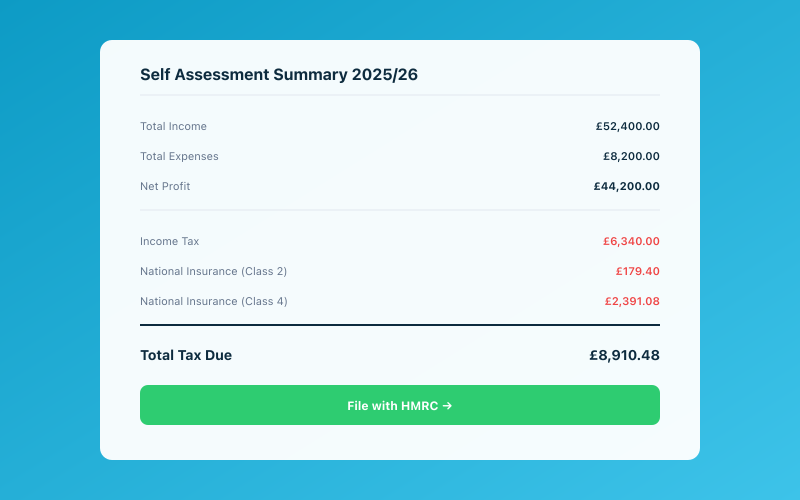 Your Accounted dashboard shows your real-time tax position
There are two methods you can use: the simplified method (flat rate) and the actual cost method. You need to pick one — you cannot mix and match between the two for different types of household expense.
It is important to note that the rules are different for employees who work from home and for self-employed people. This guide focuses on the self-employed rules for the 2025/26 tax year.
Method 1: The Simplified Method (Flat Rate)
The simplified method is by far the easiest way to claim. HMRC sets flat rates based on the number of hours you work from home each month. You do not need to keep receipts for household bills or calculate proportions.
The Rates for 2025/26
| Hours worked from home per month | Flat rate per month | |---|---| | 25 to 50 hours | £10 | | 51 to 100 hours | £18 | | 101 or more hours | £26 |
If you work from home for fewer than 25 hours per month, you cannot use the simplified method (and realistically, your claim under the actual cost method would be very small).
How It Works in Practice
If you work from home full-time — say 40 hours per week, roughly 160 hours per month — you would claim the top rate of £26 per month, which gives you £312 per year as a deductible business expense.
That works out to roughly £6 per week, which is where the commonly quoted "£6 per week" figure comes from.
The big advantages of this method are:
- No receipts required — You do not need to keep gas bills, electricity bills, council tax statements, or broadband bills to support the claim.
- No calculations — You do not need to work out floor areas or proportions.
- Easy to record — Just note your working hours and claim the flat rate.
The disadvantage is that the flat rates are quite conservative. If your actual household costs are high, you might be leaving money on the table.
What the Simplified Method Does NOT Cover
The flat rate covers your basic household running costs: heating, lighting, electricity, and metered water. It does not cover:
- Business phone calls — Claim the actual cost of business calls separately.
- Business broadband — If you use broadband for business and personal use, you can claim a reasonable proportion separately.
- Mortgage interest or rent — Not included in the simplified method. However, see the note below about claiming rent/mortgage under the actual cost method and the potential capital gains tax implications.
Method 2: The Actual Cost Method
The actual cost method lets you claim a proportion of your real household running costs. This proportion should reflect how much of your home you use for business and for how long.
Which Costs Can You Claim?
Under the actual cost method, you can claim a reasonable share of:
- Gas and electricity
- Council tax
- Water rates (metered water only, in proportion)
- Home insurance
- Broadband and telephone (business proportion)
- Rent (if you rent your home)
- Mortgage interest (but read the CGT warning below)
- Repairs and maintenance to the home (general repairs, not improvements)
You cannot claim for:
- Food and drink
- Mortgage capital repayments (only the interest portion)
- Home improvements (as opposed to repairs)
- Costs that are entirely personal
How to Calculate the Proportion
There is no single HMRC-approved formula. The most common approach is to calculate the proportion based on:
- Rooms used — If you use one room out of four for business, 25% of your costs could be claimed.
- Time used — If you use that room for business for 8 hours out of 24, that is one-third of the day.
- Combining both — 25% of space multiplied by one-third of time = about 8.3% of total costs.
HMRC expects the proportion to be "reasonable." They do not prescribe a specific formula, but they may challenge a proportion they consider excessive.
A Worked Example
Sarah is a self-employed freelance writer. She rents a two-bedroom flat for £1,000 per month and uses the spare bedroom exclusively as her office. Her annual household costs are:
- Rent: £12,000
- Council tax: £1,800
- Gas and electricity: £2,400
- Broadband: £480
- Home insurance: £300
- Total: £16,980
She uses one room out of four main rooms (living room, kitchen, bedroom, office) exclusively for business. That is 25% of her home.
25% of £16,980 = £4,245 per year.
Compare that to the simplified method, which would give her £312 per year. The actual cost method is significantly better in this case.
However, she needs to keep all her bills and records to support the claim.
The Capital Gains Tax Warning
If you own your home and claim a proportion of your mortgage interest or rent as a business expense, you could potentially create a capital gains tax liability when you sell. The part of the property used exclusively for business may not qualify for Private Residence Relief (which normally makes your home tax-free when you sell).
In practice, this risk is reduced if:
- The room is also used for personal purposes (not exclusively business)
- You do not make structural alterations to create a distinct business space
Many accountants advise against claiming mortgage interest under the actual cost method for this reason and suggest using the simplified method instead, or claiming other household costs but excluding mortgage interest. This is something worth discussing with an accountant if you own your home.
What About Employees Working from Home?
If you are an employee rather than self-employed, the rules are different and generally less generous since April 2022. The temporary COVID-era relief (which allowed employees to claim £6 per week without evidence) ended after the 2021/22 tax year.
For 2025/26, employees can only claim tax relief for working from home if:
- Their employer requires them to work from home (not just allows it)
- They have no choice but to work from home (there is no office available to them)
- Their employer does not already reimburse their costs
If you qualify, your employer can pay you up to £6 per week (or £26 per month) tax-free. If they do not, you can claim the relief through HMRC. But the bar for qualifying is higher than it was during the pandemic.
How to Claim on Your Self Assessment Return
If you are self-employed, you claim working from home expenses on your Self Assessment tax return. The claim goes in the self-employment pages (SA103 or SA103F).
For the Simplified Method
Enter the total flat rate amount for the year in the "other expenses" box. HMRC may ask you to confirm the hours you worked from home, so keep a simple log.
For the Actual Cost Method
Enter the total of all allowable household expenses proportioned for business use. Keep all supporting bills and your calculation of the business proportion in your records for at least five years.
How Penny Helps with Home Office Claims
When you use Accounted, Penny — our AI bookkeeper — can automatically suggest working from home expenses based on your work pattern. If you tell Penny you work from home, she will prompt you at year-end to claim the flat rate deduction and include it in your tax calculations.
For those using the actual cost method, you can upload or photograph your household bills, and Penny will help you track the totals throughout the year so you are not scrambling to find twelve months of bills in January.
Make Sure You Claim What You Are Owed
Many self-employed people either forget to claim working from home expenses entirely or underestimate what they can claim. Whether you go for the simple £6 per week flat rate or the more detailed actual cost method, this is legitimate money back in your pocket.
Start your free trial of Accounted today and let Penny make sure you never miss an allowable expense — including your home office costs.
Related Reading
- Director's Loan Account: Tax Rules Every Director Must Know
- Tax Year End Pension Deadline: Why Contributing Before 5 April Saves You Money
Start your free trial and let Penny handle your bookkeeping automatically.
Penny, your AI bookkeeper, tracks your tax position in real time and flags opportunities to reduce your bill. Meet Penny →
Tax & Compliance Specialists
Our tax specialists have decades of combined experience in UK sole trader and small business taxation, MTD compliance, and HMRC submissions. All content is reviewed against current HMRC guidance before publication and updated quarterly to reflect legislative changes.
Ready to try Accounted?
Join UK sole traders who are simplifying their bookkeeping and tax.
Start your 14-day free trial