Venture Capital Trusts (VCTs) — Tax-Efficient Investing
Venture Capital Trusts — VCTs — sit in an interesting middle ground in the world of tax-efficient investing. They offer meaningful tax reliefs, professional portfolio management, and diversification across multiple small companies, but without the hands-on involvement (and concentrated risk) of investing directly through the Enterprise Investment Scheme or Seed Enterprise Investment Scheme.
If EIS and SEIS are like backing individual horses at the races, VCTs are more like buying a share in the whole stable. You still benefit from the potential upside of small, growing companies, but your risk is spread across a portfolio rather than concentrated in a single bet.
In this guide, we'll explain how VCTs work in the 2025/26 tax year, the tax benefits they offer, and how to decide whether they deserve a place in your investment portfolio.
What Is a Venture Capital Trust?
A VCT is a company listed on the London Stock Exchange that invests in small, unquoted (or AIM-listed) trading companies. VCTs are structured as closed-ended investment companies, meaning they have a fixed number of shares in issue (though they can raise new capital through further share offers).
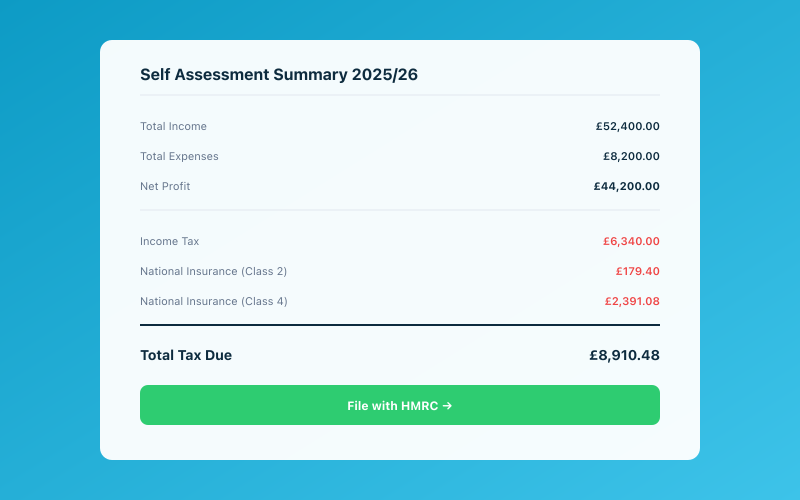 Your Accounted dashboard shows your real-time tax position
When you invest in a VCT, you're buying shares in the trust itself, and the trust's fund managers decide which underlying companies to invest in. This is fundamentally different from EIS and SEIS, where you invest directly in individual companies.
VCT managers typically build portfolios of 30 to 80 or more companies, providing natural diversification. Many VCTs specialise in particular sectors — technology, healthcare, consumer businesses — while others take a more generalist approach.
The Tax Reliefs
VCTs offer three key tax benefits. Let's look at each in detail.
1. Income Tax Relief — 30%
When you subscribe for new VCT shares (as opposed to buying them on the secondary market), you receive income tax relief of 30% on investments up to £200,000 per tax year. That's a maximum tax reduction of £60,000.
Example: You invest £50,000 in a new VCT share offer. Your income tax bill is reduced by £15,000. The effective cost of your £50,000 investment is therefore £35,000.
Unlike EIS and SEIS, you cannot carry back VCT investments to the previous tax year — the relief is only available in the year you make the investment.
To keep the relief, you must hold the VCT shares for at least five years (not three, as with EIS and SEIS). If you sell within five years, the income tax relief is clawed back.
2. Tax-Free Dividends
All dividends received from VCT shares are completely free from income tax. This is a significant benefit, especially for higher rate (40%) and additional rate (45%) taxpayers who would otherwise pay substantial tax on dividend income.
Many VCTs have a stated objective of paying regular dividends — often targeting 5% to 7% per year — funded by the profits (and sometimes return of capital) from their underlying investments. These dividends are entirely tax-free, regardless of how much you receive.
This benefit applies to all VCT shares you hold, not just newly subscribed ones. So even if you buy VCT shares on the secondary market (without income tax relief), the dividends are still tax-free.
3. Capital Gains Tax Exemption
Any gains you make when you sell your VCT shares are completely free from CGT. Again, this applies to all VCT shares, whether subscribed for new or purchased on the secondary market.
However, the flip side is that losses on VCT shares cannot be offset against other gains. This is an important distinction from EIS and SEIS, where loss relief is available.
How VCTs Compare to EIS and SEIS
Understanding the differences helps you decide which scheme (or combination) suits you best.
| Feature | VCTs | EIS | SEIS | |---|---|---|---| | Income tax relief | 30% | 30% | 50% | | Maximum annual investment for relief | £200,000 | £1,000,000 | £200,000 | | Minimum holding period | 5 years | 3 years | 3 years | | Tax-free dividends | Yes | N/A (shares typically don't pay dividends) | N/A | | CGT exemption on disposal | Yes | Yes (after 3 years) | Yes (after 3 years) | | Loss relief | No | Yes | Yes | | CGT deferral | No | Yes | 50% reinvestment relief | | Diversification | Built-in (portfolio) | Individual company | Individual company | | Carry back to previous year | No | Yes | Yes | | Liquidity | Listed (but limited) | Very limited | Very limited |
The key advantages of VCTs over EIS and SEIS are the built-in diversification, professional management, and tax-free dividends. The main disadvantages are the lack of loss relief, the longer holding period, and the absence of CGT deferral.
For more on EIS, see our Enterprise Investment Scheme guide. For SEIS, see our Seed Enterprise Investment Scheme guide.
Types of VCT
Not all VCTs are created equal. They broadly fall into two categories:
Generalist VCTs
These invest across a range of sectors and company stages (within the qualifying rules). They tend to build large, diversified portfolios and aim for a balance of capital growth and dividend income. Most of the largest and longest-established VCTs fall into this category.
Specialist VCTs
Some VCTs focus on specific sectors — such as technology, healthcare, or renewable energy — or specific investment styles. These can offer higher growth potential if the sector performs well, but they carry more concentrated sector risk.
AIM VCTs
A smaller number of VCTs invest primarily in companies listed on AIM (the Alternative Investment Market). These shares are more liquid than typical VCT investments in unquoted companies, which can make the portfolio easier to manage, but the VCT rules limit how much of the portfolio can be in AIM-listed stocks.
The Risks
While VCTs offer attractive tax reliefs, they come with genuine risks that you need to understand before investing.
Underlying Company Risk
VCTs invest in small, growing companies. Many of these will fail. A well-managed VCT mitigates this through diversification — if a portfolio of 50 companies includes 10 failures but also 5 big successes, the overall result can still be positive. But there's no guarantee.
Liquidity Risk
Although VCT shares are listed on the London Stock Exchange, the market for them is often thin. The spread between buying and selling prices can be wide, and it's not always easy to sell shares quickly at a fair price. Many VCTs operate share buyback schemes (typically at a 5% to 10% discount to net asset value) to provide some liquidity, but these are discretionary and not guaranteed.
Share Price Discount
VCT shares often trade at a discount to their net asset value (NAV). This means the market price of your shares might be lower than the value of the underlying investments. While the 30% income tax relief more than offsets a typical discount when you first invest, it can be frustrating when you come to sell.
Fees
VCT management fees are typically higher than mainstream investment funds. Annual management charges of 2% to 2.5% are common, and some VCTs also charge performance fees. Over time, these fees eat into your returns, so it's important to factor them in when comparing VCTs.
Who Should Consider VCTs?
VCTs tend to work best for:
- Higher rate and additional rate taxpayers who benefit most from the 30% income tax relief and tax-free dividends.
- Investors seeking regular tax-free income — the dividend stream from a VCT can be attractive for those approaching or in retirement.
- People who want exposure to small companies without the hassle of picking individual investments.
- Investors who've already maximised their ISA (£20,000) and pension allowances and are looking for additional tax-efficient options.
- Those comfortable with a five-year minimum holding period and limited liquidity.
If you're self-employed with variable income, VCTs can be a useful tool in years when your profits are higher than usual. The 30% income tax relief immediately reduces your tax bill, and the ongoing tax-free dividends provide a welcome income stream during quieter periods. Just make sure you've covered your tax liabilities and essential expenses before locking money into a VCT.
How to Invest in VCTs
New Share Offers
VCTs typically raise new capital through annual share offers, often launched between October and March to coincide with the end of the tax year. This is the only way to get the 30% income tax relief — you must subscribe for new shares, not buy existing ones on the secondary market.
Most VCT offers are arranged through financial advisers or investment platforms. There's usually a minimum subscription (often £3,000 to £5,000), and popular offers can close early due to high demand.
Secondary Market
You can buy existing VCT shares on the London Stock Exchange through a stockbroker, but you won't get the 30% income tax relief. You will still benefit from tax-free dividends and CGT exemption. This can sometimes be attractive if shares are available at a large discount to NAV.
Timing
With the tax year ending on 5 April, many investors make VCT subscriptions in the first few months of the calendar year to secure their income tax relief before the deadline. Don't leave it to the last minute — popular offers fill up, and processing times mean you need to act well before 5 April.
Fitting VCTs into Your Tax Plan
VCTs work best as part of a broader tax planning strategy rather than in isolation. A sensible approach might be:
- Max out your pension — the tax relief on pension contributions is the most powerful tax break available, with the annual allowance at £60,000 in 2025/26.
- Fill your ISA — £20,000 per year of tax-free growth with full liquidity.
- Consider VCTs for additional tax-efficient investing, particularly if you're a higher rate taxpayer looking for tax-free dividend income.
Keep track of your overall financial position throughout the year. Accounted makes it straightforward for sole traders to monitor their income and tax liability in real time, so you can see when a strong quarter creates an opportunity to invest in VCTs or other tax-efficient vehicles before the tax year end.
Record-Keeping
When you invest in a VCT, keep records of:
- The date and amount of your subscription
- Your VCT5 certificate (issued by the VCT confirming your investment qualifies)
- Any dividends received
- The five-year holding period end date
Claim the income tax relief on your Self Assessment tax return, and declare any disposals when you eventually sell. The dividends don't need to be reported (as they're tax-free), but keeping a record for your own financial planning is sensible.
Accounted helps UK sole traders stay on top of their bookkeeping and tax. Start your free 30-day trial at getaccounted.co.uk
Related reading:
- Enterprise Investment Scheme (EIS) — Tax Relief Guide
- Seed Enterprise Investment Scheme (SEIS) — Complete Guide
- Tax-Efficient Investments for Self-Employed People
Related Reading
Start your free trial and let Penny handle your bookkeeping automatically.
Penny, your AI bookkeeper, tracks your tax position in real time and flags opportunities to reduce your bill. Meet Penny →
Tax & Compliance Specialists
Our tax specialists have decades of combined experience in UK sole trader and small business taxation, MTD compliance, and HMRC submissions. All content is reviewed against current HMRC guidance before publication and updated quarterly to reflect legislative changes.
Ready to try Accounted?
Join UK sole traders who are simplifying their bookkeeping and tax.
Start your 14-day free trial