Shared Parental Leave When One Parent Is Self-Employed
Shared Parental Leave (SPL) was introduced to give parents more flexibility in how they share time off work after having or adopting a child. The idea is straightforward: instead of the mother taking all the maternity leave and the father or partner getting a couple of weeks, parents can divide the leave between them in a way that works for their family.
But when one parent is self-employed, the picture gets considerably more complicated. The SPL system was designed primarily for employed parents, and the rules don't always translate neatly to self-employment. If you or your partner is self-employed and you're trying to work out your options, this guide will help you understand what you're entitled to, what you're not, and how to make the most of what's available.
How Shared Parental Leave Works — The Basics
Shared Parental Leave allows eligible parents to share up to 50 weeks of leave and up to 37 weeks of pay between them. The mother must take at least the first two weeks after birth as compulsory maternity leave (four weeks if she works in a factory), but after that, the remaining leave and pay can be split.
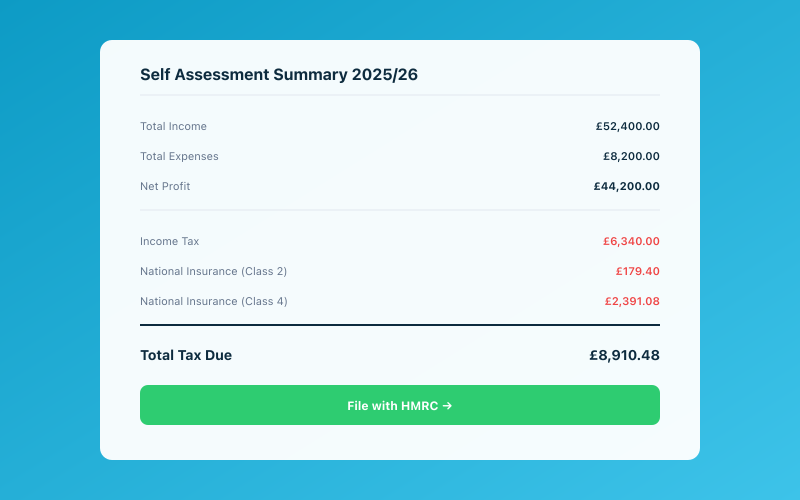 Your Accounted dashboard shows your real-time tax position
The leave can be taken in blocks, with periods of work in between, and both parents can be off at the same time if they choose. It's designed to be flexible — parents can take turns, overlap, or alternate periods of leave.
However — and this is the crucial point for our purposes — Shared Parental Leave is an employment right. It's available to employees. Self-employed people don't have the right to take SPL, because they're not employees. There's no employer to take leave from.
This doesn't mean self-employed parents are left out entirely. But the way the system works when one parent is self-employed is different from when both parents are employed.
Scenario 1: The Mother Is Employed, the Partner Is Self-Employed
This is probably the most common mixed scenario. The mother is employed and entitled to maternity leave and Statutory Maternity Pay (SMP). Her self-employed partner wants to share the time off.
Can the self-employed partner take SPL? No. SPL is only available to employees. The self-employed partner cannot take Shared Parental Leave because they don't have an employer to take leave from.
Can the self-employed partner receive ShPP (Shared Parental Pay)? No. Statutory Shared Parental Pay is paid by an employer and is only available to employees who meet the eligibility criteria.
What can the self-employed partner do? The self-employed partner can simply choose to stop working (or reduce their workload) when the baby arrives. Since they're self-employed, they have the freedom to decide their own schedule — but they won't receive any government pay for this period.
Does the mother's entitlement change? Here's where it gets interesting. For the mother to qualify for SPL and ShPP, her partner needs to meet certain eligibility criteria. The partner must have been employed or self-employed for at least 26 of the 66 weeks before the baby's due date, and must have earned at least £30 in total in any 13 of those weeks.
If the self-employed partner meets these criteria — which most will, since it requires very modest earnings over a relatively short period — the employed mother can access SPL. She can then convert her remaining maternity leave into SPL and either take it herself in a more flexible pattern or, if her employer agrees, share it.
But critically, only the employed mother can actually take the SPL and receive the pay. The self-employed partner doesn't receive any payment from the system.
Scenario 2: The Mother Is Self-Employed, the Partner Is Employed
In this scenario, the self-employed mother is entitled to Maternity Allowance (MA) rather than SMP, and her employed partner may want to take some of the leave.
Can the employed partner take SPL? Potentially, yes — but it depends on whether the mother's Maternity Allowance can be "converted" to enable SPL for the partner. The rules here are specific: the employed partner can take SPL and receive ShPP if the mother curtails her Maternity Allowance period.
The employed partner must meet the standard SPL eligibility criteria: they must have been employed continuously for at least 26 weeks by the 15th week before the due date, they must still be employed at the start of the SPL period, and they must earn at least £123 per week.
Can the self-employed mother take SPL? No. The self-employed mother receives Maternity Allowance, not SMP, and she cannot take SPL because she's not an employee. She can curtail (end early) her MA to allow her employed partner to take SPL, but she can't take SPL herself.
What happens to the mother's Maternity Allowance? The self-employed mother can choose to end her Maternity Allowance early. Once she curtails her MA, the employed partner can take SPL for the remaining weeks (up to the combined total of 50 weeks minus what the mother has already taken). The partner would receive ShPP from their employer for the remaining pay weeks.
This arrangement can work well in practice. For example, the self-employed mother might take 20 weeks of Maternity Allowance, then curtail her claim and return to her business, while the employed partner takes the remaining weeks as SPL. The partner receives ShPP from their employer, and the mother resumes her self-employed income.
For more detail on how Maternity Allowance works, including the claim process and eligibility, our guide to maternity allowance and tax when having a baby covers everything you need to know.
Scenario 3: Both Parents Are Self-Employed
This is the scenario with the fewest options under the current system. When both parents are self-employed:
Neither parent can take SPL, because neither is an employee.
The birth mother can claim Maternity Allowance (if she meets the eligibility criteria — 26 weeks of self-employment in the 66 weeks before the due date, with at least 13 weeks of Class 2 NI contributions).
The partner has no entitlement to parental leave pay under the statutory system. The self-employed partner can take time off (by choosing not to work), but there's no government payment to replace their income during that period.
Paternity pay is not available. Statutory Paternity Pay, like SPL, is an employment right. Self-employed partners are not entitled to it.
This gap in the system is widely acknowledged as unfair, and there have been calls for reform. But as things stand, self-employed couples need to plan for this financially — essentially self-funding any time the non-birth parent takes off.
Paternity Leave for Self-Employed Partners
Since we've touched on it, let's be clear about paternity leave and pay. Statutory Paternity Leave (SPL — confusingly, the same abbreviation) and Statutory Paternity Pay (SPP) are employment rights. Self-employed parents are not entitled to either.
An employed partner can take up to two weeks of paternity leave, paid at £184.03 per week (2025/26 rate). A self-employed partner gets nothing from the statutory system.
Some self-employed parents build up a financial buffer before the baby arrives to cover a self-funded "paternity leave." This is the most practical approach — essentially saving enough to cover your household expenses for the period you plan to take off, plus any tax liability that will come due later.
Financial Planning for Mixed Households
When one parent is self-employed and the other is employed, financial planning around parental leave becomes especially important. Here are some practical steps:
Calculate your combined income during leave. Work out what the employed parent will receive (SMP/ShPP) and what the self-employed parent will receive (MA, if applicable, or nothing). Add in any enhanced maternity/paternity pay from the employer. This is your baseline income during leave.
Build a financial buffer. If there's a gap between your baseline income and your essential expenses, start saving for it before the baby arrives. Even a modest buffer takes the pressure off during those first months.
Review your business expenses. During your leave period, can you reduce business costs? Cancel subscriptions you won't use, pause marketing spend, and minimise overheads. Every pound saved is a pound you don't need to earn. Using Accounted, you can see all your subscriptions and recurring costs at a glance, making it easy to identify what can be paused. Penny tracks everything, so you won't forget to reinstate things when you're back.
Invoice before the baby arrives. If you have completed work that hasn't been invoiced, get those invoices out. Chase outstanding payments. Having cash in hand before the baby arrives is much better than chasing debts with a newborn.
Understand your tax position. A period of lower income affects your tax calculation. If you've been making payments on account based on a higher income year, you might be able to reduce them. Conversely, if you return to work and have a strong second half of the year, be prepared for a higher tax bill.
For help understanding how National Insurance works during breaks from self-employment, our guide on National Insurance for sole traders is worth reading.
National Insurance During Parental Leave
National Insurance is a common concern for self-employed parents taking time off.
If you're receiving Maternity Allowance, you automatically receive NI credits, which count towards your State Pension. You don't need to do anything — the credits are applied when you claim MA.
If you're a self-employed partner taking unpaid time off, you won't automatically receive NI credits. This means a gap could appear in your NI record, which might affect your State Pension entitlement in the long term. You can make voluntary Class 2 NI contributions (currently £3.45 per week) to fill the gap, which is usually very cost-effective.
If you're caring for a child under 12, you may be eligible for National Insurance credits through the Specified Adult Childcare Credit — but this applies to people who aren't already getting NI credits through other means (such as working or receiving benefits). It's primarily designed for grandparents and other carers, but it's worth checking your eligibility. Our guide on State Pension and National Insurance gaps explains how to check your record and fill any gaps.
Keeping Your Business Alive During Leave
Whether you're the birth parent or the partner, taking time off from self-employment doesn't have to mean your business goes silent. Some practical approaches:
Set up an autoresponder. Let people who email you know that you're on parental leave and when you expect to be available again. This is professional and expected.
Schedule social media in advance. A few hours of batch-creating content before the baby arrives can keep your social media presence active during your leave.
Automate your bookkeeping. Accounted and Penny can keep your financial records ticking over even when you're not actively managing them. Bank transactions are categorised, income is tracked, and your records stay up to date with minimal input from you.
Brief a trusted colleague or subcontractor. If you have a colleague who can handle urgent enquiries or take on small pieces of work in your absence, it keeps your clients happy and maintains the relationship.
Communicate with clients early. Give your clients plenty of notice about your leave. Most will be understanding, and advanced notice allows them to plan around your absence.
The Case for Reform
It's worth acknowledging that the current system doesn't serve self-employed parents well. Shared Parental Leave was a step forward for employed parents, but it left self-employed parents largely out of the picture. The lack of paternity pay for self-employed partners, the inability to share leave when both parents are self-employed, and the generally lower level of support compared to employees are all areas where the system falls short.
Various groups have called for reforms, including extending SPL rights to self-employed parents and introducing a form of self-employed paternity pay. Whether and when these changes will happen is uncertain, but it's important to be aware that the current system has limitations — and to plan accordingly.
Making the Best of It
Despite the gaps in the system, thousands of self-employed parents navigate parental leave successfully every year. The key is understanding your entitlements clearly, planning your finances in advance, and being realistic about what the early months with a new baby will look like.
Self-employment offers something that no statutory scheme can: genuine flexibility. You can choose when to work, how much to work, and how to structure your time. That flexibility is incredibly valuable during the transition to parenthood, even if it doesn't come with a pay cheque attached.
And when you're ready to ramp back up — whether that's after six weeks, six months, or longer — your business is waiting for you. The clients, the skills, and the independence that drew you to self-employment in the first place are all still there.
Accounted helps UK sole traders stay on top of their bookkeeping and tax. Start your free 30-day trial at getaccounted.co.uk
Related reading:
- Maternity Allowance and Tax When Having a Baby
- National Insurance for Sole Traders
- State Pension and National Insurance Gaps
Related Reading
- Maternity Allowance for Self-Employed Women — Complete Guide
- Running a UK Business From Spain — Tax Residency Rules
Start your free trial and let Penny handle your bookkeeping automatically.
Penny, your AI bookkeeper, tracks your tax position in real time and flags opportunities to reduce your bill. Meet Penny →
Tax & Compliance Specialists
Our tax specialists have decades of combined experience in UK sole trader and small business taxation, MTD compliance, and HMRC submissions. All content is reviewed against current HMRC guidance before publication and updated quarterly to reflect legislative changes.
Ready to try Accounted?
Join UK sole traders who are simplifying their bookkeeping and tax.
Start your 14-day free trial