Maternity Allowance for Self-Employed Women — Complete Guide
If you're self-employed and expecting a baby, one of the first financial questions on your mind is likely: what maternity pay am I entitled to? Unlike employed women who may receive Statutory Maternity Pay (SMP) through their employer, self-employed women need to claim Maternity Allowance (MA) directly from the government. The good news is that most self-employed women do qualify. The less good news is that the process isn't always straightforward.
This guide covers everything you need to know — from eligibility and how to claim, to what happens to your National Insurance and how to keep your business ticking over while you're on maternity leave.
What Is Maternity Allowance?
Maternity Allowance is a weekly benefit paid by the Department for Work and Pensions (DWP) to pregnant women and new mothers who don't qualify for Statutory Maternity Pay. This typically includes self-employed women, women who've recently stopped working, and women who don't earn enough to qualify for SMP.
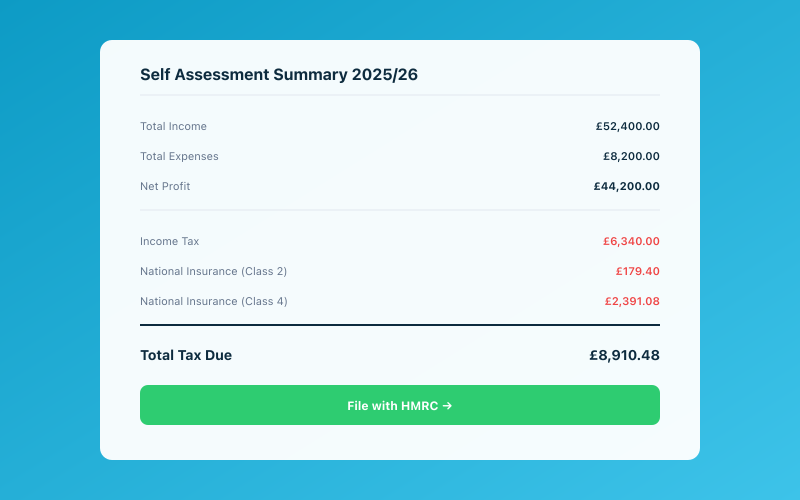 Your Accounted dashboard shows your real-time tax position
MA is paid for up to 39 weeks, and you can start claiming it from 11 weeks before your expected due date. Unlike SMP, which is paid by your employer, MA is paid directly by the government.
It's important to understand that Maternity Allowance is a separate benefit from Universal Credit, Child Benefit, or any other support you might receive. You can claim MA alongside these other benefits, though the amounts may interact.
Are You Eligible?
To qualify for Maternity Allowance as a self-employed woman, you need to meet the following conditions:
You've been registered as self-employed for at least 26 weeks in the 66 weeks before your baby's due date. The 26 weeks don't need to be consecutive — they just need to fall within that 66-week window (known as the "test period").
You've paid Class 2 National Insurance contributions for at least 13 of those 66 weeks. This is the key requirement for self-employed claimants. If you're registered as self-employed and your profits are above the small profits threshold, you'll be paying Class 2 NI as part of your Self Assessment. If your profits are below the threshold, you can choose to pay Class 2 NI voluntarily specifically to maintain your eligibility for benefits like MA.
The 13 weeks of Class 2 NI contributions don't need to be the most recent 13 weeks — they just need to fall within the test period. If you're not sure whether you've paid enough, HMRC can check your NI record for you.
You're at least 26 weeks pregnant when you start your claim. You can claim from the 26th week of pregnancy, and payments can start from the 11th week before your due date. You can choose your start date within this window.
There's no minimum earnings requirement for self-employed MA claimants — unlike employed women, who need to earn at least £123 per week to qualify for SMP. As long as you've paid your Class 2 NI, you're eligible regardless of how much your business earns.
How Much Will You Receive?
The standard rate of Maternity Allowance for self-employed women is £184.03 per week (2025/26 rate), paid for up to 39 weeks. That works out to approximately £7,177 over the full claim period.
Unlike SMP, which starts at 90% of your average earnings for the first six weeks, MA is paid at a flat rate for the entire 39 weeks. If your average weekly earnings are less than £184.03, you'll receive 90% of your average earnings instead.
For most self-employed women, the flat rate applies. It's not a fortune, but it provides a baseline income during the first months of your baby's life.
MA is not taxable — you don't need to include it in your Self Assessment tax return, and it doesn't count towards your income tax calculation. This is a genuinely helpful feature, as it means you keep the full amount without any deductions.
How to Claim
You can start your claim from 26 weeks of pregnancy (the beginning of the 15th week before your due date). Here's what you need to do:
1. Get the MATB1 form. Your midwife or doctor will give you a MATB1 certificate, which confirms your due date. You'll need this to make your claim. It's usually issued around the 20th week of pregnancy.
2. Complete the MA1 claim form. This is available on the GOV.UK website or from your local Jobcentre Plus. You can fill it in online and post it, or do it entirely by post. There isn't currently an option to submit it fully online, which feels a bit outdated, but that's the process.
3. Provide evidence of your self-employment. As a self-employed claimant, you'll need to provide your Self Assessment tax reference (UTR number) and evidence that you've been paying Class 2 NI. If you've recently registered as self-employed, you should also include any evidence of trading, such as invoices or business records.
4. Send your MATB1 certificate with the claim form. The DWP will return it to you after processing.
5. Wait for a decision. Processing typically takes a few weeks. The DWP will write to you confirming whether your claim has been accepted and when payments will start.
The process is not complicated, but it does require some planning. Make sure you've got your NI contributions in order well before you need to claim — if there's a gap, you may be able to make voluntary Class 2 contributions to fill it, but this takes time. For more on National Insurance for sole traders, our guide to National Insurance for sole traders covers the different classes and how they work.
Choosing Your Start Date
You have some flexibility over when your MA payments begin. The earliest you can start is 11 weeks before your due date, and the latest is the day after you give birth (your MA would then be backdated if you hadn't already claimed).
There are a few things to consider when choosing your start date:
If you plan to work until close to your due date, you might want to start your MA later to maximise the weeks you receive payments after the birth. Remember, you get 39 weeks of MA regardless of when you start — so starting later means the payments extend further into your baby's first year.
If your business income is irregular, starting MA earlier gives you financial security during the final weeks of pregnancy, when you might not be able to work as much.
If you give birth early, your MA will start automatically from the day after the birth, regardless of your planned start date.
You can also stop and restart your MA if you want to do some work during the claim period (within the rules — see below).
Working During Your MA Claim
Self-employed women receiving Maternity Allowance are allowed up to 10 "Keeping in Touch" (KIT) days during their claim period. On these days, you can do self-employed work without it affecting your MA payments.
The 10 days are flexible — you can use them all at once or spread them out. They're useful for things like meeting a key client, fulfilling an important order, or attending a business event that you don't want to miss.
If you work more than 10 days during your MA claim period, your MA will be reduced. Specifically, you'll lose a week's MA for each week in which you work (beyond the 10 KIT days). "Work" includes any day on which you do work for your business, regardless of how long you spend on it.
This is worth planning carefully. If you're running an online business that ticks along with minimal input — a few customer service emails here, a social media post there — it's a grey area. HMRC's definition of "work" is broad, and if you're consistently engaging with your business, you could be considered to be working. Using a tool like Accounted can help here, because Penny handles a lot of the bookkeeping automatically — categorising transactions, tracking income, and organising your records without requiring you to actively "work" on your finances.
National Insurance During Maternity Leave
While you're receiving Maternity Allowance, you'll automatically receive National Insurance credits. These credits count towards your State Pension entitlement, ensuring that your time on maternity leave doesn't create a gap in your NI record.
You don't need to do anything to claim these credits — they're applied automatically when you're receiving MA. This is important, because gaps in your NI record can affect your State Pension. For more on how NI gaps work and why they matter, our guide on State Pension and National Insurance gaps explains the impact.
If you continue to do some self-employed work alongside your MA (within the KIT days), you may still be liable for Class 2 and Class 4 NI on any profits you earn. This is calculated through your Self Assessment tax return as normal.
Planning Your Finances Before the Baby Arrives
The weeks before your due date are a good time to get your financial house in order. Here's a practical checklist:
Build a financial buffer. MA provides a baseline, but if your business income is higher than £184 per week, you'll be taking a pay cut. Try to save enough to cover the gap for at least a few months.
Invoice outstanding work. If you have any completed work that hasn't been invoiced, get those invoices out before the baby arrives. Chasing payments is harder when you're sleep-deprived.
Set up automated systems. The less manual work your business requires while you're on leave, the better. Automated invoicing, scheduled social media posts, and auto-replies on your email can keep things ticking over.
Review your expenses. Cut any business subscriptions or costs you won't need during your leave period. There's no point paying for a co-working space membership if you won't be using it for six months.
Talk to your clients. Let your regular clients know your plans. They'll appreciate the advance notice, and it gives them time to find cover or adjust their timelines. Many clients will be happy to wait for you — if you're good at what you do, they'd rather pause than find someone new.
Get your bookkeeping up to date. You really don't want to come back from maternity leave to a backlog of unsorted receipts and unreconciled bank transactions. Using Accounted means Penny keeps things organised even when you're not actively checking in, but it's still worth doing a thorough tidy-up before the baby arrives.
Returning to Work
When your MA ends (or before, if you choose), you'll return to self-employment as normal. There's no formal process for this — you simply start working again. Your self-employed registration with HMRC continues throughout your maternity leave, so there's nothing to re-register or re-activate.
If you decide during your maternity leave that you want to change the nature of your business, pivot to something new, or stop being self-employed altogether, that's fine too. You can close your self-employed registration with HMRC at any time if you decide not to continue trading.
For many women, the return to self-employment after having a baby involves adjusting their working patterns. Part-time hours, flexible scheduling, and working around childcare become the new normal. The beauty of self-employment is that you have more control over this than an employed worker — you set your own hours and choose your own clients. For ideas and practical advice on getting back into the swing of things, our first year of self-employment guide has tips that apply to restarters as well as newcomers.
Key Takeaways
Maternity Allowance for self-employed women is a valuable benefit that's often underutilised. Make sure you qualify by keeping your Class 2 NI contributions up to date, claim in good time, and plan your finances to bridge any gap between your usual income and the MA rate.
Most importantly, don't let the paperwork overwhelm you. The claim process is manageable, the rules are clear once you understand them, and the financial support — while modest — makes a real difference during those first extraordinary months of parenthood.
Accounted helps UK sole traders stay on top of their bookkeeping and tax. Start your free 30-day trial at getaccounted.co.uk
Related reading:
- Maternity Allowance and Tax When Having a Baby
- National Insurance for Sole Traders
- State Pension and National Insurance Gaps
Related Reading
- How Foster Carers Are Taxed — The Qualifying Care Relief
- Tax Year End Checklist — 15 Things to Do Before 5 April
Start your free trial and let Penny handle your bookkeeping automatically.
Penny, your AI bookkeeper, tracks your tax position in real time and flags opportunities to reduce your bill. Meet Penny →
Tax & Compliance Specialists
Our tax specialists have decades of combined experience in UK sole trader and small business taxation, MTD compliance, and HMRC submissions. All content is reviewed against current HMRC guidance before publication and updated quarterly to reflect legislative changes.
Ready to try Accounted?
Join UK sole traders who are simplifying their bookkeeping and tax.
Start your 14-day free trial