How Foster Carers Are Taxed — The Qualifying Care Relief
Foster caring is one of the most rewarding things a person can do, but when tax season comes around, many foster carers are unsure about their obligations. The good news is that HMRC offers a generous tax relief specifically for foster carers — called Qualifying Care Relief — which means a significant portion of your fostering income (and in many cases all of it) is completely free of income tax. In this guide, we will explain how the relief works, walk through the numbers for 2025/26, cover what happens if your income exceeds the threshold, and clear up some common misunderstandings.
What Is Qualifying Care Relief?
Qualifying Care Relief (QCR) is a tax exemption designed specifically for foster carers, shared lives carers, and kinship carers who are approved by a local authority or an independent fostering agency. It recognises that foster care payments are not the same as regular employment income — they are intended to cover the costs of looking after a child or young person, and the government does not want to discourage people from fostering by taxing those payments heavily.
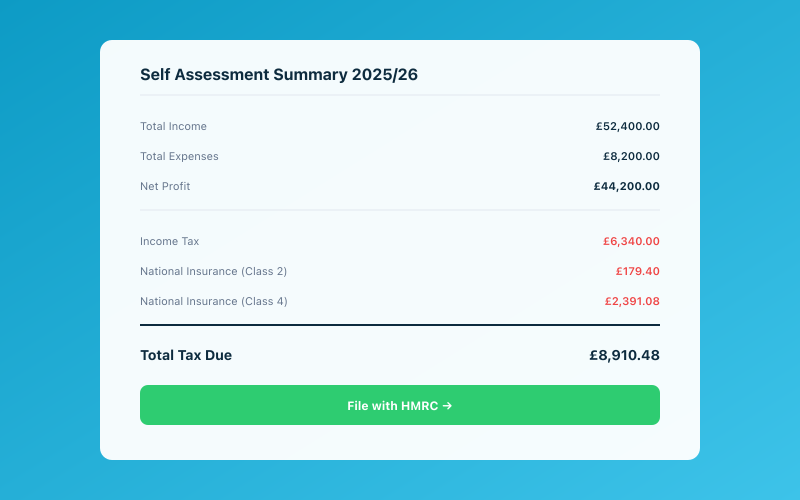 Your Accounted dashboard shows your real-time tax position
Under QCR, your fostering income is compared against a tax-free threshold. If your total foster care receipts for the year are below the threshold, you owe no income tax at all. If they exceed the threshold, you only pay tax on the excess — and even then, you have a choice about how to calculate it.
The relief applies to payments from local authorities, independent fostering agencies, and (in some cases) directly from other organisations involved in placing children. It does not apply to any other income you earn — if you also have a job or another business, that income is taxed separately under normal rules.
How the Tax-Free Threshold Works
The QCR threshold has two components:
A fixed amount per household per year. For the 2025/26 tax year, this is £18,140. Every qualifying foster carer gets this regardless of how many children they look after.
A per-child weekly amount. This varies depending on the age of the child:
- £375 per week for a child aged under 11
- £450 per week for a child aged 11 or over
These weekly amounts apply for each week (or part-week) that a child is placed with you. So if you look after two children for the full year — one aged 8 and one aged 13 — your weekly relief would be £375 + £450 = £825 per week. Over 52 weeks, that is £42,900, plus the £18,140 fixed amount, giving a total threshold of £61,040.
Here is a worked example. Sarah is a foster carer who looks after one child aged 9 for the full 2025/26 tax year. Her total foster care income from the local authority is £22,000.
Her QCR threshold is:
- Fixed amount: £18,140
- Per-child amount: £375 x 52 = £19,500
- Total threshold: £37,640
Since her income of £22,000 is well below her threshold of £37,640, she pays no income tax on her fostering income at all.
Now consider David, who looks after three children aged 14, 15, and 16 throughout the year. His total foster care income is £75,000.
His QCR threshold is:
- Fixed amount: £18,140
- Per-child amount: (£450 x 3) x 52 = £70,200
- Total threshold: £88,340
David's income of £75,000 is below his threshold of £88,340, so he also pays no income tax on his fostering income.
What If Your Income Exceeds the Threshold?
If your foster care income exceeds your QCR threshold, you have two options for calculating the taxable amount:
Option 1: Use QCR as your deduction. You subtract the QCR threshold from your total income, and pay tax on the difference. For example, if your income is £65,000 and your threshold is £55,000, you pay tax on £10,000.
Option 2: Calculate actual profit. Instead of using the QCR threshold, you work out your actual taxable profit in the normal way — total income minus actual allowable expenses. This might give a better result if your expenses are very high (for example, if you have adapted your home, bought a larger vehicle, or incurred significant costs related to caring for children with complex needs).
You should calculate both options and use whichever gives you the lower taxable amount. In practice, most foster carers find that the QCR threshold is more generous than their actual expenses, so Option 1 is usually the better choice. But it is worth checking, especially if you look after children who require expensive specialist equipment or adaptations.
It is important to note that you cannot use QCR and claim actual expenses at the same time. It is one or the other. If you choose QCR, you do not need to track or report your individual expenses for tax purposes (though keeping records is still good practice).
Do You Need to File a Self Assessment Tax Return?
This depends on your circumstances. If your foster care income is fully covered by QCR (meaning it is below the threshold), you may not need to file a Self Assessment return, provided you do not have other untaxed income that requires reporting. However, HMRC's rules on this have nuances.
If you have any other self-employment income, untaxed savings income above your allowance, capital gains to report, or income above £150,000, you will need to file regardless.
Even if you are not strictly required to file, many foster carers choose to file a return anyway. It creates a clear record with HMRC that you have claimed QCR, which can prevent any confusion or enquiries down the line. It also ensures you are paying the correct amount of Class 2 and Class 4 National Insurance, which affects your State Pension entitlement.
If you do file, you enter your foster care income and QCR claim on the self-employment pages. HMRC's online filing system has a specific section for qualifying care relief.
Using a tool like Accounted to manage your Self Assessment return makes the filing process straightforward, even if your tax situation is simple. Penny, the AI bookkeeping assistant, can guide you through the relevant sections and help ensure your QCR claim is entered correctly.
National Insurance for Foster Carers
Foster carers are treated as self-employed for National Insurance purposes. This means you may need to pay:
- Class 2 NICs at £3.45 per week if your profits (after QCR) exceed the small profits threshold
- Class 4 NICs at 6% on profits between £12,570 and £50,270, and 2% above £50,270
If your foster care income is fully covered by QCR (so your taxable profit is zero), you will not owe Class 4 NICs. However, you may still want to pay voluntary Class 2 NICs to protect your State Pension record. Each year of Class 2 contributions counts as a qualifying year for State Pension purposes.
This is an important consideration for foster carers who do not have another job that generates NI contributions. If you have gaps in your NI record, your State Pension could be reduced. The cost of voluntary Class 2 contributions is relatively small compared to the long-term pension benefit.
Shared Lives Carers and Kinship Carers
QCR is not limited to traditional foster carers. It also applies to:
Shared Lives carers (formerly adult placement carers) who provide accommodation and support to adults with learning disabilities, mental health conditions, or other needs. The same threshold structure applies — a fixed annual amount plus a weekly amount per person placed with you.
Kinship carers who are formally approved by a local authority to look after a child who is related to them. If you are receiving foster care payments through a kinship arrangement, you qualify for QCR in the same way as any other foster carer.
Staying Put carers who continue to look after a young person after they turn 18 under a Staying Put arrangement. The payments received under Staying Put are also covered by QCR.
If you are providing informal care without local authority approval and are not receiving foster care payments, QCR does not apply. Similarly, if you are a childminder or run a children's home, different tax rules apply.
Keeping Records
Even though QCR may eliminate your tax liability entirely, HMRC still expects you to keep records of your fostering income. At a minimum, you should retain:
- Records of all payments received from local authorities or fostering agencies
- Details of each child placed with you, including their age and the dates of placement
- Your QCR calculation showing the threshold versus your actual income
If you choose to calculate your actual profit instead of using QCR, you will also need records of all your expenses — household bills, food, clothing, transport, activities, and any other costs related to caring for the children.
Keeping these records digitally using an app like Accounted means they are organised, searchable, and ready if HMRC ever asks to see them. It also means your Self Assessment return can be prepared quickly when the time comes.
For further reading on managing your tax as a self-employed individual, our guide on how to calculate tax as a sole trader covers the general principles, and our guide on Self Assessment for first-time filers walks you through the process step by step.
Related Reading
Start your free trial and let Penny handle your bookkeeping automatically.
Accounted helps UK sole traders stay on top of their bookkeeping and tax. Start your free 30-day trial at getaccounted.co.uk
Penny, your AI bookkeeper, tracks your tax position in real time and flags opportunities to reduce your bill. Meet Penny →
Tax & Compliance Specialists
Our tax specialists have decades of combined experience in UK sole trader and small business taxation, MTD compliance, and HMRC submissions. All content is reviewed against current HMRC guidance before publication and updated quarterly to reflect legislative changes.
Ready to try Accounted?
Join UK sole traders who are simplifying their bookkeeping and tax.
Start your 14-day free trial