Tour Operators' Margin Scheme (TOMS) — VAT Guide
If you buy in travel services and resell them to travellers, there's a good chance you need to use the Tour Operators' Margin Scheme — or TOMS, as it's commonly known. This special VAT scheme is mandatory (not optional) for businesses that fall within its scope, and it changes how you account for VAT in some fairly fundamental ways.
TOMS can feel complicated at first glance, but the underlying logic is sensible: instead of accounting for VAT on each individual component of a holiday or travel package, you account for VAT on your overall profit margin. Let's walk through how it works.
What Is TOMS?
The Tour Operators' Margin Scheme is a special VAT accounting method for businesses that buy in and resell travel, holiday, and certain hospitality services. Under TOMS, you account for VAT on the margin — the difference between what you charge the traveller and what you pay your suppliers — rather than on the full selling price.
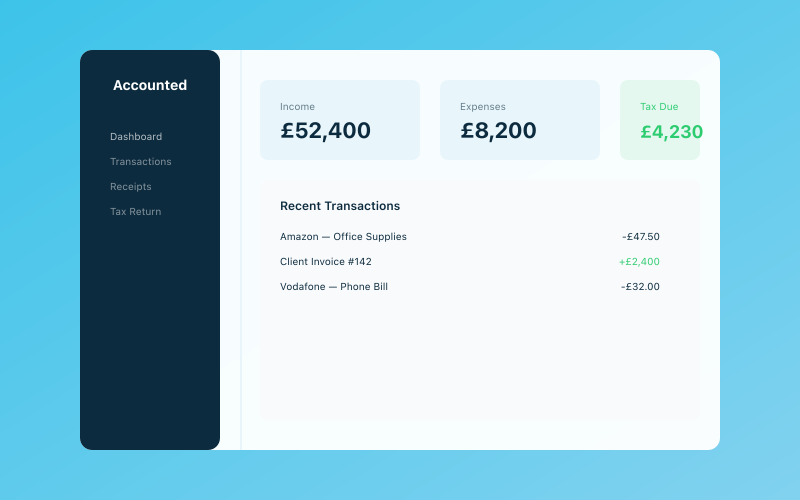 Your Accounted dashboard — income, expenses, and tax at a glance
The scheme exists because tour operators typically buy services in multiple countries (flights, hotels, transfers, excursions) and resell them as packages. Without TOMS, a UK tour operator would face a nightmare of registering for VAT in every country where they buy services. TOMS simplifies this by treating the margin as the taxable amount, subject to UK VAT.
Key Features of TOMS
- VAT is calculated on the margin (selling price minus cost of bought-in services)
- The margin is treated as VAT-inclusive, so VAT is calculated at 1/6 of the margin
- You cannot reclaim input VAT on the travel services you buy in (these are called "margin scheme supplies")
- You can still reclaim input VAT on your general business overheads (rent, marketing, office costs)
- You cannot show VAT separately on invoices for TOMS supplies
Who Must Use TOMS?
TOMS is mandatory — if your business falls within the scope, you must use it. You can't opt out. The scheme applies if you:
- Buy in travel, accommodation, or related services from third-party suppliers
- Resell those services to travellers (either as packages or individual components)
- Act in your own name (i.e., the traveller has a contract with you, not directly with the hotel or airline)
Businesses Typically Caught by TOMS
- Traditional tour operators — those selling package holidays
- Travel agents acting as principals — if you buy services and resell them (rather than acting as an agent on commission)
- Event organisers — if you buy in accommodation, transport, or venue hire and include it in an event package
- Conference organisers — similar to event organisers
- Companies arranging business travel — if you buy and resell travel services to your corporate clients
- Hospitality businesses — in some cases, if you buy in accommodation from third parties and resell it
Who Doesn't Need to Use TOMS?
- Agents acting in the supplier's name — if you sell hotel rooms on behalf of the hotel and earn a commission, you're an agent. You account for VAT on your commission, not under TOMS.
- Businesses providing their own services — if you own the hotel, drive the coach, or employ the tour guide, those are "in-house supplies," not bought-in services. In-house supplies don't go through TOMS (though they follow normal VAT rules).
- Transport-only businesses — airlines, coach companies, and train operators providing their own transport services.
The distinction between acting as a principal and acting as an agent is crucial. If you're not sure which you are, check your contracts carefully. HMRC looks at the substance of the arrangement, not just the labels.
How to Calculate VAT Under TOMS
The Basic Margin Calculation
The VAT calculation under TOMS works like this:
- Total selling price to the traveller (what they pay you)
- Minus the cost of bought-in margin scheme supplies (what you pay your suppliers for accommodation, transport, etc.)
- Equals the margin
- VAT due = margin × 1/6 (because the margin is treated as VAT-inclusive)
Example
You sell a holiday package for £1,500. Your costs are:
| Component | Cost | Type | |-----------|------|------| | Hotel (bought from third party) | £600 | Margin scheme supply | | Flights (bought from airline) | £400 | Margin scheme supply | | Airport transfers (bought in) | £50 | Margin scheme supply | | Tour guide (your own employee) | £100 | In-house supply | | Total bought-in costs | £1,050 | |
The TOMS calculation:
- Selling price: £1,500
- Minus bought-in margin scheme costs: £1,050
- Margin: £450
- VAT due: £450 × 1/6 = £75
The tour guide cost of £100 is an in-house supply and is dealt with under normal VAT rules (outside TOMS). If the guiding service is standard-rated, you'd account for VAT on the value of that element separately.
Negative Margins
If your costs exceed the selling price (you sell a holiday at a loss), the margin is negative. You don't get a VAT refund on a negative margin — you simply treat it as zero. However, you can use negative margins to offset positive margins if you use the annual calculation method.
The Annual Calculation
HMRC allows (and in practice expects) most tour operators to use an annual calculation rather than working out the margin on every individual transaction. Here's how it works:
- At the start of your financial year, estimate your expected margin percentage based on the previous year
- Use this provisional percentage to calculate VAT on your quarterly returns
- At the end of the year, calculate the actual margin based on real figures
- Make an adjustment on your final return for any difference
This smooths out seasonal variations and avoids the impracticality of calculating margins on every single booking.
In-House Supplies vs Margin Scheme Supplies
This distinction is important and often misunderstood.
Margin Scheme Supplies
Services you buy from third parties and resell to travellers. These go through the TOMS calculation. You cannot reclaim the input VAT on these purchases — the margin scheme is the alternative mechanism.
Examples: hotels booked through wholesalers, flights from airlines, car hire from rental companies, excursions from local operators.
In-House Supplies
Services you provide using your own resources — your own staff, your own vehicles, your own premises. These are dealt with under normal VAT rules, outside TOMS.
Examples: guiding services using your own guides, transport using your own coaches, accommodation in your own hotel.
If a package includes both margin scheme supplies and in-house supplies, you need to split the selling price between the two types and apply the correct VAT treatment to each.
Record-Keeping Requirements
TOMS record-keeping is more demanding than standard VAT accounting. You need to maintain:
- Details of each package or supply — what was included, the selling price, and the cost of each component
- Identification of margin scheme vs in-house supplies — clearly distinguishing which services were bought in and which were provided internally
- Purchase invoices for all bought-in services
- The annual calculation — showing provisional and actual margin percentages, and any year-end adjustment
HMRC expects you to be able to demonstrate your TOMS calculation clearly. If your records are inadequate, they may assess VAT on the full selling price rather than just the margin — a much more expensive outcome.
Keeping on top of TOMS record-keeping is where good software really earns its keep. If you're tracking costs and revenues in Accounted, categorising your bought-in costs separately from in-house costs makes the annual calculation much more straightforward.
TOMS and Invoicing
A key restriction under TOMS: you cannot show VAT separately on invoices for margin scheme supplies. Your customer receives an invoice showing the total price only, with a note that the supply is made under the Tour Operators' Margin Scheme.
This means your business customers cannot reclaim VAT on margin scheme supplies. If a corporate client needs to reclaim VAT on travel, you may need to structure the arrangement differently — for example, by acting as an agent rather than a principal, or by providing in-house services where possible.
TOMS Post-Brexit
Since the UK left the EU, TOMS continues to operate in the UK under retained EU law, with some modifications. The most significant practical change is that the scheme now applies to supplies made in the UK by UK-established businesses.
If you sell holidays or travel services that include components supplied in the EU, those bought-in costs still count as margin scheme costs. The TOMS calculation works the same way — you just need to be aware that your EU suppliers may now be charging you local VAT (which you can't reclaim under TOMS but which forms part of your cost base).
Common Mistakes
Not Recognising You're Within TOMS
Some businesses don't realise TOMS applies to them — particularly event organisers and conference companies that buy in accommodation and travel as part of a wider package. If you're buying and reselling travel services, check whether TOMS applies.
Trying to Reclaim Input VAT on Bought-In Services
Under TOMS, the margin scheme replaces the normal input tax mechanism for bought-in travel services. You cannot claim input VAT on hotel invoices, flight costs, or other margin scheme purchases. This is a common error that HMRC actively checks.
For your general overheads (office costs, marketing, professional fees), you can still reclaim input VAT as normal under the standard input tax recovery rules.
Incorrect Splitting of In-House and Margin Scheme Supplies
Getting the split wrong affects both the TOMS calculation and the normal VAT due on in-house supplies. Review your supply chains carefully and categorise each component correctly.
Not Doing the Annual Adjustment
The annual calculation and year-end adjustment are integral parts of TOMS. Forgetting to do this — or doing it incorrectly — can lead to under- or over-payment of VAT.
Is TOMS Complex? Yes. Is It Manageable? Also Yes.
TOMS is undeniably more complex than standard VAT accounting. But for businesses within its scope, it's not optional — and once you've set up the right processes and record-keeping systems, it becomes part of the routine.
The key is to categorise your costs correctly from the outset, maintain clear records linking costs to sales, and make sure your annual calculation is done properly. If your travel business is growing and the TOMS calculations are becoming unwieldy, specialist VAT advice is a worthwhile investment.
Accounted helps UK sole traders stay on top of their bookkeeping and tax. Start your free 30-day trial at getaccounted.co.uk
Related reading:
- VAT on Second-Hand Goods — The Margin Scheme Explained
- How to File a VAT Return Under MTD
- Input Tax Recovery Rules
Related Reading
See how Accounted handles MTD and start your free trial.
Accounted handles VAT returns and MTD for VAT with direct HMRC filing built in. See VAT features →
Tax & Compliance Specialists
Our tax specialists have decades of combined experience in UK sole trader and small business taxation, MTD compliance, and HMRC submissions. All content is reviewed against current HMRC guidance before publication and updated quarterly to reflect legislative changes.
Ready to try Accounted?
Join UK sole traders who are simplifying their bookkeeping and tax.
Start your 14-day free trial