How to Deregister for VAT
There are plenty of reasons you might want to come off the VAT register — your turnover has dropped, you're closing your business, or perhaps you registered voluntarily and it's no longer working out. Whatever the reason, deregistering for VAT is a straightforward process, but there are a few important details you need to get right.
This guide walks you through everything: when you can deregister, how to do it, what happens to your stock and assets, and the final VAT return you'll need to submit.
When Can You Deregister for VAT?
You can apply to deregister for VAT if any of the following apply:
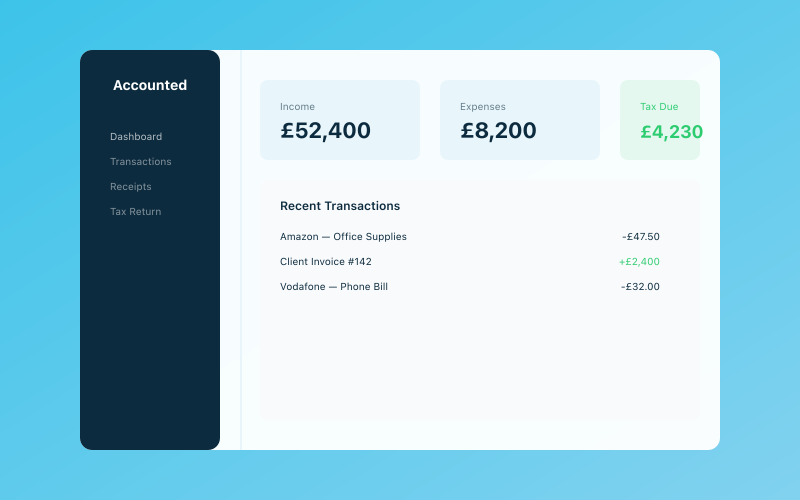 Your Accounted dashboard — income, expenses, and tax at a glance
Your Turnover Has Dropped Below the Threshold
You can deregister if your taxable turnover for the next 12 months will be below £88,000. Note that this is the deregistration threshold, which is different from the £90,000 registration threshold. There's a deliberate gap between the two to prevent businesses from constantly registering and deregistering as their turnover fluctuates around the threshold.
You need to be confident that your turnover will stay below £88,000 — not just that it happened to dip one month. HMRC looks at your reasonable expectation for the coming year.
You've Stopped Making Taxable Supplies
If you've stopped trading entirely, or you've stopped making taxable supplies (for example, you now only make exempt supplies), you must deregister. In fact, HMRC requires you to notify them within 30 days of ceasing to make taxable supplies.
You Registered Voluntarily and Want to Leave
If you registered for VAT voluntarily — meaning your turnover was below the threshold when you signed up — you can deregister at any time. However, if you registered voluntarily, HMRC generally expects you to stay registered for at least two years. Deregistering very quickly after a voluntary registration, especially if you reclaimed significant input tax, may attract scrutiny.
You're Closing Your Business
If you're winding down your sole trader business or dissolving a company, you'll need to deregister as part of the process. Don't forget this step — your VAT obligations continue until your registration is formally cancelled.
When You Can't Deregister
You cannot deregister if:
- Your taxable turnover in the next 12 months is expected to be above £88,000
- You're part of a VAT group (the representative member would need to handle this)
- HMRC believes you're trying to deregister to avoid paying VAT you owe
If your turnover has temporarily dropped but you expect it to bounce back above £88,000, you shouldn't deregister. HMRC looks at your genuine expectations, not just your current position.
How to Deregister — Step by Step
Step 1: Check You're Eligible
Before starting the process, make sure your expected taxable turnover for the next 12 months is genuinely below £88,000, or that you've ceased trading. If you're uncertain, it's worth speaking to an accountant.
Step 2: Apply Online
The quickest way to deregister is through your HMRC online account (the Government Gateway). Here's the process:
- Log in to your Government Gateway account
- Go to your VAT account
- Select "Cancel VAT registration" or "Deregister for VAT"
- Complete the online form with your details
- Choose your deregistration date (more on this below)
- Submit the application
You can also deregister by post using form VAT7, but the online route is faster and you'll get confirmation sooner.
Step 3: Choose Your Deregistration Date
You can request a specific date for your deregistration to take effect. This is important because:
- If you've stopped trading, the date should be when you made your last taxable supply
- If your turnover has dropped, you can choose the date you realised it would stay below £88,000
- If you registered voluntarily, you can choose any current or future date
HMRC may not always agree with your chosen date — they'll confirm the actual effective date in writing.
Step 4: Wait for Confirmation
HMRC will process your application and send you a confirmation letter (or online notification) with your official deregistration date. This usually takes a few weeks, but can take longer if HMRC has questions.
Until you receive confirmation, you're still VAT-registered and must continue charging VAT and keeping records.
Your Final VAT Return
After deregistration, you'll need to submit a final VAT return covering the period from your last regular return up to your deregistration date. This is where things need a bit of care.
VAT on Stock and Assets
On your final return, you may need to account for VAT on any stock and assets you're keeping. The logic is that you reclaimed VAT on these items when you bought them, and now they're leaving the VAT system with you.
You must account for output VAT on stock and assets if:
- You claimed input tax when you purchased them
- Their total VAT value is more than £1,000
The VAT is calculated on the market value of the goods at the date of deregistration — not what you originally paid for them. So if you bought a laptop for £1,200 plus VAT two years ago, and it's now worth £400, you'd account for VAT on the £400 figure.
If the total VAT on all your remaining stock and assets is £1,000 or less, you don't need to account for it. This is a helpful de minimis rule that means most small businesses with minimal stock won't face a surprise bill.
Reclaiming VAT on Your Final Return
You can still reclaim input tax on your final return for business expenses incurred up to the deregistration date. Make sure you include everything — once the final return is submitted, you can't go back and claim more.
This is a good time to review any outstanding supplier invoices. If you've been using Accounted to track your expenses, you can pull a report of all VAT-able purchases to make sure nothing's been missed.
What Happens After Deregistration
Stop Charging VAT Immediately
From your deregistration date, you must stop charging VAT on your sales. If you issue an invoice after your deregistration date that includes VAT, you'll need to correct it.
Update your invoicing templates, point-of-sale systems, and any online checkout pages to remove VAT from your prices on the effective date.
Adjust Your Prices
Here's a decision you'll need to make: do you reduce your prices by removing the VAT element, or keep them the same and pocket the difference?
If you sell to VAT-registered businesses, they'll expect you to drop your prices — they were reclaiming the VAT anyway, so your effective price to them was the net amount. Keeping prices the same would effectively be a price increase.
If you sell to consumers, you have more flexibility. Many businesses keep their prices the same (or close to it) after deregistering, giving themselves a margin boost.
Keep Your Records
Even after deregistering, you must keep your VAT records for at least six years. HMRC can still enquire into your VAT affairs for past periods, so don't throw anything away.
Your VAT Number Becomes Invalid
Your VAT number will be cancelled. Remove it from your invoices, website, and any other business stationery. If a customer asks for a VAT invoice after your deregistration date, you won't be able to provide one.
Common Questions About VAT Deregistration
Can I Re-Register Later?
Yes, absolutely. If your turnover grows and you hit the £90,000 registration threshold again, you'll need to re-register compulsorily. Or you can register voluntarily at any time.
If you're deregistering because of a temporary dip in business but expect to need to re-register soon, consider whether it's worth the hassle of deregistering and re-registering. Staying registered might be simpler.
What About the Flat Rate Scheme?
If you were on the Flat Rate Scheme, you'll leave it automatically when you deregister. Your final return will be calculated using the flat rate percentage as usual, but remember the stock and assets rule above still applies separately.
What If HMRC Refuses My Application?
It's rare, but HMRC can refuse a deregistration application if they believe your turnover will exceed the threshold, or if they suspect you're trying to avoid a VAT liability. If your application is refused, HMRC will explain why and you can appeal.
Do I Need to Tell My Customers?
There's no legal obligation to notify customers, but it's good practice — especially for B2B customers who need to know they can no longer reclaim VAT on your invoices. A brief email or note on your next invoice is usually sufficient.
Making the Decision
Deregistering for VAT can simplify your life and reduce your admin burden. But it also means you can no longer reclaim VAT on your purchases, which could cost you more than you save — especially if your expenses are significant.
Before deregistering, run the numbers. Add up the VAT you reclaim each year on business expenses and compare it with the benefit of simpler admin and potentially more competitive pricing. If the input tax you're reclaiming is substantial, staying registered might still make sense even if your turnover is below the threshold.
And if you're filing VAT returns under Making Tax Digital, remember that deregistering also removes that obligation — one less quarterly filing to worry about.
Accounted helps UK sole traders stay on top of their bookkeeping and tax. Start your free 30-day trial at getaccounted.co.uk
Related reading:
- Voluntary VAT Registration — When It Makes Sense
- VAT Registration Threshold Guide
- VAT Return Common Mistakes
Related Reading
- Annual Accounting Scheme for VAT — Is It Right for You?
- VAT Groups — What They Are and When to Use Them
You may also find our Reverse Charge VAT: Construction Businesses Guide helpful.
Related reading: Setting Up Your First VAT Scheme: Which One Is Right.
You may also find our VAT Cash Accounting Scheme Explained helpful.
For step-by-step guidance, see our article on How to Deregister for VAT: When and How.
Related reading: VAT on Digital Services: Rules for Online Businesses.
You may also find our VAT Margin Scheme Explained: Second-Hand Goods helpful.
Related reading: Common VAT Mistakes That Cost Businesses Thousands.
See our detailed comparison: VAT on Property: Residential vs Commercial Rules.
See how Accounted handles MTD and start your free trial.
Accounted handles VAT returns and MTD for VAT with direct HMRC filing built in. See VAT features →
Tax & Compliance Specialists
Our tax specialists have decades of combined experience in UK sole trader and small business taxation, MTD compliance, and HMRC submissions. All content is reviewed against current HMRC guidance before publication and updated quarterly to reflect legislative changes.
Ready to try Accounted?
Join UK sole traders who are simplifying their bookkeeping and tax.
Start your 14-day free trial