Voluntary VAT Registration — When It Makes Sense
If your turnover is below the £90,000 VAT registration threshold, you might assume VAT isn't something you need to think about just yet. But here's the thing — registering for VAT voluntarily can actually save you money and give your business a more professional edge. It's not right for everyone, but for plenty of sole traders and small businesses, it's a genuinely smart move.
In this guide, we'll walk you through what voluntary VAT registration means, when it makes sense, and when you're better off staying unregistered.
What Is Voluntary VAT Registration?
Voluntary VAT registration is exactly what it sounds like — choosing to register for VAT with HMRC even though your taxable turnover hasn't hit the compulsory registration threshold of £90,000.
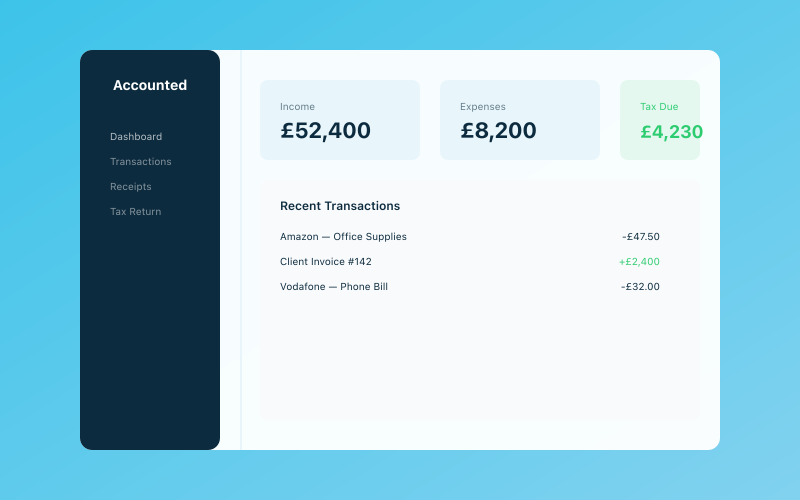 Your Accounted dashboard — income, expenses, and tax at a glance
Once you're registered, you'll need to charge VAT on your sales (at the standard rate of 20%, the reduced rate of 5%, or the zero rate of 0%, depending on what you sell), submit VAT returns, and keep proper VAT records. In return, you can reclaim the VAT you pay on your business purchases — known as input tax.
It's worth noting that anyone carrying on a business can register voluntarily, regardless of turnover. You could be turning over £5,000 a year and still register if it suits you. There's no minimum threshold for voluntary registration.
If you're not sure whether you need to register compulsorily, our guide to the VAT registration threshold covers the rules in detail.
When Voluntary VAT Registration Makes Sense
Let's look at the scenarios where registering early genuinely pays off.
You Sell Mainly to VAT-Registered Businesses
If most of your customers are other VAT-registered businesses, voluntary registration is almost a no-brainer. Your customers can reclaim the VAT you charge them, so it doesn't cost them a penny more. Meanwhile, you get to reclaim the VAT on all your business expenses.
This is especially common for B2B service providers — consultants, web developers, copywriters, and tradespeople who mainly work for other businesses rather than the general public.
You Have Significant Business Expenses
If you're spending a lot on materials, equipment, software subscriptions, or other VAT-able purchases, you could be sitting on a decent chunk of reclaimable VAT. Without registration, that VAT is just an extra cost you have to absorb.
For example, if you spend £2,000 a month on VAT-able business expenses, that's £400 in VAT you could be reclaiming each month — nearly £5,000 a year back in your pocket.
You're About to Make a Large Purchase
Planning to buy a van, expensive equipment, or fit out a workshop? Registering for VAT before making that purchase means you can reclaim the VAT on it. On a £30,000 van, that's £5,000 in VAT you'd get back.
Some businesses register voluntarily specifically to reclaim VAT on a big one-off purchase. Just be aware that once you're registered, you'll need to stay registered for a reasonable period — HMRC might look askance if you register, reclaim a large amount, and immediately deregister.
You can also reclaim VAT on certain purchases made before you registered. Our guide on reclaiming VAT on pre-registration expenses explains the rules.
You Want to Look More Established
Having a VAT number on your invoices signals to potential clients that your business has a certain level of turnover and professionalism. Some larger businesses and public sector organisations prefer (or even require) working with VAT-registered suppliers. Being on the VAT register can open doors.
You Sell Zero-Rated Goods or Services
If your sales are zero-rated (charged at 0% VAT), voluntary registration is particularly attractive. You won't need to charge your customers any VAT at all, but you can still reclaim the VAT on your purchases. It's essentially free money.
Common zero-rated supplies include most food items, children's clothing, books, and certain construction services on new residential buildings.
When Voluntary VAT Registration Doesn't Make Sense
It's not always a good idea, though. Here are the situations where staying unregistered is usually the wiser choice.
Your Customers Are Mainly Consumers
If you sell to the general public — people who can't reclaim VAT — then registering means your prices effectively go up by 20%. You'd either need to absorb that cost (reducing your margins) or pass it on (potentially losing customers to unregistered competitors who can charge less).
For consumer-facing businesses like hairdressers, tutors, or market traders, voluntary registration rarely makes financial sense unless your expenses are very high.
Your Expenses Are Low
If you run a service-based business with minimal overheads — perhaps you're a freelance writer working from home with just a laptop and a broadband connection — the VAT you'd reclaim on expenses might not justify the extra admin burden.
You Don't Want the Admin
Let's be honest — VAT adds paperwork. You'll need to keep detailed VAT records, issue VAT invoices, and submit quarterly VAT returns (or monthly, if you prefer). For some sole traders, the time and hassle simply aren't worth it.
That said, tools like Penny — the AI bookkeeper built into Accounted — can automate much of the VAT record-keeping, making it far less painful than it used to be. But it's still something to factor in.
How to Register Voluntarily
The process for voluntary registration is the same as compulsory registration. You apply online through your HMRC Government Gateway account. You'll need:
- Your business details (name, address, type of business)
- Your National Insurance number or Unique Taxpayer Reference
- Details of your bank account
- An estimate of your expected turnover for the next 12 months
- Details of your business activities
HMRC typically processes applications within a few weeks, though it can sometimes take longer. They may ask follow-up questions, particularly if your turnover is very low — they want to make sure you're genuinely trading and not trying to game the system.
For a step-by-step walkthrough, see our guide to registering for VAT.
Choosing Your VAT Effective Date
When you register voluntarily, you can choose your registration date. This is handy because you can backdate it to reclaim VAT on recent purchases, or set it for a future date if you're not quite ready.
If you backdate your registration, you can go back up to four years. However, you'll need to account for any VAT-able sales you made during that period too, so it's not always advantageous.
VAT Schemes Worth Considering
Once you're registered, you don't have to use the standard VAT accounting method. Several special schemes can simplify things or improve your cash flow.
The Flat Rate Scheme
The Flat Rate Scheme lets you pay a fixed percentage of your gross turnover to HMRC instead of calculating the exact VAT on every transaction. It simplifies your record-keeping enormously, and for some businesses, it can result in paying less VAT overall.
However, be aware of the limited cost trader rules, which apply a higher flat rate to businesses that spend less than 2% of their turnover (or less than £1,000 a year) on goods.
The Cash Accounting Scheme
With the Cash Accounting Scheme, you only account for VAT when you actually receive or make payments, rather than when you issue or receive invoices. This is brilliant for cash flow, especially if your customers are slow to pay.
The Annual Accounting Scheme
If quarterly returns feel like too much, the Annual Accounting Scheme lets you submit just one VAT return a year, with interim payments throughout the year based on your estimated liability. It's worth exploring if you want to keep things as simple as possible.
Things to Watch Out For
The De Minimis Rule Doesn't Apply to Voluntary Registration
Some people confuse voluntary registration with partial exemption or the de minimis limits. They're completely separate concepts. If you register voluntarily, you're fully in the VAT system with all the obligations that come with it.
You Can Deregister Later
If voluntary registration turns out not to suit you, you can deregister — provided your taxable turnover in the next 12 months will be below £88,000 (the deregistration threshold). So it's not a permanent commitment.
Keep Proper Records from Day One
HMRC expects the same standard of record-keeping from voluntarily registered businesses as from those that registered compulsorily. Make sure your invoices, receipts, and VAT records are in order from the start.
Making Your Decision
The decision to register voluntarily usually comes down to a straightforward calculation: will the VAT you reclaim on your purchases outweigh the cost — both financial and administrative — of being VAT-registered?
If you sell mainly to other businesses, have significant expenses, or deal in zero-rated goods, the answer is often yes. If you sell to consumers and have low overheads, it's usually no.
Take an hour to add up the VAT you've paid on business expenses over the past year. That's roughly what you'd get back annually. Then weigh that against the time you'd spend on VAT admin and any impact on your pricing. The numbers usually make the decision pretty clear.
Accounted helps UK sole traders stay on top of their bookkeeping and tax. Start your free 30-day trial at getaccounted.co.uk
Related reading:
- VAT Registration Threshold Guide
- How to Register for VAT
- Reclaiming VAT on Pre-Registration Expenses
Related Reading
- VAT on Food and Drink — Zero-Rated vs Standard Rated
- VAT on Second-Hand Goods — The Margin Scheme Explained
You may also find our Reverse Charge VAT: Construction Businesses Guide helpful.
Related reading: Setting Up Your First VAT Scheme: Which One Is Right.
You may also find our VAT Cash Accounting Scheme Explained helpful.
For step-by-step guidance, see our article on How to Deregister for VAT: When and How.
Related reading: VAT on Digital Services: Rules for Online Businesses.
You may also find our VAT Margin Scheme Explained: Second-Hand Goods helpful.
Related reading: VAT Annual Accounting Scheme: Simplified Filing.
Related reading: Common VAT Mistakes That Cost Businesses Thousands.
See our detailed comparison: VAT on Property: Residential vs Commercial Rules.
Related reading: Reclaiming VAT on Business Expenses: What Counts.
Related reading: VAT Registration Threshold 2026: When to Register.
See how Accounted handles MTD and start your free trial.
Accounted handles VAT returns and MTD for VAT with direct HMRC filing built in. See VAT features →
Tax & Compliance Specialists
Our tax specialists have decades of combined experience in UK sole trader and small business taxation, MTD compliance, and HMRC submissions. All content is reviewed against current HMRC guidance before publication and updated quarterly to reflect legislative changes.
Ready to try Accounted?
Join UK sole traders who are simplifying their bookkeeping and tax.
Start your 14-day free trial