Tax When Selling to EU Customers After Brexit
Brexit changed the rules for selling to EU customers, and if you're a UK sole trader trading across the Channel, those changes affect you directly. What used to be a relatively seamless process — selling within a single market — now involves customs declarations, different VAT treatment, and a fair bit of paperwork.
The good news is that plenty of UK businesses continue to sell successfully to EU customers. You just need to understand the new framework. In this guide, we'll cover the key tax and compliance issues for UK sole traders selling goods and services to EU-based customers.
Selling Services to EU Customers
If you're a service-based sole trader — a consultant, designer, writer, developer, or any other professional selling services — the post-Brexit rules are actually more straightforward than those for goods.
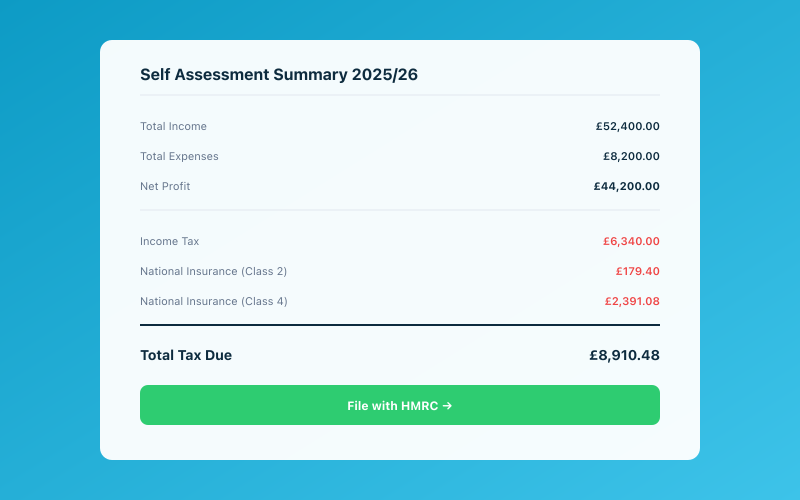 Your Accounted dashboard shows your real-time tax position
For business-to-business (B2B) services, the general rule is that the service is taxable where the customer is established. This means if you're a UK-based freelancer selling services to a business in France, your services are outside the scope of UK VAT. You don't charge VAT on your invoice. The French business accounts for VAT in France under the reverse charge mechanism.
For this to work properly, you should:
- Obtain your customer's VAT registration number and verify it
- Include the customer's VAT number on your invoice
- Add a note stating "Reverse charge: VAT Act 1994 Section 7A" or similar wording
- Report these sales in Box 6 of your VAT return (if you're VAT registered)
For business-to-consumer (B2C) services, things get more nuanced. The general rule is that B2C services are taxable where the supplier is based — so you'd charge UK VAT. However, there are important exceptions for digital services, telecommunications, and broadcasting services, which are taxable where the consumer is located.
If you sell digital services to EU consumers, you may need to register for the One Stop Shop (OSS) scheme in an EU member state, or register for VAT in each country where your customers are based. There's a threshold of EUR 10,000 per year across all EU member states before this kicks in, but it's something to be aware of if your EU consumer sales are growing.
Selling Goods to EU Customers
This is where things got significantly more complex after Brexit. Selling goods to EU customers now counts as exporting, which brings customs procedures into play.
Customs Declarations and Duties
Every shipment of goods from the UK to the EU requires a customs declaration. You'll need to:
- Classify your goods using the correct commodity code (the Harmonised System code)
- Determine the origin of your goods — this affects whether preferential tariff rates under the UK-EU Trade and Cooperation Agreement (TCA) apply
- Complete export declarations, either yourself or through a customs broker or freight forwarder
Under the TCA, goods that originate in the UK can enter the EU at zero tariffs and zero quotas, provided the rules of origin are met. This is a significant benefit, but you need to be able to prove the origin of your goods. If your products contain components from outside the UK or EU, you may not qualify for preferential treatment.
VAT on Goods Sold to EU Businesses (B2B)
When selling goods to a VAT-registered EU business, you export the goods from the UK at zero-rate VAT (0%). The EU business then accounts for import VAT in their country through the reverse charge. To zero-rate the supply, you need:
- Your customer's EU VAT registration number
- Evidence that the goods have left the UK (shipping documents, tracking information)
- Commercial invoices showing the zero-rated supply
Keep thorough records. HMRC can and does check that zero-rated exports are properly evidenced. If you can't prove the goods left the UK, you may be liable for standard-rate VAT.
VAT on Goods Sold to EU Consumers (B2C)
Selling goods to individual consumers in the EU is more complicated. Since July 2021, the EU introduced the Import One Stop Shop (IOSS) scheme for goods valued at EUR 150 or less. If you register for IOSS, you charge EU VAT at the point of sale and remit it through a single return.
Without IOSS registration, your EU customers will be charged import VAT (and potentially customs duties) when the goods arrive. This creates a poor customer experience and can lead to refused deliveries. If you're selling regularly to EU consumers, IOSS registration is usually worth considering.
For goods over EUR 150 in value, the customer will always need to pay import VAT and any applicable duties on arrival, regardless of IOSS.
The VAT Registration Threshold and EU Sales
As a UK sole trader, you need to register for UK VAT if your taxable turnover exceeds £90,000 in a rolling 12-month period (the threshold from April 2024). Your EU sales count towards this threshold differently depending on whether they're goods or services.
For services supplied to EU businesses under the reverse charge, these are outside the scope of UK VAT and generally don't count towards your registration threshold. However, you should still track them carefully.
For goods exported to the EU, these are zero-rated rather than exempt, so they do count towards your VAT registration threshold. If your combined UK and export sales exceed £90,000, you'll need to register.
If you're dealing with VAT on foreign transactions more broadly, our dedicated guide covers the wider picture including non-EU countries.
Record-Keeping Requirements
HMRC expects robust records for international sales. At a minimum, you should keep:
- Invoices showing the customer's name, address, and (for B2B) VAT number
- Proof of export — shipping documents, courier tracking, or carrier documentation
- Customs declarations for goods exports
- Currency conversion records — the exchange rate used and the date of the transaction
- Correspondence with customers relating to the supply
This is one area where good bookkeeping software pays for itself. Accounted makes it straightforward to categorise international sales, track VAT treatment, and keep all your documentation organised. Penny can flag transactions that need attention — like an EU sale that hasn't been properly categorised — before they become a problem.
Practical Considerations for Small Businesses
Beyond the tax technicalities, there are practical issues to think about when selling to the EU:
Shipping costs and times have increased. Customs checks add time and expense. Factor this into your pricing and delivery promises. Some UK sellers have found that using fulfilment centres within the EU can simplify the process for goods.
Returns are more complicated. If an EU customer returns goods, you may need to deal with customs declarations in both directions. Make sure your returns policy accounts for this.
EORI numbers are essential. You'll need a UK EORI (Economic Operators Registration and Identification) number to export goods. If you also import from the EU, you may need an EU EORI number as well. You can apply for a UK EORI through HMRC — it's free and usually processed within a few working days.
Consider your pricing strategy. EU customers now face potential import charges that they didn't before. Being transparent about this — or absorbing the costs into your pricing — can make a big difference to your conversion rates.
Product labelling and standards. Some products now need different labelling for the EU market (CE marking vs. UKCA marking, for instance). Check the requirements for your specific product category.
Do You Need to Register for VAT in an EU Country?
In some cases, you might need to register for VAT in one or more EU member states. This typically applies if you:
- Store goods in an EU country (for example, using Amazon FBA warehouses in the EU)
- Sell digital services to EU consumers above the EUR 10,000 threshold
- Have a fixed establishment in an EU country
VAT registration in an EU country means filing returns in that country, which adds administrative complexity. If you're approaching this territory, it's worth getting specialist advice to make sure you're compliant without over-complicating your setup.
For sole traders who are just starting out with international sales, our guide on tax when moving to the UK to start a business covers some related ground on setting up your tax affairs properly from the beginning.
Related Reading
Start your free trial and let Penny handle your bookkeeping automatically.
Accounted helps UK sole traders stay on top of their bookkeeping and tax. Start your free 30-day trial at getaccounted.co.uk.
Penny, your AI bookkeeper, tracks your tax position in real time and flags opportunities to reduce your bill. Meet Penny →
Tax & Compliance Specialists
Our tax specialists have decades of combined experience in UK sole trader and small business taxation, MTD compliance, and HMRC submissions. All content is reviewed against current HMRC guidance before publication and updated quarterly to reflect legislative changes.
Ready to try Accounted?
Join UK sole traders who are simplifying their bookkeeping and tax.
Start your 14-day free trial