UK Tax on Foreign Income — What You Need to Declare
If you earn money from outside the UK — whether that's freelance work for an overseas client, rental income from a property abroad, or interest from a foreign savings account — there's a good chance you need to tell HMRC about it.
The rules around foreign income can feel overwhelming, especially when you're trying to figure out what counts, what's exempt, and how to avoid paying tax twice. But getting it right matters. HMRC has increasingly sophisticated ways of finding out about undeclared overseas earnings, and the penalties for non-disclosure can be steep.
In this guide, we'll walk you through exactly what foreign income means in UK tax terms, who needs to declare it, and how to report it properly on your Self Assessment return.
What Counts as Foreign Income?
In broad terms, foreign income is any money you receive from a source outside the UK. HMRC's definition is wide-reaching and includes:
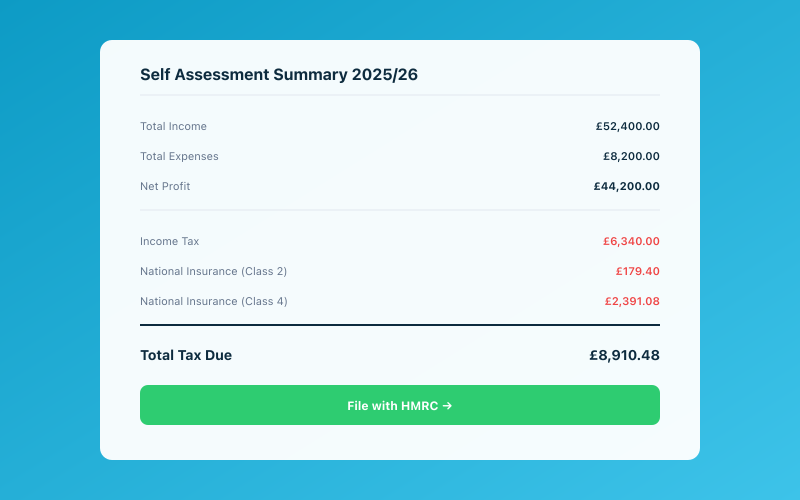 Your Accounted dashboard shows your real-time tax position
- Employment income earned while working overseas
- Self-employment income from clients or customers based abroad
- Rental income from property you own in another country
- Interest and dividends from foreign bank accounts or investments
- Pension income from overseas pension schemes
- Capital gains from selling assets located abroad
It doesn't matter whether you bring the money into the UK or leave it sitting in a foreign bank account. For most UK residents, worldwide income is taxable — full stop.
One area that catches people out is foreign freelance income. If you're a sole trader based in the UK doing work for a client in, say, Germany or the United States, that income is taxable in the UK just like any domestic earnings. The fact that the client is overseas doesn't change your UK tax position.
Who Needs to Declare Foreign Income?
Your obligation to declare foreign income depends primarily on your UK tax residency status. Here's the general breakdown:
UK tax residents must declare their worldwide income to HMRC. This includes all foreign income, regardless of where it's earned or where the money is held. For the 2025/26 tax year, the same income tax bands apply to foreign income as to domestic income:
- Personal Allowance: £12,570 (for income up to £100,000)
- Basic rate (20%): £12,571 to £50,270
- Higher rate (40%): £50,271 to £125,140
- Additional rate (45%): over £125,140
Non-UK residents generally only need to declare UK-sourced income. However, there are exceptions — particularly if you have UK rental income or UK employment income.
If you're unsure about your residency status, HMRC uses the Statutory Residence Test (SRT) to determine whether you're a UK tax resident. This looks at factors like how many days you spend in the UK, whether you have a home here, and your connections to the country. If you're spending 183 days or more in the UK during a tax year, you're almost certainly a UK resident for tax purposes.
It's also worth noting that the rules around the remittance basis for non-domiciled individuals changed significantly from April 2025. The old remittance basis has been replaced with a new regime, so if you're non-domiciled, it's worth checking how the new rules on the remittance basis affect your position.
How to Report Foreign Income on Your Tax Return
Foreign income is reported through your Self Assessment tax return. You'll need to complete the Foreign pages (SA106) alongside your main return. Here's what you'll typically need to include:
- Foreign employment income — report the gross amount in pounds sterling
- Foreign self-employment income — include this in your self-employment pages as part of your total turnover
- Foreign property income — complete the foreign property section
- Foreign interest and dividends — report these in the relevant sections of the foreign pages
- Foreign pensions — declare these in the pension income section
When converting foreign currency to pounds sterling, you should use the exchange rate at the time the income was received, or you can use HMRC's published yearly average exchange rates. Be consistent with whichever method you choose.
One practical tip: keep records of the exchange rates you use and the dates of transactions. If HMRC ever queries your return, having clear documentation makes the process much smoother. Penny, the AI assistant inside Accounted, can help you categorise foreign transactions correctly as they come in, which saves a lot of headaches at year end.
Double Taxation Relief — Avoiding Paying Tax Twice
One of the biggest concerns people have about foreign income is being taxed on it twice — once in the country where it's earned, and again in the UK. The good news is that there are mechanisms to prevent this.
The UK has Double Taxation Agreements (DTAs) with over 130 countries. These treaties set out which country has the right to tax specific types of income, and they provide relief so you're not taxed twice on the same money. You can read our full breakdown in our guide to double taxation agreements.
In practice, double taxation relief usually works in one of two ways:
- Tax credit relief: You pay tax in the foreign country and then claim a credit against your UK tax bill for the foreign tax paid. The credit is limited to the lower of the foreign tax paid or the UK tax due on that income.
- Exemption: Under some treaties, certain types of income are only taxable in one country.
To claim double taxation relief, you'll need to complete the relevant sections of the SA106 form and have evidence of the foreign tax you've paid. This usually means obtaining a tax certificate or statement from the overseas tax authority.
What Happens If You Don't Declare Foreign Income?
HMRC takes undeclared foreign income seriously. Through international information exchange agreements — including the Common Reporting Standard (CRS) — HMRC automatically receives financial data from tax authorities in over 100 countries. This means they can see if you have bank accounts, investments, or income sources abroad.
If HMRC discovers undeclared foreign income, the consequences can include:
- Penalties of up to 200% of the tax owed (penalties are higher for offshore matters than for domestic non-disclosure)
- Interest on unpaid tax, calculated from the date the tax was originally due
- Criminal prosecution in the most serious cases of deliberate evasion
If you've got foreign income you haven't declared in previous years, it's far better to come forward voluntarily. HMRC's Worldwide Disclosure Facility allows you to make a disclosure and typically results in lower penalties than if HMRC finds the issue first.
The key takeaway is simple: declare everything. The risk of not doing so far outweighs any short-term benefit of keeping quiet.
Practical Tips for Managing Foreign Income
Staying on top of foreign income doesn't have to be complicated if you build good habits from the start. Here are some practical suggestions:
Keep a separate record of all overseas earnings. Whether you use a spreadsheet or bookkeeping software like Accounted, make sure every piece of foreign income is logged with the date, amount in the original currency, the sterling equivalent, and the exchange rate used.
Save evidence of foreign tax paid. If you're claiming double taxation relief, you'll need proof. Keep tax certificates, withholding statements, and any correspondence with foreign tax authorities.
Understand your obligations in the other country too. Just because you're paying UK tax on foreign income doesn't necessarily mean you're exempt from obligations in the source country. Some countries require you to file a return even if a DTA means no tax is due there.
Don't forget about foreign bank account interest. Even small amounts of interest from overseas accounts need to be declared. It's easy to overlook, but HMRC will see it through CRS data.
Set money aside for tax. Foreign income can sometimes push you into a higher tax band. If you're new to the UK and starting a business, make sure you're setting aside enough to cover your tax bill.
If you're a sole trader juggling domestic and international income, having a system that tracks everything in real time makes a huge difference. Accounted is designed to handle exactly this kind of complexity, letting you categorise foreign transactions and keep your records audit-ready throughout the year.
Related Reading
Start your free trial and let Penny handle your bookkeeping automatically.
Accounted helps UK sole traders stay on top of their bookkeeping and tax. Start your free 30-day trial at getaccounted.co.uk.
Penny, your AI bookkeeper, tracks your tax position in real time and flags opportunities to reduce your bill. Meet Penny →
Tax & Compliance Specialists
Our tax specialists have decades of combined experience in UK sole trader and small business taxation, MTD compliance, and HMRC submissions. All content is reviewed against current HMRC guidance before publication and updated quarterly to reflect legislative changes.
Ready to try Accounted?
Join UK sole traders who are simplifying their bookkeeping and tax.
Start your 14-day free trial