Tax When You Move to the UK and Start a Business
Moving to the UK is an exciting step, and if you are planning to start a business here, there is a lot to get right from the beginning. The UK tax system has its own rules about who pays tax, when, and on what. Your residency status, the type of business you set up, how you interact with HMRC, and how your overseas income is treated all depend on getting the fundamentals right from day one. This guide walks you through the key tax considerations for people moving to the UK and starting a business, whether you are coming as a sole trader, freelancer, or aspiring company director.
Determining Your Tax Residency
The first and most important question is whether the UK considers you a tax resident. This matters because UK tax residents are generally taxed on their worldwide income, while non-residents are only taxed on UK-source income.
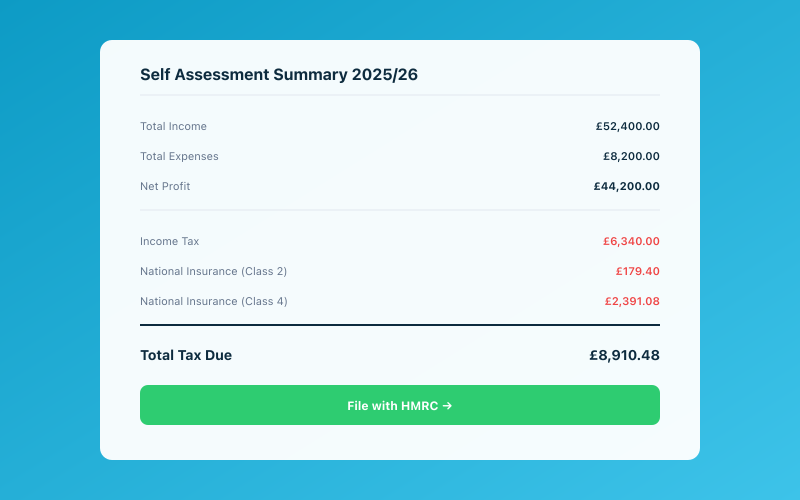 Your Accounted dashboard shows your real-time tax position
The UK uses the Statutory Residence Test (SRT) to determine your tax residency. It is a structured test with three main components:
The automatic overseas test. You are automatically non-resident if you were not UK resident in any of the three previous tax years and you spend fewer than 46 days in the UK in the current tax year. There are other automatic overseas tests based on working full-time abroad.
The automatic UK test. You are automatically UK resident if you spend 183 days or more in the UK in a tax year, or if your only home is in the UK for at least 91 consecutive days (with at least 30 of those days falling in the tax year in question).
The sufficient ties test. If neither automatic test applies, your residency is determined by counting your UK ties (family, accommodation, work, 90-day presence, and country tie) and matching them against the number of days you spend in the UK. The more ties you have, the fewer days it takes to become UK resident.
For most people who move to the UK permanently, the automatic UK test will apply — you will spend more than 183 days here in your first full tax year, or your only home will be here. But the tax year in which you actually arrive can be split under the SRT, meaning you may only be UK resident for part of that year. This is called "split year treatment" and can be beneficial because your overseas income for the non-resident part of the year is not subject to UK tax.
Understanding your residency position from the outset is important. If you get it wrong, you could end up paying too much tax, too little tax, or both (if you are also paying tax in your home country).
Registering Your Business
Once you are in the UK and ready to start working, you need to register with HMRC. The process depends on your business structure.
Sole trader. You register as self-employed with HMRC online. You will receive a Unique Taxpayer Reference (UTR) and be enrolled for Self Assessment. You need to register by 5 October following the end of the tax year in which you started self-employment, but registering sooner is better — it avoids delays later.
Limited company. You register with Companies House, which also notifies HMRC. You will need to set up corporation tax, PAYE if you are taking a salary, and potentially VAT registration. Directors who are also shareholders typically pay themselves a mix of salary and dividends.
Partnership. Similar to sole trader registration, but the partnership itself is also registered, and each partner files their own Self Assessment return.
For most people arriving in the UK and starting a small business, sole trader status is the simplest starting point. You can always incorporate later if it makes sense.
You will also need a National Insurance number. If you do not already have one, you can apply through the Department for Work and Pensions. Your NI number is used to track your National Insurance contributions and is needed for your Self Assessment registration.
If your work falls within certain sectors, such as construction, you may also need to register under the Construction Industry Scheme. Our CIS registration guide covers this process in detail.
The Remittance Basis — A Key Decision
One of the most important decisions for new arrivals who are not domiciled in the UK is whether to use the remittance basis of taxation. This area underwent major reform from April 2025 with the introduction of the new Foreign Income and Gains (FIG) regime.
Under the new FIG regime, individuals who become UK tax resident and have been non-resident for at least 10 consecutive tax years before arriving can elect for a four-year exemption on foreign income and gains. During this four-year window, your overseas income and gains are not subject to UK tax, regardless of whether you bring the money to the UK. This replaces the old remittance basis and non-dom rules.
This means if you move to the UK in the 2025/26 tax year and qualify, your foreign income and investment gains may be exempt from UK tax for up to four tax years. After the four years expire, you are taxed on your worldwide income just like any other UK resident.
It is worth noting that this regime is complex and the rules have specific conditions. Professional tax advice is strongly recommended, especially if you have significant overseas income, investments, or business interests. The decisions you make in your first year can have lasting consequences.
UK Tax Rates and Allowances You Need to Know
For the 2025/26 tax year, the key figures are:
Personal allowance: £12,570. This is the amount you can earn before paying income tax. It reduces by £1 for every £2 of income above £100,000, disappearing entirely at £125,140.
Income tax rates:
- Basic rate: 20% on income from £12,570 to £50,270
- Higher rate: 40% on income from £50,270 to £125,140
- Additional rate: 45% on income above £125,140
National Insurance (self-employed):
- Class 2: £3.45 per week
- Class 4: 6% on profits between £12,570 and £50,270, 2% above £50,270
VAT registration threshold: £90,000 of taxable turnover in a rolling 12-month period.
Capital gains tax: 10% (basic rate) or 20% (higher rate) on most assets. 18% (basic rate) or 24% (higher rate) on residential property. Business Asset Disposal Relief (formerly Entrepreneurs' Relief) offers a 10% rate on the first £1 million of lifetime qualifying gains.
If you are coming from a country with very different tax rates, these figures will help you plan your pricing, expenses, and overall financial strategy.
Avoiding Double Taxation
If you are earning income in both the UK and your home country, there is a risk of being taxed twice on the same income. The UK has double taxation agreements (DTAs) with over 130 countries, which provide relief from this.
Under a DTA, you will typically only pay tax in one country on any given source of income, or you will receive a credit in one country for tax paid in the other. The specific rules depend on which country you are coming from and the type of income involved.
Common scenarios include:
- Self-employment income from UK clients is usually only taxable in the UK if you are performing the work here
- Rental income from a property abroad is usually taxed in the country where the property is located, with a credit or exemption available in the UK
- Investment income such as dividends or interest from overseas sources may be subject to withholding tax in the source country, with relief available under the DTA
- Pension income from a former employer overseas may be taxable in the UK, the source country, or both, depending on the DTA
You claim DTA relief through your Self Assessment tax return. It is important to keep records of any overseas tax paid so you can claim the correct credit.
Practical Steps for Your First Year
Here is a checklist to help you get set up properly:
- Determine your tax residency using the Statutory Residence Test
- Get a National Insurance number if you do not already have one
- Register with HMRC as self-employed, or register a limited company
- Open a UK business bank account — you will need proof of address and identity
- Set up bookkeeping from day one — using an app like Accounted to track income and expenses means you are ready for Self Assessment and Making Tax Digital from the start
- Understand your obligations — filing deadlines, payment dates, and record-keeping requirements
- Consider professional tax advice — especially if you have overseas income or assets, or if the FIG regime may apply to you
- Keep all receipts and records — Penny, the AI bookkeeping assistant within Accounted, makes this easy by letting you photograph receipts and automatically categorise them
The UK tax system rewards good record-keeping and penalises poor planning. Getting organised from the beginning saves both money and stress.
For a broader look at UK tax obligations for the self-employed, our capital gains tax property guide is useful if you are also investing in UK property, and our CIS subcontractors guide is essential reading if you are entering the construction industry.
Related Reading
Start your free trial and let Penny handle your bookkeeping automatically.
Accounted helps UK sole traders stay on top of their bookkeeping and tax. Start your free 30-day trial at getaccounted.co.uk
Penny, your AI bookkeeper, tracks your tax position in real time and flags opportunities to reduce your bill. Meet Penny →
Tax & Compliance Specialists
Our tax specialists have decades of combined experience in UK sole trader and small business taxation, MTD compliance, and HMRC submissions. All content is reviewed against current HMRC guidance before publication and updated quarterly to reflect legislative changes.
Ready to try Accounted?
Join UK sole traders who are simplifying their bookkeeping and tax.
Start your 14-day free trial