IR35 and Personal Service Companies — Complete Guide
If you work through your own limited company as a contractor, you've almost certainly come across the term IR35. It's one of those pieces of tax legislation that can feel bewildering at first — but understanding it properly is absolutely essential if you operate a personal service company (PSC).
In this guide, we'll break down what IR35 actually means, how it applies to personal service companies, and what you need to do to stay on the right side of HMRC. No jargon overload, just the practical stuff you need to know.
What Is a Personal Service Company?
A personal service company is simply a limited company through which an individual provides their services to clients. There's no formal legal definition — HMRC uses the term to describe any company where the worker owns the majority of the shares and personally carries out the contracted work.
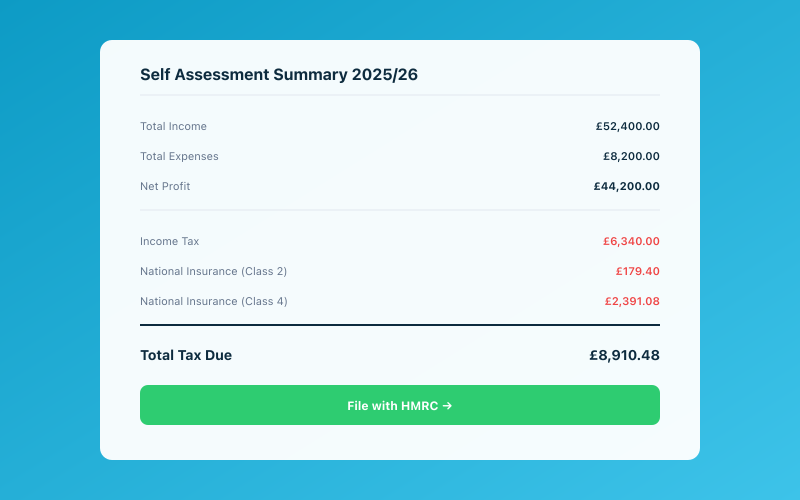 Your Accounted dashboard shows your real-time tax position
So if you're a freelance IT consultant, marketing specialist, or engineering contractor who invoices clients through your own limited company, you're operating a PSC. Thousands of UK contractors do exactly this, and for good reason. Working through a limited company can offer tax efficiency, limited liability, and a more professional image.
The catch? HMRC wants to make sure that people who are essentially employees aren't using a company structure purely to pay less tax. That's where IR35 comes in.
What Is IR35 and Why Does It Exist?
IR35 is the shorthand name for the Intermediaries Legislation, originally introduced in April 2000. The legislation is designed to identify workers who would be employees if they were providing their services directly to the end client, but who instead work through an intermediary — typically a PSC.
The core question IR35 asks is this: if you removed the limited company from the arrangement, would the working relationship look like employment?
If the answer is yes, the engagement falls "inside IR35," and the income from that contract should be taxed broadly the same as employment income — meaning Income Tax and National Insurance contributions at employed rates. If the answer is no, you're "outside IR35" and can continue to take income through a combination of salary and dividends in the usual way.
The difference in tax can be significant. A contractor earning £60,000 per year outside IR35 could take home several thousand pounds more than one caught inside IR35. That's precisely why HMRC keeps a close eye on these arrangements.
For a deeper look at the fundamentals, have a read of our complete IR35 guide for contractors.
How IR35 Status Is Determined
Determining whether a contract falls inside or outside IR35 isn't always straightforward. There's no single test — instead, HMRC and the courts look at a range of factors drawn from decades of employment case law. The three most important tests are:
Personal service and substitution. Can you send a substitute to do the work in your place? If you genuinely have the right to send someone else — and the client can't refuse an appropriately qualified substitute — that's a strong indicator of self-employment.
Mutuality of obligation (MOO). Is the client obliged to offer you work, and are you obliged to accept it? In a genuine business-to-business arrangement, either party should be free to walk away between engagements. If there's an ongoing obligation to provide and accept work, that looks more like employment.
Control. Does the client dictate how, when, and where you do the work? The more control they exert over the detail of how tasks are completed, the more likely the arrangement falls inside IR35. A truly self-employed contractor typically controls their own methods and working patterns.
Beyond these three core tests, other factors are also considered: whether you provide your own equipment, whether you bear financial risk, whether you have the opportunity to profit from sound management, and whether you're integrated into the client's organisation.
We've put together a separate piece with practical inside and outside IR35 examples that may help you assess your own situation.
The Off-Payroll Working Rules — Who Decides?
Before April 2021, if you worked through a PSC, the responsibility for determining your IR35 status sat with you (or rather, your company). That changed with the off-payroll working reforms.
Now, for medium and large private sector clients (and all public sector clients), the end client is responsible for determining whether IR35 applies. They must issue a Status Determination Statement (SDS) for each engagement, setting out their conclusion and the reasons behind it.
If the client determines the engagement is inside IR35, the fee-payer (often an agency sitting between you and the client) must deduct Income Tax and employee National Insurance before paying your PSC. They'll also pay employer National Insurance on top.
For small private sector clients — broadly those meeting two of the following three criteria: turnover under £10.2 million, balance sheet under £5.1 million, or fewer than 50 employees — the old rules still apply. The PSC itself remains responsible for assessing IR35 status.
This means that if all or most of your clients are small businesses, you still need to make your own IR35 determination. Getting it wrong could mean a hefty tax bill down the line, so it's worth taking seriously.
What Happens If You're Caught Inside IR35?
If a contract is deemed inside IR35, the tax treatment changes considerably. Here's what it means in practice:
The income from that contract is treated as deemed employment income. After deducting a flat 5% allowance for the costs of running your company, the remaining income is subject to Income Tax and both employee and employer National Insurance contributions.
You lose the ability to take that income as low-salary-plus-dividends, which is the main tax advantage of operating through a limited company in the first place.
If HMRC investigates and finds that you've been operating inside IR35 but haven't accounted for the correct tax, they can go back and assess the tax for previous years — potentially up to six years, or twenty years if they suspect deliberate avoidance. Interest and penalties will be added on top.
It's also worth noting that being inside IR35 on one contract doesn't automatically mean all your contracts are caught. Each engagement is assessed individually based on its own working practices.
Practical Steps to Protect Your PSC
If you're running a PSC and want to ensure you're operating compliantly, here are the key steps to take:
Review every contract carefully. Before you start any new engagement, look at the contract terms. Do they reflect genuinely self-employed working practices? Are there clauses around substitution, control, and the scope of work? If the written terms don't match reality, that's a problem.
Keep evidence of your working practices. HMRC cares about what actually happens, not just what the contract says. Keep notes, emails, and records that demonstrate how you work in practice — for example, evidence that you set your own hours, use your own equipment, or have offered a substitute.
Use HMRC's CEST tool — but cautiously. HMRC's Check Employment Status for Tax (CEST) tool can give you an indication of your IR35 status, but it's been widely criticised for being unreliable in borderline cases. It's a starting point, not a definitive answer.
Get a professional IR35 review. For important or high-value contracts, consider getting a specialist IR35 review from a qualified professional. This will give you a much more robust assessment and something to rely on if HMRC ever queries your status.
Have IR35 insurance. Some contractors take out specific IR35 tax investigation insurance to cover the costs of defending their position if HMRC comes knocking. It's worth considering, especially if you're working on contracts that sit in a grey area.
Using tools like Penny in Accounted can help you keep your PSC's financial records in good order — so if your IR35 status is ever questioned, you've got clean, well-organised books to back up your position.
Common Misconceptions About IR35 and PSCs
Let's clear up a few things that trip people up:
"I have a contract that says I'm self-employed, so I'm fine." Not necessarily. HMRC looks at the reality of the working arrangement, not just what the paperwork says. If the contract says you can send a substitute but you'd never actually be allowed to, that clause carries little weight.
"I work for multiple clients, so IR35 can't apply." Having multiple clients is a positive indicator of genuine self-employment, but it doesn't guarantee you're outside IR35. Each contract is assessed on its own merits.
"My client said I'm outside IR35, so that's settled." If a medium or large client issues a Status Determination Statement saying you're outside IR35, that's helpful — but HMRC can still challenge it if they disagree with the reasoning.
"IR35 doesn't apply because I'm a sole trader." This is actually correct — IR35 specifically targets intermediaries like limited companies and partnerships. If you're a sole trader, IR35 doesn't apply to you, although other employment status rules might.
Planning Ahead — What Contractors Should Do Now
The IR35 landscape has settled somewhat since the 2021 reforms, but it remains one of the most significant tax risks for contractors operating through PSCs. Here's what we'd recommend:
First, don't bury your head in the sand. If you're working through a PSC, make sure you understand whether each of your current engagements is inside or outside IR35. Ignorance isn't a defence.
Second, keep your financial records immaculate. Whether you're inside or outside IR35, well-maintained books make everything easier — from preparing your tax returns to defending your position during an HMRC enquiry.
Third, consider your overall business structure. If most of your work is now inside IR35, the tax advantages of operating through a limited company may be significantly reduced. In some cases, it might be worth exploring whether going back to being a sole trader or restructuring your arrangements makes more sense.
Finally, stay informed. The rules around IR35 have changed several times over the years, and further tweaks are always possible. Keeping up to date means you won't be caught off guard.
Related Reading
Start your free trial and let Penny handle your bookkeeping automatically.
Accounted helps UK sole traders stay on top of their bookkeeping and tax. Start your free 30-day trial at getaccounted.co.uk.
Penny, your AI bookkeeper, tracks your tax position in real time and flags opportunities to reduce your bill. Meet Penny →
Tax & Compliance Specialists
Our tax specialists have decades of combined experience in UK sole trader and small business taxation, MTD compliance, and HMRC submissions. All content is reviewed against current HMRC guidance before publication and updated quarterly to reflect legislative changes.
Ready to try Accounted?
Join UK sole traders who are simplifying their bookkeeping and tax.
Start your 14-day free trial