Tax When Getting Married — What Changes
Getting married is one of life's big moments. Between the planning, the celebrations, and the adjustment to life as a couple, tax is probably the last thing on your mind. But if you're self-employed, getting married does change a few things about your tax situation — and some of those changes could save you money.
The UK doesn't have joint taxation for income tax (unlike some other countries), so you and your spouse will continue to be taxed as individuals. But there are several areas where being married opens up planning opportunities that aren't available to unmarried couples. Let's go through what actually changes and what you should be thinking about.
Marriage Allowance — The Quick Win
The Marriage Allowance is the most straightforward tax benefit available to married couples, and it's one that many people miss.
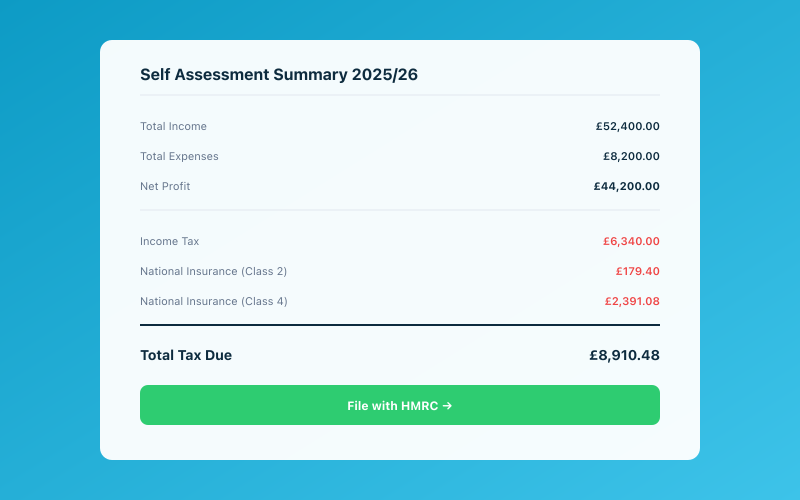 Your Accounted dashboard shows your real-time tax position
Here's how it works. If one spouse earns less than the Personal Allowance (£12,570 for the 2025/26 tax year), they can transfer up to £1,260 of their unused allowance to the other spouse. The receiving spouse must be a basic-rate taxpayer — meaning they earn between £12,571 and £50,270.
The result? The receiving spouse gets an extra £1,260 of tax-free income, which saves them up to £252 in income tax per year. It's not a life-changing amount, but it's money in your pocket for doing very little.
This is particularly relevant for self-employed people whose income varies. In a year where your business income is below the Personal Allowance — perhaps because you're just starting out, or because you've had a quieter period — transferring the unused portion to your employed spouse makes good financial sense.
You can apply for Marriage Allowance online through HMRC, and you can even backdate it for up to four previous tax years. So if you got married a few years ago and didn't claim, you could be owed a lump sum.
For a more detailed look at how this works in practice, have a read of our guide on how married couples can save tax.
Capital Gains Tax — Transfers Between Spouses
One of the most significant tax advantages of marriage is how Capital Gains Tax (CGT) works between spouses. Transfers of assets between married couples (or civil partners) are treated as taking place at "no gain, no loss." In practical terms, this means you can transfer assets to each other without triggering a CGT charge.
Why does this matter? Because each person has their own CGT Annual Exempt Amount (£3,000 for 2025/26). If you're selling an asset that would generate a large gain, transferring a share of it to your spouse before the sale effectively doubles the exemption available.
For example, if you're selling a buy-to-let property that's gained £30,000 in value, you'd normally only have your own £3,000 exemption. But if you transfer half the property to your spouse before selling, you'd each have £3,000 exempt — saving CGT on an additional £3,000 of gains.
This also applies to business assets. If you're a sole trader thinking about selling equipment, vehicles, or other capital assets, transferring a portion to your spouse first could reduce the tax bill. But get advice before you do this — there are anti-avoidance rules, and the timing and circumstances matter.
Inheritance Tax — The Spousal Exemption
Inheritance Tax (IHT) is another area where marriage makes a real difference. Transfers between spouses — whether during lifetime or on death — are completely exempt from Inheritance Tax. There's no limit on this exemption.
This means that if one spouse dies, they can leave their entire estate to the surviving spouse without any IHT being due. Additionally, any unused portion of the deceased spouse's nil-rate band (currently £325,000) can be transferred to the surviving spouse, effectively giving the survivor a doubled threshold of £650,000 before IHT applies.
For self-employed people, this is particularly important because your business assets form part of your estate. The value of your business, any property you own, your savings, and your pension funds all count. Knowing that spousal transfers are IHT-exempt gives you flexibility in how you structure your estate planning.
If you're a sole trader with significant business assets, it's worth getting professional advice on how marriage affects your overall estate plan. But the basic principle is clear: being married provides IHT advantages that aren't available to unmarried couples.
Income Splitting and Business Arrangements
There's a common misconception that getting married allows you to split your business income with your spouse to reduce your overall tax bill. Unfortunately, it's not that simple.
If you're a sole trader, your business income is your income — it's taxed on you personally. You can't simply declare that half of it belongs to your spouse. However, if your spouse genuinely works in your business, you can pay them a salary. That salary is a deductible business expense for you (reducing your taxable profit) and is taxed on your spouse at their marginal rate.
The key word here is "genuinely." HMRC will challenge arrangements where a spouse is paid a salary but doesn't actually do any work. The payment must reflect the work done and be at a reasonable rate. If your spouse does your bookkeeping for 10 hours a week, paying them a fair hourly rate for that work is perfectly legitimate. Paying them £30,000 a year for doing nothing is not.
If you're considering involving your spouse in your business, it's worth thinking about the structure carefully. Some couples choose to form a partnership, which allows profits to be shared according to an agreed ratio. This can be tax-efficient if one partner is a basic-rate taxpayer and the other would otherwise be higher-rate. But again, the partnership must be genuine — HMRC has specific rules about this.
Pensions — Planning Together
Marriage doesn't change the rules around pension contributions, but it does open up planning opportunities that make more sense as a couple.
If your spouse doesn't work or earns very little, they can still contribute up to £2,880 per year into a personal pension, which the government tops up to £3,600 through basic-rate tax relief. Over the years, this builds a meaningful retirement fund even for a non-earning spouse.
As a self-employed person, you should already be thinking about your pension — it's one of the most tax-efficient things you can do. Pension contributions reduce your taxable profit, which means less income tax and less National Insurance. Our guide on when to start paying into a pension covers the basics.
As a married couple, you can coordinate your pension planning. If one of you is approaching the Annual Allowance limit (£60,000 for most people), the other might have unused allowance that can be carried forward. This kind of planning works best with professional advice, but the principle is worth understanding: as a married couple, you have more flexibility in how you allocate your retirement savings.
Self Assessment — What Changes?
Getting married doesn't change how you file your Self Assessment tax return. You still file individually, and your tax is calculated on your individual income. There's no joint filing in the UK.
However, there are a few things to update. If you've changed your name, you should let HMRC know. You should also tell them about Marriage Allowance if you're eligible, as this affects how your tax is calculated.
If your spouse earns income that pushes them into Self Assessment (for example, if they start helping in your business and earn above a certain threshold, or if they have rental income), they'll need to register and file their own return.
Using accounting software like Accounted makes it straightforward to keep your business income and expenses clearly separated and accurately recorded. When you file your Self Assessment, having clean records means fewer mistakes and less stress. And if you're claiming Marriage Allowance or making pension contributions for your spouse, Penny can help remind you of deadlines and amounts.
Practical Steps After Getting Married
Here's a checklist of tax-related things to do after getting married:
- Notify HMRC of your change of marital status and any name change.
- Apply for Marriage Allowance if one of you earns below the Personal Allowance and the other is a basic-rate taxpayer. Don't forget to backdate if eligible.
- Review your estate planning. Update your will to reflect your new marital status. Consider the IHT implications and spousal exemptions.
- Discuss pension planning. Look at what each of you is contributing and whether there are opportunities to optimise.
- Consider involving your spouse in the business if it makes genuine commercial sense. Get advice on whether a salary or partnership structure is more appropriate.
- Review Capital Gains Tax planning. If you're holding assets with significant gains, consider whether spousal transfers before disposal could save tax.
Marriage is a partnership in every sense, including the financial one. Taking a bit of time to understand how it affects your tax position can pay real dividends — both now and in the years to come.
For more on the specific tax-saving opportunities available to married couples, see our dedicated guide on self-assessment and marriage tax.
Related reading:
- How Married Couples Can Save Tax
- Self-Assessment and Marriage Tax
- When to Start Paying Into a Pension
Accounted helps UK sole traders stay on top of their bookkeeping and tax. Start your free 30-day trial at getaccounted.co.uk.
Related Reading
Start your free trial and let Penny handle your bookkeeping automatically.
Penny, your AI bookkeeper, tracks your tax position in real time and flags opportunities to reduce your bill. Meet Penny →
Tax & Compliance Specialists
Our tax specialists have decades of combined experience in UK sole trader and small business taxation, MTD compliance, and HMRC submissions. All content is reviewed against current HMRC guidance before publication and updated quarterly to reflect legislative changes.
Ready to try Accounted?
Join UK sole traders who are simplifying their bookkeeping and tax.
Start your 14-day free trial