Foreign Bank Accounts — Do You Need to Tell HMRC?
Having a bank account in another country is perfectly legal. Millions of UK residents hold overseas accounts for all sorts of legitimate reasons — perhaps you moved to the UK and kept your old account open, you receive payments in a foreign currency, or you have savings in a country with better interest rates. None of that is a problem in itself.
What can become a problem is failing to tell HMRC about the income those accounts generate. And thanks to international information-sharing agreements, HMRC almost certainly already knows the account exists. So the question isn't really whether to declare it — it's how to do it properly.
Does HMRC Already Know About Your Foreign Account?
In most cases, yes. The UK participates in the Common Reporting Standard (CRS), an automatic exchange of financial information framework developed by the OECD. Over 100 countries and jurisdictions participate, including all major financial centres.
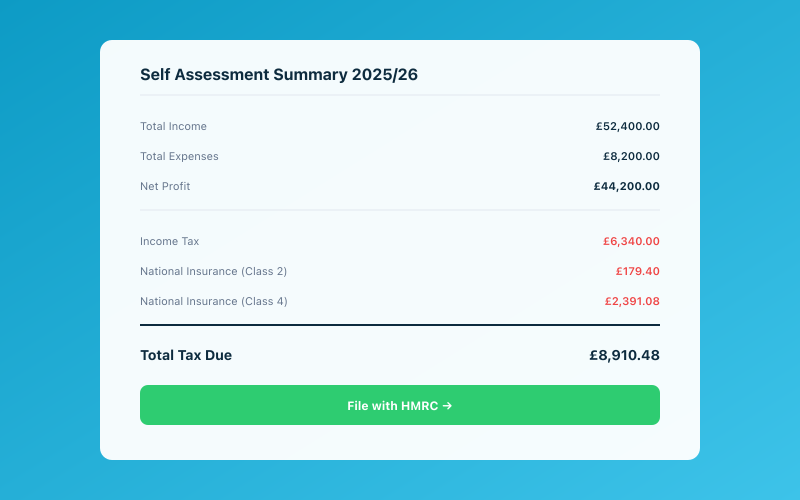 Your Accounted dashboard shows your real-time tax position
Under CRS, foreign banks and financial institutions are required to report information about accounts held by UK tax residents to their local tax authority, which then shares that data with HMRC. The information exchanged typically includes:
- Your name, address, and tax identification number
- Account number
- Account balance or value at the end of each year
- Total interest, dividends, and other income credited to the account
- Gross proceeds from the sale of financial assets
This means HMRC receives an annual data dump covering virtually every UK resident's overseas financial holdings. If you have a foreign bank account and you're not declaring the income from it, there's a very high chance HMRC will find out.
The UK also has separate bilateral agreements, including the FATCA (Foreign Account Tax Compliance Act) agreement with the United States, which covers US financial institutions reporting on UK taxpayers.
What Do You Need to Declare?
Here's the key distinction: you don't need to tell HMRC that a foreign bank account exists. There's no requirement to register or report the mere existence of an overseas account. What you do need to declare is any income or gains arising from that account.
This includes:
- Interest earned on savings or current accounts
- Dividends received from foreign investments held through the account
- Capital gains from selling investments or converting currency at a profit
- Rental income if overseas rental payments are received into the account
- Any other taxable income credited to the account
For the 2025/26 tax year, the Personal Savings Allowance applies to foreign interest just as it does to UK interest:
- Basic rate taxpayers: £1,000 of interest tax-free
- Higher rate taxpayers: £500 of interest tax-free
- Additional rate taxpayers: no Personal Savings Allowance
Foreign interest that falls within your Personal Savings Allowance doesn't need to be paid tax on, but it still needs to be declared on your tax return. This catches many people out — they assume that because no tax is due, they don't need to report it. That's not the case.
How to Declare Foreign Bank Account Income
Foreign bank account income is reported on your Self Assessment tax return. If you're only declaring foreign interest, you can usually include this on the main tax return without needing the separate Foreign pages (SA106). However, if you're claiming double taxation relief on the interest, you will need to complete the Foreign pages.
Here's a step-by-step approach:
-
Gather your statements. Get end-of-year statements from your foreign bank showing all interest and income credited during the UK tax year (6 April to 5 April).
-
Convert to pounds sterling. Use the exchange rate on the date the interest was credited, or use HMRC's yearly average exchange rates. Be consistent in your approach.
-
Report on your tax return. Enter the interest in the foreign income section. If you've had tax withheld at source in the other country, note the amount — you may be able to claim double taxation relief.
-
Claim relief if applicable. If the foreign country has withheld tax on your interest, check whether a double taxation agreement exists. If it does, you can usually claim a credit against your UK tax.
-
Keep records. Retain bank statements, exchange rate calculations, and any foreign tax certificates for at least five years after the filing deadline.
Using Accounted to track foreign income as it arrives makes the year-end process much less painful. Rather than trawling through twelve months of foreign bank statements in January, you can categorise transactions throughout the year and have everything ready when it's time to file.
What About Currency Gains?
This is an area that surprises many people. If you hold foreign currency in an overseas bank account and the exchange rate moves in your favour, you might think that's just good luck. But HMRC may see it differently.
For individuals, foreign currency bank accounts are generally exempt from capital gains tax under the rules for personal bank accounts. However, this exemption applies to accounts used for personal spending — not to accounts held primarily as an investment or for business purposes.
If you're holding large sums in foreign currency specifically to benefit from exchange rate movements, any gains could potentially be subject to Capital Gains Tax. The annual CGT exempt amount for 2025/26 is £3,000, so smaller gains may be covered by this allowance.
For sole traders, currency gains and losses on business transactions are treated as trading income or expenses. If you receive a payment in euros and the exchange rate changes between invoicing and receiving the money, the difference is part of your trading profit or loss. Penny inside Accounted can help you track these currency differences automatically.
The Risks of Not Declaring
HMRC's approach to undeclared offshore income has become increasingly aggressive over the past decade. The penalties for failing to declare foreign income are deliberately set higher than for equivalent domestic non-disclosure:
- Standard penalties for offshore non-disclosure range from 30% to 200% of the tax owed, depending on the level of culpability and the country involved
- Countries are categorised into three groups based on the quality of their information exchange with HMRC — penalties are highest for countries in Category 3 (those with the least transparency)
- In the most serious cases, HMRC can bring criminal prosecution for offshore tax evasion
Since 2017, there's also been a specific offence of failure to correct past offshore non-compliance. This strict liability offence carries penalties of up to 200% of the tax due, and the burden is on you to demonstrate that you had a reasonable excuse for not correcting your position.
The message is clear: voluntary disclosure is always better than being caught. If you have undeclared foreign account income from previous years, HMRC's Worldwide Disclosure Facility is the proper route to put things right. Penalties are typically lower for voluntary disclosures.
Special Situations to Watch For
Joint accounts. If you hold a foreign bank account jointly with a spouse, partner, or family member, you each need to declare your share of the income. The default split is 50/50 unless you have a formal agreement stating otherwise.
Accounts inherited abroad. If you've inherited a bank account in another country, any income it generates after the date of death is your taxable income. The inheritance itself may have Inheritance Tax implications depending on the domicile status of the deceased and the value of the estate.
Business accounts overseas. If you're a sole trader using a foreign bank account for business purposes, all income received into that account and any expenses paid from it need to be reflected in your business accounts. This is no different from a UK business account — it just needs to be converted to sterling. Our guide on the remittance basis for non-domiciled individuals covers some related considerations.
Accounts in countries without CRS. A small number of countries don't participate in CRS. But HMRC has other information sources, and the number of non-participating jurisdictions shrinks every year. Don't assume that an account in a non-CRS country is invisible.
Closed accounts. Even if you've closed a foreign account, you still need to declare any income it generated during the period it was open within the relevant tax year.
Keeping on Top of Foreign Account Reporting
The best approach is to treat foreign bank account income exactly like UK bank account income — something you track, categorise, and report as a matter of routine. Accounted makes this easier by letting you connect and monitor your accounts in one place, so nothing slips through the cracks.
If you're a sole trader with international clients and foreign currency coming in, having a system that handles the currency conversion and categorisation automatically saves hours of manual work. And more importantly, it means you're always ready if HMRC comes knocking.
Related Reading
Start your free trial and let Penny handle your bookkeeping automatically.
Accounted helps UK sole traders stay on top of their bookkeeping and tax. Start your free 30-day trial at getaccounted.co.uk.
Penny, your AI bookkeeper, tracks your tax position in real time and flags opportunities to reduce your bill. Meet Penny →
Tax & Compliance Specialists
Our tax specialists have decades of combined experience in UK sole trader and small business taxation, MTD compliance, and HMRC submissions. All content is reviewed against current HMRC guidance before publication and updated quarterly to reflect legislative changes.
Ready to try Accounted?
Join UK sole traders who are simplifying their bookkeeping and tax.
Start your 14-day free trial