Tax on Business Grants and Government Subsidies
Receiving a business grant or government subsidy is a welcome boost, but many business owners are surprised to discover that most grants are taxable. Understanding when a grant counts as taxable income — and the handful of exceptions — is essential for accurate tax planning and avoiding unexpected bills.
This guide explains how grants and subsidies are taxed in the UK, covering the most common types of funding that small businesses and sole traders receive.
The General Rule: Grants Are Taxable
The default position in UK tax law is straightforward: if a grant is received in connection with your trade, it is taxable as trading income. It does not matter that you did not earn the money through selling goods or services. If the grant relates to your business, it forms part of your taxable profits.
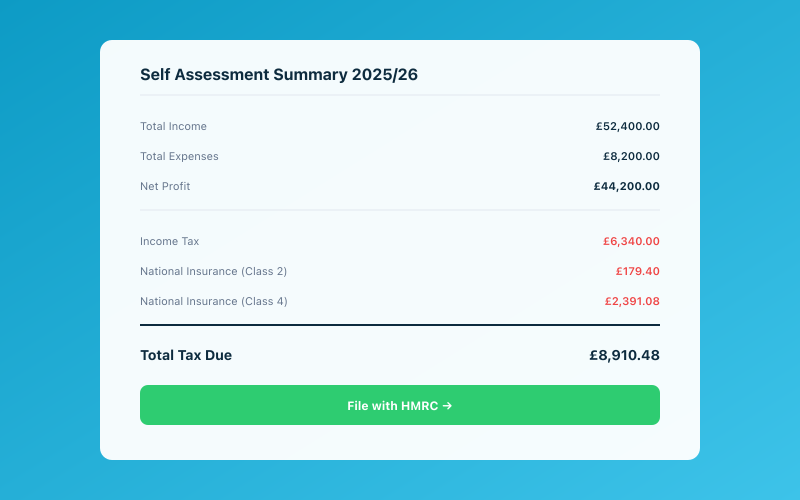 Your Accounted dashboard shows your real-time tax position
This applies to:
- Local authority business grants
- Government support scheme payments
- Innovation and research grants
- Startup grants and enterprise allowance payments
- Sector-specific subsidy schemes
The grant is included in your turnover for the period in which you receive it (or are entitled to receive it, if using accrual accounting). It is then subject to income tax and National Insurance in the same way as any other business income.
Why This Catches People Out
Many people assume that because a grant is not earned income or because it comes from the government, it must be tax-free. This assumption is wrong. The only grants that escape tax are those with specific statutory exemptions, and these are relatively rare.
Revenue Grants vs Capital Grants
The tax treatment depends in part on whether the grant is a revenue grant or a capital grant.
Revenue Grants
A revenue grant is one that supports your day-to-day trading activities — covering running costs, wages, rent, or general business expenses. Revenue grants are taxable as trading income in full.
Examples include:
- Grants to cover staff costs
- Subsidies for business rates
- Payments to support businesses through disruption
- Grants for training or business development activities
Capital Grants
A capital grant is one that is intended to fund the purchase of capital assets — such as equipment, machinery, or property improvements. The tax treatment of capital grants is more nuanced.
In most cases, a capital grant reduces the amount on which you can claim capital allowances. If you receive a £10,000 grant to buy a £25,000 piece of equipment, you claim capital allowances on the net cost of £15,000, not the full £25,000.
Some capital grants may be treated as taxable income if they do not relate to assets that qualify for capital allowances. The precise treatment depends on the nature of the grant and the asset.
SEISS Grants
The Self-Employment Income Support Scheme (SEISS) provided grants to self-employed individuals during the COVID-19 pandemic. HMRC issued five rounds of SEISS grants between 2020 and 2021.
All SEISS grants are taxable as trading income. They should have been reported on the Self Assessment return for the tax year in which they were received. HMRC pre-populated some of this information, but it was the taxpayer's responsibility to ensure the figures were correct.
If you received SEISS grants and did not include them on your tax return, you should correct this as soon as possible. HMRC has been actively checking SEISS compliance and issuing assessments where grants were not declared.
Local Authority Grants
Local councils have awarded a wide range of business grants over the past several years, including small business grants, restart grants, additional restrictions grants, and various local economic development funds.
Almost all local authority grants are taxable as trading income. This includes:
- Small Business Grant Fund payments
- Retail, Hospitality and Leisure Grant Fund payments
- Local Restrictions Support Grants
- Additional Restrictions Grants
- Omicron Hospitality and Leisure Grants
There are very limited exceptions. Some local authority grants explicitly state that they are not taxable, but this is uncommon. Always check the terms of the specific grant you received.
How to Report
Local authority grants are included in your self-employment income on the SA103 (self-employment pages) of your tax return. If you received the grant but were not trading at the time, it may need to be reported as miscellaneous income on SA101 instead.
Innovate UK and Research Grants
Innovate UK awards grants for research and development, innovation, and commercialisation projects. The tax treatment depends on the type of grant:
Revenue Grants from Innovate UK
Grants that fund research activities, staff costs, or operational expenses are taxable as trading income. This is consistent with the general rule.
Capital Grants from Innovate UK
Grants that fund the purchase of capital equipment reduce the amount on which capital allowances can be claimed.
Interaction with R&D Tax Relief
If you receive a grant for R&D expenditure, you cannot also claim R&D tax relief on the same costs. The costs funded by the grant are excluded from your R&D tax relief claim. This prevents double relief — you cannot receive a grant and then claim additional tax relief on money that was not your own expenditure.
For sole traders and partnerships, R&D tax relief is not available in the same way as for companies. However, this principle is relevant if you are considering incorporating or if you operate through a limited company.
Enterprise Allowance and Startup Grants
Various government and charitable schemes offer grants to help people start businesses. The New Enterprise Allowance (which ran until 2021) provided a weekly allowance plus a startup loan.
Weekly allowance payments under the New Enterprise Allowance were taxable as trading income. Loans, on the other hand, are not income and are not taxable — but any loan forgiveness would be taxable.
Other startup grants from charities, enterprise agencies, or local schemes are also generally taxable unless specifically exempted.
Grants That Are Not Taxable
While most grants are taxable, there are some exceptions:
Certain Agricultural and Environmental Grants
Some grants paid to farmers and landowners for environmental management (such as Environmental Stewardship payments or Countryside Stewardship payments) may have specific tax rules. The treatment depends on the particular scheme, and some payments are capital in nature.
Enterprise Finance Guarantee Payments
Payments made by the government to lenders under the Enterprise Finance Guarantee scheme are not income of the business — they are payments to the lender. These do not affect the business's tax position directly.
COVID-19 Test and Trace Support Payments
The £500 Test and Trace Support Payments made to individuals on low incomes who were told to self-isolate were not taxable.
Personal Grants
Grants that are genuinely personal — such as a personal hardship grant from a charity, not connected to your trade — are not taxable as trading income. However, the line between personal and business grants can be blurred.
Record Keeping for Grants
Proper record keeping is essential:
- Keep the grant offer letter — this specifies the purpose and any conditions
- Record the date received and the amount
- Note which tax year the grant falls into (particularly important if the grant bridges a 5 April boundary)
- Separate grant income from your normal trading income in your accounts for clarity
- Keep records of how you spent the grant — this may be relevant for capital vs revenue classification
If a grant has conditions attached (for example, it must be spent on specific items), keep evidence that you met those conditions. While this does not change the tax treatment, it protects you if the grant body audits your use of funds.
Reporting on Your Tax Return
On your Self Assessment return:
- Revenue grants are included as part of your total business income on the SA103 self-employment pages. You can include them in "Other income" or simply add them to your turnover figure.
- Capital grants are reflected through the reduced capital allowances claim.
- SEISS grants had a specific box on the SA103 in the relevant tax years (boxes 27.1 to 27.5 for the five SEISS grants).
HMRC's guidance notes for the SA103 provide specific instructions on where to enter different types of grant income.
Let Accounted Keep Track
Grants and subsidies need to be categorised correctly to ensure accurate tax reporting. Accounted tracks all your income sources, and Penny, your AI bookkeeper, flags grant income for proper classification — distinguishing between revenue and capital grants so your tax return is right first time. Start your free trial and let Accounted handle the details.
Related Reading
-
Do I Pay Tax on Savings Interest? Personal Savings Allowance Explained
-
Annual Investment Allowance Explained: Claim 100% of Equipment Costs
Start your free trial and let Penny handle your bookkeeping automatically.
Penny, your AI bookkeeper, tracks your tax position in real time and flags opportunities to reduce your bill. Meet Penny →
Tax & Compliance Specialists
Our tax specialists have decades of combined experience in UK sole trader and small business taxation, MTD compliance, and HMRC submissions. All content is reviewed against current HMRC guidance before publication and updated quarterly to reflect legislative changes.
Ready to try Accounted?
Join UK sole traders who are simplifying their bookkeeping and tax.
Start your 14-day free trial