Annual Investment Allowance Explained: Claim 100% of Equipment Costs
When you buy equipment for your business, you cannot usually deduct the full cost as a simple expense in the way you would with, say, stationery or travel. Equipment is capital expenditure, and capital expenditure follows different tax rules. However, the Annual Investment Allowance (AIA) lets you claim tax relief on the entire cost of qualifying assets in the year you purchase them — up to a generous limit.
For many sole traders and small businesses, the AIA means you can write off the full cost of computers, tools, machinery, and certain vehicles against your taxable profits in a single year. This guide explains how it works, what qualifies, and how to claim it on your tax return.
What Is the Annual Investment Allowance?
The AIA is a type of capital allowance. Capital allowances are the tax system's way of letting you deduct the cost of business assets over time. Without any special allowance, you would claim relief through writing down allowances, which spread the deduction over several years at a fixed percentage.
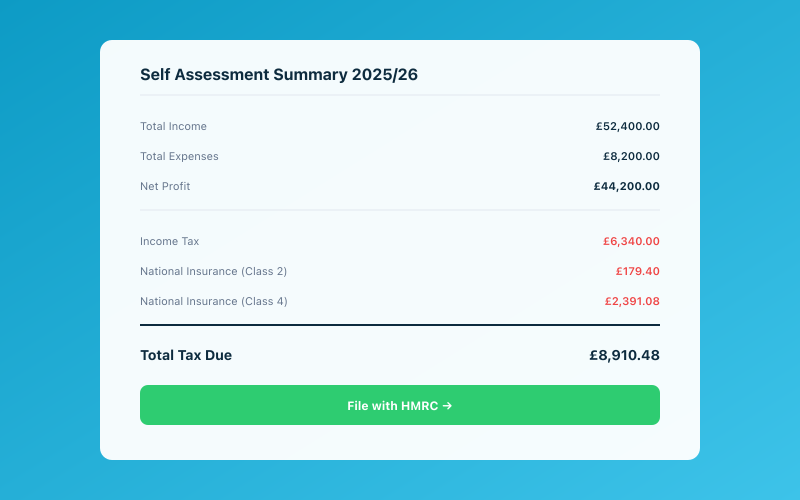 Your Accounted dashboard shows your real-time tax position
The AIA short-circuits this process. Instead of spreading the cost over multiple years, you can deduct 100% of the cost in the year you buy the asset, up to the AIA limit.
The Current AIA Limit
The AIA limit is £1,000,000 per year. This limit has been permanent since April 2023, after years of being temporarily increased and decreased.
For the vast majority of sole traders and small businesses, this limit is more than enough. You would need to spend over £1 million on qualifying assets in a single tax year before the AIA cap became relevant. In practice, almost every small business can claim the full cost of every qualifying purchase through the AIA.
What Qualifies for the AIA
The AIA covers most tangible assets that you use in your business, provided they qualify as plant and machinery. HMRC's definition of plant and machinery is broad and includes:
Office Equipment and Technology
- Computers, laptops, and tablets
- Printers, scanners, and monitors
- Servers and networking equipment
- Software (if purchased outright, not subscriptions)
- Office furniture — desks, chairs, shelving, filing cabinets
Tools and Machinery
- Power tools and hand tools
- Workshop machinery — lathes, drill presses, welding equipment
- Manufacturing equipment
- Diagnostic equipment
Vehicles
- Vans and commercial vehicles
- Lorries and trucks
- Motorcycles used for business
Cars are a special case — see the section below.
Other Qualifying Items
- Shop fittings and display units
- Security systems (CCTV, alarms)
- Air conditioning and heating systems (where they are separate from the building)
- Kitchen equipment for catering businesses
- Gym equipment for fitness businesses
- Agricultural machinery and equipment
Integral Features
Certain building-related items qualify as integral features and are eligible for the AIA. These include:
- Electrical systems (including lighting)
- Cold water systems
- Space and water heating systems
- Lifts, escalators, and moving walkways
- External solar shading
Integral features qualify for the AIA up to the £1,000,000 limit, but if you exceed the limit, they fall into the special rate pool at 6% writing down allowance rather than the main rate pool at 18%.
What Does Not Qualify for the AIA
Buildings and Structures
You cannot claim the AIA on the cost of a building itself, or on any structural alterations. The Structures and Buildings Allowance (SBA) provides a separate 3% annual relief for qualifying commercial buildings, but that is a different scheme entirely.
Land
The purchase price of land is never eligible for capital allowances of any kind.
Cars
This is the most common point of confusion. Cars do not qualify for the AIA. Instead, they are handled through other capital allowance rules:
- Zero-emission cars (fully electric): 100% first-year allowance — you can deduct the full cost in year one, but through a different mechanism than the AIA.
- Cars with CO2 emissions of 50g/km or less: 18% writing down allowance (main rate pool).
- Cars with CO2 emissions above 50g/km: 6% writing down allowance (special rate pool).
Vans, however, do qualify for the AIA. The distinction between a car and a van matters and is based on the vehicle's construction and design, not just what you call it.
Items for Non-Business Use
If you buy an asset that is partly for business and partly for personal use, you can only claim the AIA on the business proportion. For example, if you buy a laptop for £1,200 and use it 70% for business, you can claim AIA on £840.
Second-Hand Assets Purchased from a Connected Person
If you buy an asset from a spouse, family member, or a business you control, special rules may restrict your claim. The AIA is generally available for second-hand purchases from unconnected third parties.
How to Claim the AIA on Your Tax Return
Sole Traders
If you are self-employed, you claim the AIA on the capital allowances section of the self-employment pages of your Self Assessment return (SA103). You list the qualifying expenditure, apply the AIA, and the resulting figure reduces your taxable profit.
If you use cash basis accounting, you generally do not need to worry about capital allowances at all — most asset purchases are simply treated as allowable expenses. However, cars are an exception even under cash basis. If you use traditional accruals accounting, the AIA is your primary tool for claiming relief on equipment.
Partnerships
Each partnership gets one AIA of £1,000,000, not one per partner. The claim is made on the partnership tax return (SA800).
Limited Companies
Companies claim the AIA on their Corporation Tax return (CT600). Each company gets its own AIA, but groups of companies or companies under common control may need to share a single allowance.
Timing
The AIA is based on when you incur the expenditure, not when the asset is delivered or put into use. For sole traders using accruals accounting, this is typically the date you are invoiced. For those on cash basis, it is the date you actually pay.
AIA vs Full Expensing
Since April 2023, companies (not sole traders or partnerships) can also claim full expensing — a 100% first-year deduction on qualifying new plant and machinery with no upper limit. Full expensing is only available to companies paying Corporation Tax and only applies to new (not second-hand) assets.
For sole traders and partnerships, the AIA remains the primary route to 100% first-year relief.
Practical Examples
Example 1: Freelance Photographer
You buy a new camera body for £2,500, two lenses for £1,800 each, a lighting kit for £600, and a computer for editing for £2,200. Total qualifying expenditure: £8,900. You claim the full £8,900 as AIA, reducing your taxable profit by that amount.
Example 2: Plumber
You buy a new van for £28,000 and £3,000 worth of tools. The van qualifies for the AIA (it is a van, not a car). The tools qualify too. Total AIA claim: £31,000.
Example 3: Consultant
You buy a laptop for £1,400 and an office chair for £500. You use the laptop 80% for business. AIA claim: (£1,400 x 80%) + £500 = £1,620.
Keep Your Records
HMRC requires you to keep records of every asset you claim AIA on, including purchase invoices, proof of payment, and evidence of business use. If you claim a partial deduction for mixed-use assets, keep a note of how you calculated the business proportion.
Accounted's AI bookkeeper, Penny, identifies capital purchases automatically from your bank feed and categorises them separately from day-to-day expenses, so your capital allowances are always up to date.
Start your free trial of Accounted today and let Penny track your equipment purchases, calculate your AIA claim, and keep your tax return figures ready year-round.
Related Reading
Start your free trial and let Penny handle your bookkeeping automatically.
Penny, your AI bookkeeper, tracks your tax position in real time and flags opportunities to reduce your bill. Meet Penny →
Tax & Compliance Specialists
Our tax specialists have decades of combined experience in UK sole trader and small business taxation, MTD compliance, and HMRC submissions. All content is reviewed against current HMRC guidance before publication and updated quarterly to reflect legislative changes.
Ready to try Accounted?
Join UK sole traders who are simplifying their bookkeeping and tax.
Start your 14-day free trial