Getting a Mortgage When You're Self-Employed — The 2026 Guide
Buying a home is stressful enough without the added complication of being self-employed. If you've ever spoken to a mortgage adviser and watched their expression change the moment you said "sole trader" or "freelancer," you'll know what we mean. The process can feel like it's stacked against you.
But here's the truth: self-employed people get mortgages every single day. Lenders haven't stopped lending to the self-employed — they just want more evidence that you can afford the repayments. The key is understanding what they're looking for, preparing your paperwork thoroughly, and presenting your finances in the best possible light.
Here's your complete guide to getting a mortgage when you're self-employed in 2026.
What Lenders Want to See
When an employed person applies for a mortgage, lenders typically ask for three months of payslips and a P60. It's straightforward because the income is predictable and verified by an employer.
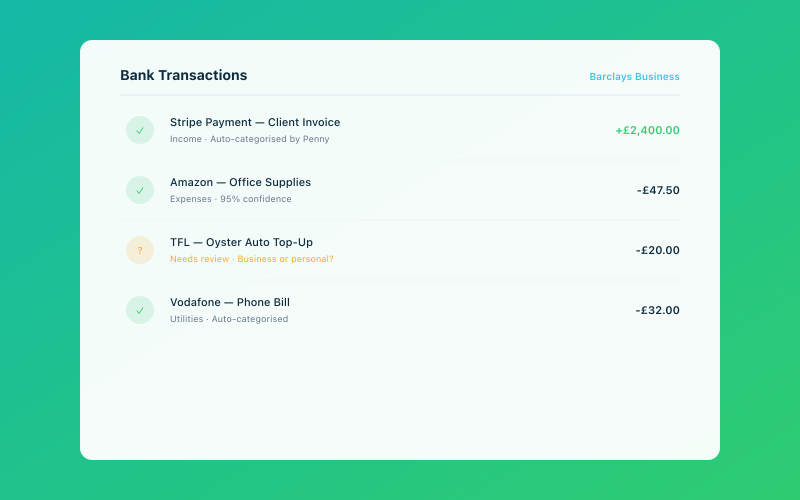 Penny auto-categorises your bank transactions with 95%+ accuracy
When you're self-employed, there's no employer to vouch for you. So lenders need to do more digging. Here's what most will ask for:
Two to three years of accounts or tax returns. This is the big one. Most high-street lenders want to see at least two full years of Self Assessment tax returns (SA302s) or accounts prepared by an accountant. Some specialist lenders will consider applicants with just one year of records, though the rates may be higher.
SA302 tax calculations. These are the official documents from HMRC that summarise your taxable income and tax paid for each year. You can download them from your HMRC online account or ask your accountant to provide them.
Tax year overviews. These confirm that your tax has been paid and that the SA302 figures are correct. Lenders use these to verify your income.
Bank statements. Usually three to six months of business and personal bank statements. Lenders want to see regular income coming in and responsible spending habits.
Proof of deposit. Evidence of where your deposit money has come from. If it's savings, they'll want to see the savings account. If it's a gift from family, they'll want a signed letter confirming it.
ID and address verification. Passport or driving licence, plus recent utility bills or council tax statements.
How Lenders Calculate Your Income
This is where it gets interesting — and where many self-employed applicants get confused.
For sole traders, most lenders look at your net profit (income minus allowable expenses) as declared on your tax return. Some will take the average of your last two or three years' profits, while others will use the most recent year. If your income has been growing, lenders who use the latest year's figure will give you a more favourable assessment.
For limited company directors, lenders typically look at your salary plus dividends. However, some lenders will also consider retained profits within the company, which can significantly increase the amount you're able to borrow.
For partnerships, lenders look at your share of the partnership profits.
The amount you can borrow is usually calculated as a multiple of your income — typically 4 to 4.5 times, though some lenders will stretch to 5 or even 5.5 times for well-qualified applicants.
Example: If your average net profit over the last two years is £45,000, a lender offering 4.5 times income would consider a mortgage of up to £202,500. Add your deposit to that figure to get an idea of the property price you could afford.
How to Prepare Before You Apply
Preparation is everything. The more organised your finances are when you apply, the smoother the process will be. Start preparing at least 6 to 12 months before you plan to buy.
File your tax returns on time
Late filing is a red flag for lenders. It suggests disorganisation at best and financial difficulty at worst. Make sure your Self Assessment is filed well before the deadline — January 31st for online filing — and that your tax is paid up to date.
Keep your accounts clean and up to date
Lenders want to see well-organised financial records. If your books are a mess of unsorted transactions and missing receipts, it's going to make the process harder (and your accountant more expensive). Using Accounted to keep your records current throughout the year means you're always mortgage-ready, rather than scrambling to pull everything together at the last minute.
Maximise your declared income
This is a common tension for the self-employed: you want to minimise your taxable income to reduce your tax bill, but you also need to declare enough income to qualify for a mortgage. Overclaiming expenses or using aggressive tax avoidance can reduce your declared profits to the point where lenders won't offer you enough.
The honest truth is that there's a trade-off. You need to claim all the expenses you're genuinely entitled to — but don't artificially inflate them. Your cash flow forecasting should account for both your tax position and your borrowing ambitions.
Build a strong deposit
The bigger your deposit, the better your mortgage terms. Aim for at least 10% if possible — 15% or 20% will unlock even better rates. Self-employed applicants with larger deposits are viewed as lower risk, which can offset any concerns a lender might have about income variability.
Check your credit score
We won't repeat the full guide here, but your credit score matters enormously. Check your reports with Experian, Equifax, and TransUnion, fix any errors, and make sure you're on the electoral roll. If your score needs work, give yourself time to improve it before applying.
Reduce existing debt
Outstanding loans, credit card balances, and overdrafts all affect your affordability assessment. Pay down as much debt as possible before applying. Lenders look at your total monthly commitments to determine how much you can afford in mortgage repayments.
Choosing the Right Lender
Not all lenders are created equal when it comes to self-employed applicants. High-street banks tend to have stricter criteria, while specialist lenders and building societies are often more flexible.
High-street lenders (Barclays, HSBC, Nationwide, etc.) — generally require at least two years of accounts and use standard income calculations. Good rates but less flexibility.
Building societies — many have more flexible criteria for self-employed applicants. Some will consider applications with just one year of accounts, or look at gross income rather than net profit.
Specialist lenders — focus on applicants who don't fit the standard mould. They may accept fewer years of accounts, contractor day rates, or retained company profits. Rates are typically slightly higher.
Using a mortgage broker is strongly recommended if you're self-employed. A good broker knows which lenders are most receptive to self-employed applicants, which criteria they use, and how to present your application in the best light. They can save you from wasting time (and hard credit searches) on lenders who are likely to decline.
Common Mistakes to Avoid
Applying to too many lenders. Each full application creates a hard search on your credit file. Multiple searches in a short period can damage your score and put other lenders off. Use a broker or eligibility checkers first.
Not having your paperwork ready. Delays in providing documents slow down the process and can frustrate underwriters. Have everything organised and ready to go before you start.
Changing your business structure just before applying. Switching from sole trader to limited company (or vice versa) resets the clock on your trading history. If you're planning to apply for a mortgage, keep your business structure stable.
Forgetting about affordability. Lenders don't just look at your income — they stress-test your ability to afford repayments if interest rates rise. Make sure you've considered this yourself. Could you afford your mortgage if rates went up by 2 or 3 percentage points?
Hiding financial problems. If you've had a difficult year, don't try to hide it. Lenders will find out, and dishonesty is far worse than a dip in profits. If your most recent year was strong, focus on finding a lender who uses the latest year's figures rather than an average.
What If You've Only Been Self-Employed for a Short Time?
If you have fewer than two years of accounts, your options are more limited but not non-existent. Some lenders will consider:
- One year of accounts — particularly if you were previously employed in the same field (showing continuity of income).
- Contractor mortgages — if you work on fixed-term contracts, some lenders will calculate affordability based on your daily or annual contract rate rather than your tax returns.
- Joint applications — if your partner is employed, their income can strengthen the application significantly.
It's also worth keeping meticulous records from day one. Even if you're not ready to apply yet, building a clean financial history with organised books and timely tax returns puts you in the strongest possible position when you are.
The Role of Your Accountant
If you have an accountant, they're one of your most valuable allies in the mortgage process. They can prepare your accounts in a format lenders recognise, provide references or confirmation of income, and help you understand the trade-offs between tax efficiency and borrowing capacity.
If you don't have an accountant, keeping your books meticulously in Accounted gives you a solid foundation. Penny helps ensure your records are accurate and up to date, and when the time comes to file your Self Assessment, everything is in order — which means your SA302 figures accurately reflect your trading position.
Related Reading
Accounted helps UK sole traders stay on top of their bookkeeping and tax. Start your free 30-day trial at getaccounted.co.uk.
Further Reading
- Check the current income tax rates on GOV.UK.
- HMRC outlines record-keeping requirements for businesses.
- See the rules on dividends on GOV.UK.
Try Accounted free for 30 days — no credit card required.
Accounted makes bookkeeping simple — Penny categorises your transactions automatically so you don't have to. See how →
Tax & Compliance Specialists
Our tax specialists have decades of combined experience in UK sole trader and small business taxation, MTD compliance, and HMRC submissions. All content is reviewed against current HMRC guidance before publication and updated quarterly to reflect legislative changes.
Ready to try Accounted?
Join UK sole traders who are simplifying their bookkeeping and tax.
Start your 14-day free trial