How to Save for Your Tax Bill — Practical Methods
If you've ever opened a Self Assessment statement and felt your stomach drop, you're not alone. For many sole traders and freelancers, the tax bill is the single most stressful moment of the year — not because the amount is unreasonable, but because they simply didn't plan for it.
The good news? Saving for your tax bill doesn't have to be complicated. With the right method (and a bit of discipline), you can make January and July payment deadlines feel like just another Tuesday. Let's walk through the most practical ways to set money aside so you're always ready.
Why So Many Sole Traders Get Caught Out
It's easy to see why tax bills catch people off guard. When you're employed, PAYE handles everything behind the scenes — your tax and National Insurance are deducted before you even see your wages. But when you're self-employed, every penny of your income lands in your account untouched. It feels like it's all yours, even though a chunk of it isn't.
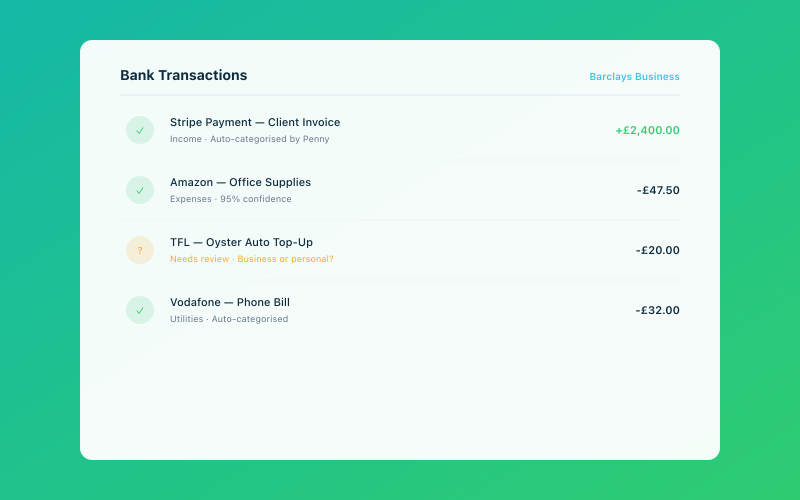 Penny auto-categorises your bank transactions with 95%+ accuracy
Add in payments on account — where HMRC asks you to pay towards next year's bill in advance — and you can end up facing a bill that's significantly larger than you expected. If you haven't been putting money aside regularly, that's when the panic sets in.
The solution isn't earning more or spending less (though those help). It's building a reliable system for saving throughout the year. Here are the methods that actually work.
Method 1: The Percentage Rule
This is arguably the simplest approach, and it's the one most accountants recommend as a starting point. Every time you receive payment from a client, immediately transfer a fixed percentage into a separate savings account.
But what percentage should you use? That depends on your total income and expenses, but here's a rough guide:
- Basic rate taxpayers (profits under £50,270): Set aside 25–30% to cover income tax and National Insurance.
- Higher rate taxpayers (profits above £50,270): Set aside 35–40% on everything above the basic rate threshold.
- Not sure where you'll land? Start with 30%. It's better to over-save and give yourself a pleasant surprise than to under-save and scramble.
The beauty of this method is its simplicity. You don't need a spreadsheet or a calculator — just move the money as soon as it comes in. If you use Accounted, Penny can help you keep track of your income as it arrives, making it even easier to know exactly how much to transfer.
Method 2: The Monthly Budget Approach
If your income is relatively stable — say you have a handful of regular clients who pay you roughly the same amount each month — you might prefer a monthly budgeting approach.
Here's how it works:
- Estimate your annual profit (income minus allowable expenses).
- Calculate your likely tax and National Insurance bill using an online calculator or your accounting software.
- Divide that figure by 12.
- Set up a standing order to move that amount into your tax savings account on the same day each month.
For example, if you estimate your tax bill will be around £6,000 for the year, you'd move £500 a month into savings. Simple.
The advantage here is predictability. You know exactly what's leaving your current account each month, which makes broader budgeting much easier. The downside is that if your income varies a lot, your estimate might be off. That's why it's worth revisiting your calculation every quarter — something that becomes much simpler with proper cash flow management.
Method 3: The Separate Bank Account Strategy
Whichever saving method you choose, this one principle underpins all of them: keep your tax money in a separate account. Ideally, one you can't easily dip into with your debit card.
Many sole traders open a dedicated savings account specifically for tax. Some even use a notice account (where you need to give 30 or 60 days' notice before withdrawing) to add a barrier between themselves and temptation.
Here's a practical setup that works well:
- Account 1: Business current account — where client payments land and business expenses go out.
- Account 2: Tax savings account — where your tax percentage or monthly amount gets transferred. Touch this only for tax payments.
- Account 3: Personal account — where you pay yourself a regular "salary" from your business account.
This three-account system keeps things clean and ensures your tax money is ringfenced. If you haven't already separated your personal and business finances, this is the perfect time to start.
Method 4: Use HMRC's Budget Payment Plan
Here's one that surprisingly few people know about. HMRC actually offers a Budget Payment Plan that lets you make regular payments towards your Self Assessment bill throughout the year, rather than paying in two large lump sums.
You can set up weekly or monthly Direct Debit payments to HMRC, and the money goes towards your next tax bill. It's essentially a standing order straight to the taxman.
The benefits are clear:
- You can't accidentally spend the money because it's already gone to HMRC.
- There's no temptation to dip into savings.
- When your bill arrives, it's either fully paid or close to it.
To set this up, you'll need to log into your HMRC online account and navigate to the Budget Payment Plan section. You can adjust the amount at any time, and if you overpay, HMRC will refund the difference.
It's worth noting this only works if you're up to date with your tax returns. If you have outstanding filings, sort those first.
Method 5: The Quarterly Check-In
Rather than setting a percentage and forgetting about it, some sole traders prefer to review their position every quarter. This is particularly useful if your income fluctuates significantly — perhaps you're a seasonal business, or you have busy and quiet periods throughout the year.
Every three months, sit down and review:
- Total income received so far this tax year.
- Total expenses claimed so far.
- Estimated profit to date.
- Tax saved so far versus what you're likely to owe.
This quarterly rhythm has another advantage: it mirrors the cadence of Making Tax Digital quarterly submissions, so you're building a habit that'll serve you well as MTD for income tax rolls out.
Using Accounted, you can pull up your income and expenses in seconds, making these quarterly check-ins genuinely quick rather than an afternoon of sifting through bank statements and receipts.
Bonus Tips to Make Saving Easier
Beyond the core methods above, a few extra habits can make the whole process smoother:
Automate everything you can. The less you have to think about transferring money, the more likely you are to do it consistently. Set up automatic transfers on the day you typically get paid, or the day after.
Round up your savings. If your percentage calculation says you should save £347, round it up to £350 or even £400. Those small cushions add up over the year.
Don't forget payments on account. If your tax bill is over £1,000 and less than 80% of your tax was collected at source, HMRC will ask you to make payments on account. Factor these into your saving — they can effectively double your first Self Assessment bill if you're not prepared.
Claim all your allowable expenses. The lower your taxable profit, the lower your tax bill. Make sure you're claiming everything you're entitled to — from home office costs to mileage. Penny can help flag expenses you might have missed, so you're not paying more tax than you need to.
Build a buffer. Aim to save slightly more than you think you'll need. If your bill comes in lower than expected, you've got a lovely bonus sitting in savings. If it comes in higher (perhaps due to payments on account), you're covered.
What to Do If You're Already Behind
If you're reading this and your tax bill is already due (or overdue), don't panic. HMRC offers Time to Pay arrangements for people who genuinely can't afford to pay in one go. You can call their Self Assessment helpline and negotiate a payment plan — typically spreading the bill over 6 to 12 months.
The key is to contact them before the deadline, not after. HMRC is generally more accommodating with taxpayers who reach out proactively. And whatever you do, file your return on time even if you can't pay — the penalties for late filing are separate from (and in addition to) the penalties for late payment.
Going forward, use one of the methods above to make sure you never end up in that position again.
Related Reading
Try Accounted free for 30 days — no credit card required.
Accounted helps UK sole traders stay on top of their bookkeeping and tax. Start your free 30-day trial at getaccounted.co.uk.
Accounted makes bookkeeping simple — Penny categorises your transactions automatically so you don't have to. See how →
Tax & Compliance Specialists
Our tax specialists have decades of combined experience in UK sole trader and small business taxation, MTD compliance, and HMRC submissions. All content is reviewed against current HMRC guidance before publication and updated quarterly to reflect legislative changes.
Ready to try Accounted?
Join UK sole traders who are simplifying their bookkeeping and tax.
Start your 14-day free trial