Understanding Your Bank Statement — A Guide for New Business Owners
Your bank statement is probably the most frequently ignored financial document in your business. It lands in your inbox (or your letterbox, if your bank still does that), and unless something looks obviously wrong, you might not give it more than a passing glance.
But here's why that's a missed opportunity: your bank statement is the single most reliable record of what's actually happened with your money. Not what you planned to spend, not what you invoiced, not what your spreadsheet says — but what genuinely went in and out of your account.
For new business owners especially, learning to read and use your bank statement properly is one of the fastest ways to get a handle on your finances. Let's walk through everything you need to know.
What Is a Bank Statement?
A bank statement is a summary of all the transactions on your bank account over a set period — usually a month, though you can often request statements for custom date ranges through your online banking.
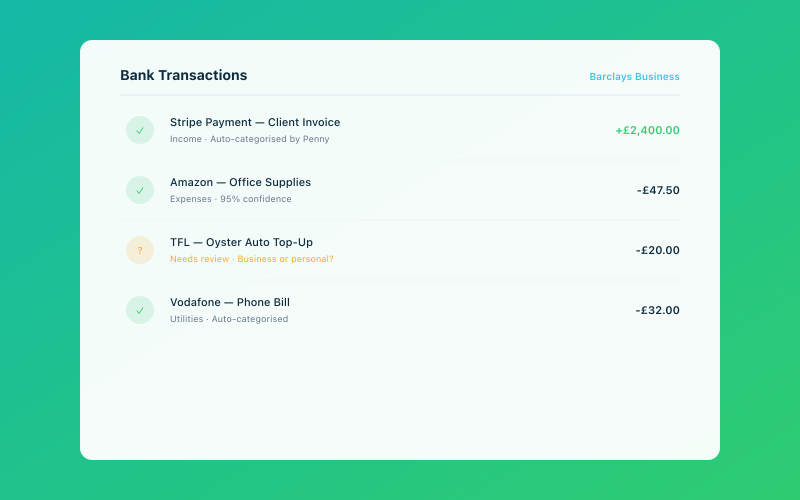 Penny auto-categorises your bank transactions with 95%+ accuracy
Each statement typically includes:
- Your account details — account name, sort code, and account number
- The statement period — the start and end dates covered
- Opening balance — what was in your account at the start of the period
- A list of transactions — every payment in and payment out, with dates, descriptions, and amounts
- Closing balance — what was in your account at the end of the period
If you bank online (and most of us do these days), you can view this information in real time rather than waiting for a monthly statement. But the principle is the same.
Reading the Transaction List
The transaction list is where most of the useful information sits, and it's also where things can get a bit confusing — particularly when the descriptions aren't exactly crystal clear.
Money In (Credits)
These are payments received into your account. For a sole trader, common credits include:
- Customer payments — bank transfers from clients, or card payments if you use a payment terminal
- BACS payments — these are typically from clients who pay via their bank's payment system, often showing as "BACS" followed by a reference
- Faster Payments — instant or same-day transfers, often labelled "FP" or "FASTER PAYMENT"
- Direct credits — sometimes used for regular payments like rental income
- Cash deposits — if you've paid cash into your account at a branch or post office
The descriptions can be cryptic. A payment from "SMITH J" might be obvious if you've got a client called John Smith, but "FP 12345678 REF ABC" is less helpful. This is one reason it's worth asking clients to include a clear reference (like their name or your invoice number) when they pay.
Money Out (Debits)
These are payments leaving your account. Common types include:
- Direct debits — regular automated payments for things like insurance, phone contracts, or software subscriptions
- Standing orders — fixed regular payments you've set up, such as rent or savings transfers
- Card payments — purchases made with your debit card, often showing the retailer name and sometimes a location
- Bank transfers — one-off payments you've made to suppliers or others
- Cash withdrawals — ATM withdrawals, which will show the date and sometimes the machine location
- Charges and fees — any bank charges, interest on overdrafts, or fees for specific services
Understanding Transaction Codes
Banks use various codes and abbreviations in transaction descriptions. Here are some of the most common:
| Code | Meaning | |---|---| | DD | Direct Debit | | SO | Standing Order | | FP or FPO | Faster Payment (outgoing) | | FPI | Faster Payment (incoming) | | BACS | Bankers' Automated Clearing System | | BGC | Bank Giro Credit | | ATM | Cash machine withdrawal | | POS | Point of Sale (card payment) | | CHQ | Cheque | | TFR | Transfer between your own accounts | | DR | Debit (money out) | | CR | Credit (money in) | | O/D | Overdraft |
Knowing these codes makes it much easier to understand what each transaction actually is, especially when the description is otherwise unhelpful.
Why Your Bank Statement Matters for Your Business
It's Your Primary Financial Record
HMRC requires you to keep accurate business records, and your bank statement is the backbone of those records. It provides an independent, verifiable record of every financial transaction — which is exactly what you need if HMRC ever asks questions.
For sole traders using cash basis accounting, your bank statement essentially drives your entire tax calculation. Income is recorded when it hits your account, and expenses are recorded when they leave it.
It Helps You Spot Errors and Fraud
Mistakes happen. A supplier might charge you twice. A subscription you cancelled might still be taking payments. In rare cases, there might be fraudulent transactions you didn't authorise. If you're not reviewing your statements, you won't catch these until they've already caused damage.
Make it a habit to review your transactions at least once a week. It only takes a few minutes, and it can save you from nasty surprises.
It Powers Bank Reconciliation
Bank reconciliation is the process of matching your bank statement transactions against your own bookkeeping records. It's one of the most important things you can do to keep your finances accurate.
The idea is simple: every transaction on your bank statement should have a corresponding entry in your books, and vice versa. If something doesn't match, you investigate why. Perhaps you forgot to record an expense. Maybe a client payment hasn't cleared yet. Or perhaps there's a genuine error somewhere.
Regular reconciliation catches mistakes early and keeps your records reliable. If you're using Accounted, Penny can help match transactions automatically, which takes most of the manual effort out of the process.
How to Use Your Bank Statement Effectively
Step 1: Separate Personal and Business Banking
If you're running your business transactions through your personal account, reading your bank statement becomes much harder. You'll need to sift through personal spending to find business transactions, which is time-consuming and error-prone.
Opening a dedicated business bank account — even a simple second current account — makes everything clearer. For more on why this matters, read our guide on separating personal and business finances.
Step 2: Review Regularly
Don't wait until tax season to look at your statements. Set a weekly reminder to review your recent transactions. Check that:
- All expected payments have been received
- No unexpected charges have appeared
- Direct debits and subscriptions are still correct
- Your balance is roughly where you expect it to be
Step 3: Categorise Your Transactions
For bookkeeping purposes, each transaction needs to be categorised — is it income, an expense, a drawing, or a transfer between accounts? And if it's an expense, what type? Office supplies, travel, subscriptions, professional fees?
Categorising as you go (rather than leaving it all until January) makes your end-of-year accounts far easier to prepare. It also means you can see at a glance where your money is going throughout the year.
Step 4: Reconcile Monthly
At the end of each month, reconcile your bank statement against your bookkeeping records. Check that:
- Your recorded income matches the credits on your statement
- Your recorded expenses match the debits
- Your opening and closing balances match
- Any discrepancies are investigated and resolved
This might sound tedious, but it's genuinely one of the most valuable financial habits you can build. It keeps your records clean, catches mistakes early, and means your tax return is largely done before you even start it.
Step 5: Keep Your Statements
HMRC requires you to keep financial records for at least five years after the 31 January submission deadline for the relevant tax year. Your bank statements are a key part of these records. Most banks let you download statements as PDFs from online banking, so it's worth saving these in an organised folder — by month and year — as you go.
Common Mistakes New Business Owners Make
Not Reviewing Statements at All
The most common mistake, and the easiest to fix. Even a five-minute weekly scan is better than nothing.
Ignoring Small Charges
That £9.99 subscription you forgot about might not seem significant, but twelve months of forgotten subscriptions can add up to hundreds of pounds. Review every line.
Assuming the Balance Is "Spare" Money
Your bank balance isn't the same as money you can spend. You may have tax to pay, invoices to settle, or upcoming expenses that will reduce it significantly. Always think about what's committed before spending what's available. Understanding the difference between profit and cash flow helps here.
Not Downloading or Saving Statements
Banks don't always keep statements available online indefinitely. Download and save yours regularly. If you ever face an HMRC enquiry years down the line, you'll be glad you did.
Mixing Personal and Business Transactions
We've said it already, but it bears repeating. Mixing personal and business banking makes everything harder — reading your statement, categorising transactions, calculating tax, and defending your figures to HMRC.
Making It All Easier
Your bank statement is a goldmine of information about your business. It tells you exactly where your money is coming from, exactly where it's going, and exactly where you stand right now. That's powerful.
The key is to engage with it regularly rather than treating it as background noise. A weekly review, monthly reconciliation, and proper categorisation of transactions will transform your understanding of your business finances — and make tax time far less stressful.
If the idea of manually categorising and reconciling transactions fills you with dread, you're not alone. That's exactly why tools like Accounted exist — to automate the tedious parts and let you focus on running your business.
Accounted helps UK sole traders stay on top of their bookkeeping and tax. Start your free 30-day trial at getaccounted.co.uk
Related reading:
- What Is Bookkeeping and Why Does It Matter?
- How to Keep Business Records for HMRC
- Separating Personal and Business Finances
Related Reading
Try Accounted free for 30 days — no credit card required.
Accounted makes bookkeeping simple — Penny categorises your transactions automatically so you don't have to. See how →
Tax & Compliance Specialists
Our tax specialists have decades of combined experience in UK sole trader and small business taxation, MTD compliance, and HMRC submissions. All content is reviewed against current HMRC guidance before publication and updated quarterly to reflect legislative changes.
Ready to try Accounted?
Join UK sole traders who are simplifying their bookkeeping and tax.
Start your 14-day free trial