ISAs for Self-Employed People — Which Type Is Best?
When you're self-employed, tax efficiency isn't just a nice-to-have — it's essential. You're already juggling income tax, National Insurance, and possibly VAT, so any opportunity to shelter your money from the taxman deserves serious consideration. And that's where ISAs come in.
Individual Savings Accounts (ISAs) let you save or invest up to £20,000 per tax year completely free from income tax and capital gains tax. Whether you're building an emergency fund, saving for a house deposit, or investing for the long term, there's an ISA type designed for your situation.
But with several types available — Cash ISAs, Stocks and Shares ISAs, Lifetime ISAs, and Innovative Finance ISAs — choosing the right one can feel overwhelming. Let's break down each option and work out which makes the most sense for self-employed people.
The ISA Basics
Before we dive into the different types, here's what all ISAs have in common:
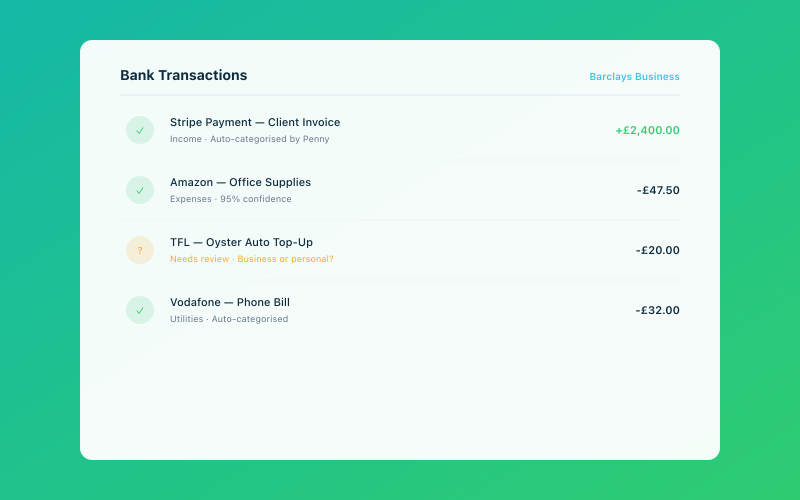 Penny auto-categorises your bank transactions with 95%+ accuracy
- Annual allowance: You can put up to £20,000 into ISAs each tax year (6 April to 5 April). This is the total across all ISA types combined — not £20,000 per ISA.
- Tax-free growth: Any interest, dividends, or capital gains earned within an ISA are completely tax-free. You don't need to declare ISA income on your Self Assessment.
- Eligibility: You must be a UK resident aged 18 or over (16 or over for Cash ISAs).
- Flexibility: Many ISAs now allow you to withdraw and replace money within the same tax year without losing your allowance (check with your provider).
- No time limit: Your ISA wrapper continues indefinitely — there's no point at which the tax-free status expires.
For self-employed people specifically, the tax-free nature of ISAs is particularly valuable because you don't have an employer providing pension matching or other tax-efficient benefits. ISAs are one of the few tools entirely within your control.
Cash ISAs — Simple and Safe
What they are: A savings account where the interest is tax-free. Your money is protected by the FSCS up to £85,000 per institution.
Best for: Emergency funds, short-term savings goals, and anyone who doesn't want to take any investment risk.
Current landscape: Cash ISA rates have improved significantly in recent years, with competitive accounts offering 4% to 5% (rates fluctuate, so always check current offers). Easy-access Cash ISAs let you withdraw your money at any time, while fixed-rate ISAs typically offer higher rates in exchange for locking your money away for one to five years.
Why self-employed people might choose this: If you need a safe, accessible place to park your emergency fund or short-term savings, a Cash ISA is hard to beat. The interest is tax-free, which matters more than you might think.
Here's why: self-employed people often have variable incomes, and in a good year, you might push into the higher rate tax band. Higher rate taxpayers only get a £500 Personal Savings Allowance (the amount of interest you can earn outside an ISA before paying tax). If you've got significant savings earning interest in a regular savings account, you could find yourself paying 40% tax on the interest above that threshold. A Cash ISA avoids this entirely.
Downsides: Returns are modest. After inflation, you may be losing purchasing power, especially if rates dip. Cash ISAs are a place to protect money, not to grow it aggressively.
Stocks and Shares ISAs — Growth Potential
What they are: An investment account where you can hold funds, shares, bonds, and other investments. All gains and dividends are tax-free.
Best for: Long-term savings goals (5+ years), building wealth, and supplementing your pension.
How they work: You choose investments within the ISA wrapper — this could be individual shares, index funds, actively managed funds, bonds, or a combination. The value of your investments can go up or down, so there's no guarantee you'll get back what you put in.
Why self-employed people might choose this: If you're thinking beyond the next year or two and want your money to grow, a Stocks and Shares ISA is one of the most tax-efficient ways to invest. For self-employed people without an employer pension, it can serve as an important complement to your private pension — offering more flexibility since you can access the money at any time (unlike pensions, which are locked away until age 55, rising to 57 from 2028).
The tax advantages are substantial. Outside an ISA, you'd pay capital gains tax on investment profits (after your annual exempt amount) and income tax on dividends (after the dividend allowance). Inside an ISA, everything is tax-free — which compounds significantly over time.
Popular options for beginners:
- Index funds or ETFs that track the whole market (e.g., a global equity tracker). Low fees, broad diversification, and no need to pick individual stocks.
- Ready-made portfolios offered by platforms like Vanguard, Nutmeg, or Wealthify, which automatically diversify your investments based on your risk appetite.
- Robo-advisers that manage your investments algorithmically based on your goals and timeline.
Downsides: Investment values can fall as well as rise. You shouldn't invest money you might need in the next few years. There's a learning curve, and fees (platform fees, fund fees) eat into your returns. If you're interested in the broader picture of tax-efficient investing, we've got a dedicated guide.
Lifetime ISAs (LISAs) — The Government Bonus
What they are: An ISA where the government adds a 25% bonus on top of your contributions, up to a maximum of £4,000 per year (giving you up to £1,000 in free money annually).
Best for: First-time buyers saving for a property, or additional retirement savings.
Key rules:
- You must be aged 18 to 39 to open a Lifetime ISA (you can continue contributing until age 50).
- The £4,000 LISA allowance counts towards your overall £20,000 ISA allowance.
- You can use the funds to buy your first home (property up to £450,000) or withdraw from age 60.
- If you withdraw for any other reason, you'll pay a 25% penalty — which actually means you lose money compared to what you put in, not just the bonus.
Why self-employed people might choose this: The 25% government bonus is incredibly generous. If you're a first-time buyer, a LISA is one of the most efficient ways to build a deposit — putting away the full £4,000 per year means an extra £1,000 from the government, every year.
For retirement savings, the LISA can complement your pension. While pensions offer tax relief on contributions, a LISA offers the bonus upfront plus tax-free growth and tax-free withdrawals after 60. Depending on your tax situation, one may be more beneficial than the other — and some people use both.
Downsides: The withdrawal penalty is harsh. If you need the money for anything other than a first home purchase or retirement, you'll effectively lose 6.25% of your original contribution. This makes LISAs unsuitable for emergency funds or short-term savings. The £450,000 property price cap may also be limiting in some parts of the country.
Innovative Finance ISAs (IFISAs) — Higher Risk, Higher Returns
What they are: An ISA that holds peer-to-peer loans. You lend money to individuals or businesses through a P2P platform, and the interest you earn is tax-free.
Best for: Experienced savers looking for higher returns and willing to accept higher risk.
Why self-employed people might consider this: Potential returns can be higher than Cash ISAs — some platforms advertise rates of 5% to 8% or more. For self-employed people with a healthy financial buffer who are looking to diversify their savings, IFISAs offer an alternative that sits between cash savings and stock market investing.
Downsides: Your capital is not protected by the FSCS. If the borrowers default or the platform fails, you could lose some or all of your money. P2P lending is regulated by the FCA, but it's inherently riskier than bank savings. For most self-employed people, the risk-reward trade-off doesn't justify making an IFISA a core part of their strategy.
Which ISA Should You Choose?
It depends on what you're saving for and when you'll need the money. Here's a practical framework:
If you need an emergency fund or will need the money within 1–2 years: Go with a Cash ISA. Safety and accessibility are what matter here, not growth.
If you're saving for a first home and you're under 40: Open a Lifetime ISA and contribute up to £4,000 per year. The 25% bonus is too good to pass up. Put anything above that into a Cash ISA or Stocks and Shares ISA depending on your timeline.
If you're saving for the long term (5+ years) and can tolerate some risk: A Stocks and Shares ISA is likely to give you the best returns over time. Start with a low-cost global index fund and let compound growth do the heavy lifting.
If you want a balance of safety and growth: Split your ISA allowance. Put your emergency fund in a Cash ISA and your long-term savings in a Stocks and Shares ISA. You can contribute to multiple ISA types in the same tax year, as long as the total stays within £20,000.
If you're already maximising pension contributions: ISAs offer a flexible complement to your pension. Unlike pensions, you can access ISA money at any time without waiting until retirement age — which is valuable when you're self-employed and your cash flow can be unpredictable.
Practical Tips for Self-Employed ISA Savers
Use your allowance before the tax year ends. The £20,000 allowance doesn't roll over. If you don't use it by 5 April, it's gone. Even small contributions are better than none.
Automate your contributions. Set up a monthly standing order into your ISA so you're consistently saving throughout the year. This also avoids the stress of trying to find a lump sum in March.
Don't forget about tax savings first. Your ISA contributions should come after you've set aside money for your tax bill. There's no point earning tax-free interest in an ISA if you can't pay HMRC when the bill arrives. Use Accounted to keep track of what you owe so you can budget confidently.
Review your ISA annually. Check that your provider's rates are still competitive (for Cash ISAs) or that your investment choices still align with your goals (for Stocks and Shares ISAs). Transferring between providers is straightforward — just make sure you use the official transfer process rather than withdrawing and re-depositing, which would use up your current year's allowance.
Consider your overall financial plan. ISAs are one piece of the puzzle alongside pensions, emergency funds, and tax savings. A holistic view of your finances helps you allocate your money where it'll do the most good.
Related Reading
Try Accounted free for 30 days — no credit card required.
Accounted helps UK sole traders stay on top of their bookkeeping and tax. Start your free 30-day trial at getaccounted.co.uk.
Accounted makes bookkeeping simple — Penny categorises your transactions automatically so you don't have to. See how →
Tax & Compliance Specialists
Our tax specialists have decades of combined experience in UK sole trader and small business taxation, MTD compliance, and HMRC submissions. All content is reviewed against current HMRC guidance before publication and updated quarterly to reflect legislative changes.
Ready to try Accounted?
Join UK sole traders who are simplifying their bookkeeping and tax.
Start your 14-day free trial