Digital Nomad Tax Rules — Working Abroad as a UK Sole Trader
The idea of working from a beach in Bali or a café in Lisbon is more than a fantasy these days — it's a genuine career choice for thousands of UK sole traders. But before you book that one-way flight, there are some important tax questions you really need to answer. Getting them wrong could mean paying tax in two countries, or worse, falling foul of HMRC without even realising it.
In this guide, we'll walk through the key digital nomad tax rules that affect UK sole traders, how residency works, and what you can do to stay compliant while living your best location-independent life.
What Does HMRC Consider a Digital Nomad?
HMRC doesn't actually have a special category for digital nomads. As far as they're concerned, you're either UK tax resident or you're not — and that determines where and how much tax you pay.
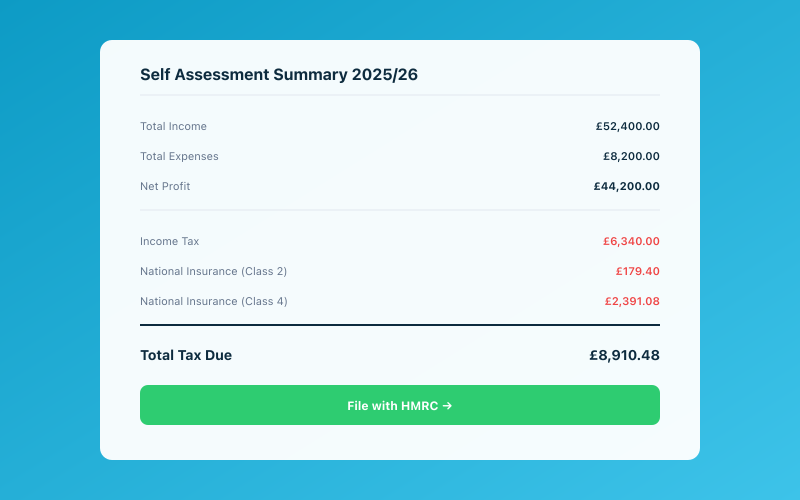 Your Accounted dashboard shows your real-time tax position
If you're a UK sole trader who decides to work from another country for a few weeks or months, HMRC still expects you to report your worldwide income on your Self Assessment tax return. The fact that you earned the money while sitting in a co-working space in Chiang Mai rather than your spare bedroom in Cheltenham doesn't change things on its own.
What can change things is how long you spend abroad and whether you meet certain conditions under the Statutory Residence Test (SRT). More on that in a moment.
The key point is this: simply leaving the UK doesn't automatically stop you being a UK taxpayer. You need to meet specific criteria, and you need to be able to prove it.
The Statutory Residence Test — Your Starting Point
The Statutory Residence Test is the framework HMRC uses to decide whether you're UK tax resident for a given tax year. It's made up of three main tests:
The Automatic Overseas Test — You're automatically non-resident if you were UK resident in one or more of the previous three tax years and you spend fewer than 16 days in the UK during the current tax year. If you weren't resident in any of the previous three years, the threshold is 46 days.
The Automatic UK Test — You're automatically UK resident if you spend 183 days or more in the UK during the tax year, or if your only home is in the UK.
The Sufficient Ties Test — If neither automatic test gives a clear answer, HMRC looks at your ties to the UK — things like family, accommodation, work, and how many days you've spent here in previous years. The more ties you have, the fewer days you can spend in the UK before being classed as resident.
For most digital nomads, the 183-day rule is the one that gets the most attention. But it's not as straightforward as simply counting days. The SRT is more nuanced than that, and getting it wrong can be expensive.
Working Abroad vs Moving Abroad — There's a Difference
This is where a lot of sole traders trip up. There's a big difference between taking your laptop abroad for a few months and genuinely relocating.
If you're still registered at a UK address, still have a UK bank account, still pop back for family events, and still have most of your clients in the UK — HMRC is likely to consider you UK resident regardless of where you physically happen to be typing.
On the other hand, if you've genuinely moved abroad — sold or let your UK home, established a permanent base overseas, and significantly reduced your ties to the UK — you might qualify as non-resident. But you'll need to keep careful records to back this up.
It's also worth noting that "working abroad temporarily" is its own category. If you're only going for a few weeks or months, you're almost certainly still UK resident, and your tax position probably hasn't changed at all. We've covered this scenario in more detail in our guide to working abroad temporarily and UK tax.
Tax in the Country You're Working From
Here's the bit that catches a lot of people off guard: even if you remain UK tax resident, the country you're working in might also want to tax you.
Many countries have rules about taxing anyone who works within their borders, even if only for a short time. Some have specific thresholds — for example, you might trigger a tax liability if you spend more than 183 days there in a calendar year, or if you're earning income from local clients.
Double Taxation Agreements (DTAs) between the UK and other countries can help prevent you being taxed twice on the same income. The UK has DTAs with over 130 countries, and they generally set out which country has the primary right to tax specific types of income.
However, DTAs don't always give you a free pass. You might still need to file a tax return in the other country, even if you don't owe any tax there. And some popular digital nomad destinations — particularly in Southeast Asia — have less clear-cut arrangements.
The safest approach? Research the specific tax rules of any country you plan to work from before you go. A few hours of homework could save you months of headaches later.
Practical Record-Keeping for Nomadic Sole Traders
If you're moving around frequently, your record-keeping needs to be watertight. HMRC can ask you to prove how many days you spent in the UK and overseas, and "I think I was in Portugal that week" won't cut it.
Here's what you should be tracking:
- Travel dates — Keep a log of every trip, including departure and arrival dates. Flight bookings and boarding passes are useful evidence.
- Days in each country — A simple spreadsheet or calendar will do. Note that HMRC counts a day as being in the UK if you're here at midnight, with a few exceptions.
- Income by location — While your UK tax bill is based on worldwide income (assuming you're UK resident), knowing where you earned what can be helpful for dealing with overseas tax authorities.
- Expenses by location — Co-working fees, travel costs, accommodation — keep receipts for everything. Some of these may be allowable business expenses.
Using a tool like Accounted makes this much easier. Penny, our AI bookkeeping assistant, can help you categorise expenses and keep track of your income in real time, even if you're hopping between time zones. Having clean, up-to-date records isn't just good practice — it's essential when your work life is spread across multiple countries.
Common Mistakes Digital Nomad Sole Traders Make
We see the same errors crop up time and again:
Assuming they're automatically non-resident. Just because you've left the UK doesn't mean you've stopped being a UK taxpayer. You need to meet the SRT criteria.
Forgetting about the other country's tax rules. Being UK tax resident doesn't necessarily protect you from tax obligations elsewhere.
Not keeping proper records. If HMRC questions your residency status, the burden of proof is on you. Without good records, you're in a weak position.
Ignoring National Insurance. Even if you become non-resident for income tax, you might still need to pay voluntary National Insurance contributions to protect your State Pension entitlement. This is particularly relevant for sole traders who plan to return to the UK eventually.
Not telling HMRC. If your circumstances change — for example, you leave the UK for a full tax year — you should notify HMRC. Staying silent can create complications later.
If you're working from a narrowboat, a van, or constantly on the move within the UK, there are separate considerations around your tax home and business base. Our article on narrowboat, van and digital nomad tax covers that ground.
What About VAT and MTD?
If you're VAT registered, leaving the UK doesn't change your VAT obligations. You'll still need to file VAT returns and comply with Making Tax Digital requirements. Your place of supply for services can get complicated when you're abroad, particularly if you're supplying services to customers in other countries.
For most UK sole traders selling services to UK clients, the place of supply remains the UK regardless of where you physically are. But if you start working with clients in the EU or elsewhere, the reverse charge mechanism and other rules may apply.
Similarly, Making Tax Digital for Income Tax is rolling out from April 2026. If you're over the threshold, you'll need MTD-compatible software to submit quarterly updates — and that applies whether you're sitting in Sheffield or São Paulo.
Planning Your Move — A Checklist
If you're seriously considering the digital nomad life, here's a quick checklist:
- Understand your SRT position — Work out whether you'll be UK resident or non-resident based on your planned travel.
- Research your destination's tax rules — Check whether you'll trigger a tax obligation in the countries you plan to work from.
- Check for a DTA — See whether the UK has a Double Taxation Agreement with your chosen destination.
- Set up proper record-keeping — Track your days, income, and expenses meticulously from day one.
- Consider National Insurance — Decide whether to pay voluntary contributions to protect your State Pension.
- Get professional advice — If your situation is complex, a tax adviser who specialises in international matters is worth every penny.
- Notify HMRC — Let them know about any significant changes to your circumstances.
The Bottom Line
Being a digital nomad as a UK sole trader is absolutely doable, but it's not a tax loophole. HMRC's rules are designed to catch people who try to have it both ways — enjoying UK services and ties while claiming to be non-resident.
The good news is that with proper planning and solid record-keeping, you can work from almost anywhere in the world without falling foul of the rules. Just make sure you understand your obligations before you go, not after.
Related reading:
- The 183-Day Rule — How Tax Residency Works
- Working Abroad Temporarily — UK Tax
- Narrowboat, Van and Digital Nomad Tax
Accounted helps UK sole traders stay on top of their bookkeeping and tax. Start your free 30-day trial at getaccounted.co.uk.
Related Reading
- How to Claim Tax Relief on Charitable Donations Through Your Business
- 10 Tax Myths That Could Cost You Money
Start your free trial and let Penny handle your bookkeeping automatically.
Penny, your AI bookkeeper, tracks your tax position in real time and flags opportunities to reduce your bill. Meet Penny →
Tax & Compliance Specialists
Our tax specialists have decades of combined experience in UK sole trader and small business taxation, MTD compliance, and HMRC submissions. All content is reviewed against current HMRC guidance before publication and updated quarterly to reflect legislative changes.
Ready to try Accounted?
Join UK sole traders who are simplifying their bookkeeping and tax.
Start your 14-day free trial