Running a Construction Business — From Sole Trader to Contractor
The construction industry is one of the best sectors in the UK for people who want to be their own boss. Whether you are a bricklayer who has been working on the tools for years and fancies going solo, or an experienced tradesperson ready to take on bigger projects and hire subcontractors, there is a clear path from sole trader to established contractor. But running a construction business involves far more than just being good at the work. You need to handle CIS obligations, manage your tax, price jobs properly, and keep your finances in order. This guide covers the practical side of building a successful construction business from the ground up.
Starting Out as a Sole Trader
Most people in construction start as sole traders. It is the simplest business structure, with the least paperwork and the lowest setup cost. You register with HMRC as self-employed, get your Unique Taxpayer Reference (UTR), register under the Construction Industry Scheme, and you are ready to go.
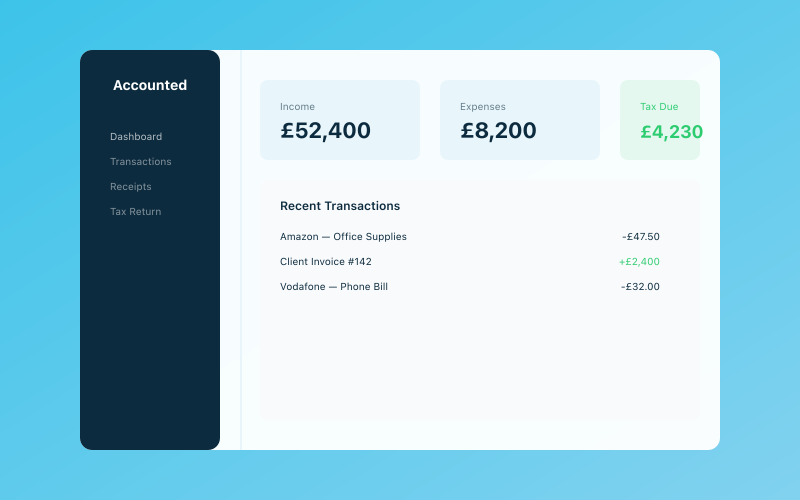 Your Accounted dashboard — income, expenses, and tax at a glance
As a sole trader, you and your business are legally the same entity. You keep all the profits, but you are also personally liable for any debts. For most tradespeople starting out, this is perfectly fine — the risk is manageable, and the simplicity is a genuine advantage.
Your first step should be registering for CIS as a subcontractor. This ensures contractors only deduct 20% from your payments rather than 30%. The registration process is covered in detail in our CIS registration guide. You will also need to register for Self Assessment so you can file your annual tax return.
From a practical standpoint, set yourself up properly from day one:
- Open a business bank account. It is not legally required for sole traders, but it makes bookkeeping vastly easier and looks more professional.
- Get insured. Public liability insurance is essential in construction. Many main contractors will not let you on site without it. Consider tool insurance and professional indemnity cover too.
- Get a CSCS card. Most construction sites require one, and it demonstrates your competence and training.
- Keep records from the start. Every receipt, every invoice, every bank transaction. Use a bookkeeping app like Accounted to track everything as you go rather than trying to reconstruct it later.
Understanding Your Tax Obligations
As a self-employed construction worker, you have several tax obligations to stay on top of.
Income tax is charged on your taxable profits — that is your total income minus allowable business expenses. For 2025/26, the personal allowance is £12,570, meaning you pay no income tax on the first £12,570 of profit. The basic rate is 20% on income between £12,570 and £50,270. The higher rate is 40% on income between £50,270 and £125,140. Above that, you pay 45%.
National Insurance comes in two types for the self-employed. Class 2 contributions are £3.45 per week (though if your profits are below the small profits threshold you may be exempt). Class 4 contributions are 6% on profits between £12,570 and £50,270, and 2% on profits above £50,270.
CIS deductions are taken from your pay before you receive it. At 20% for registered subcontractors (or 30% if unregistered), these are advance payments towards your tax bill. Most subcontractors overpay through CIS and get a refund when they file their Self Assessment. Our CIS subcontractors guide explains how this works in detail.
VAT becomes compulsory when your taxable turnover exceeds £90,000 in a rolling 12-month period. Below that threshold, registration is voluntary. Some construction businesses benefit from voluntary registration because they can reclaim VAT on materials and equipment, but it adds complexity to your invoicing and record-keeping. Consider whether the benefits outweigh the administrative burden.
Pricing Jobs and Managing Cash Flow
Getting your pricing right is one of the hardest parts of running a construction business. Price too low and you will be busy but broke. Price too high and you will not win enough work.
Start by understanding your costs. You need to cover:
- Your own time (what hourly or daily rate do you need to earn?)
- Materials
- Tool wear and replacement
- Vehicle costs
- Insurance
- Phone and admin costs
- Tax and National Insurance
- Pension contributions (if you are saving for retirement, which you should be)
Once you know your costs, add a profit margin. In construction, margins typically range from 10% to 25% depending on the type of work, the competition in your area, and how specialist your skills are. Do not be afraid to charge what you are worth — clients who only care about the cheapest price are often the most difficult to work for anyway.
Cash flow is the other critical piece. Construction businesses often struggle with cash flow because of the gap between paying for materials upfront and getting paid by the client. Some tips:
- Invoice promptly. The sooner you send the invoice, the sooner the clock starts ticking on payment.
- Set clear payment terms. 14 days is common in construction. Do not be shy about chasing late payments.
- Take deposits on larger jobs. A 25% to 50% deposit for materials is standard practice.
- Keep a cash reserve. Aim for at least one month's expenses in the bank at all times.
Penny, the AI bookkeeping assistant within Accounted, helps you track outstanding invoices and see your cash position at a glance, so you always know where you stand.
Growing From Subcontractor to Contractor
At some point, you may want to take on larger projects and hire subcontractors yourself. This is where you transition from being a subcontractor to being a contractor under CIS — and it comes with new responsibilities.
As a contractor, you must:
- Verify every subcontractor with HMRC before paying them. This tells you their CIS status and the correct deduction rate (0% for gross payment status, 20% for registered, or 30% for unregistered).
- Deduct CIS tax from payments to subcontractors (unless they have gross payment status) and pay those deductions to HMRC.
- File monthly CIS returns with HMRC, showing the payments made and deductions taken.
- Give subcontractors a payment and deduction statement each time you pay them.
These obligations apply even if you only use one subcontractor on one job. The penalties for getting it wrong can be steep — late filing penalties start at £100 per month and increase over time, and incorrect deductions can result in HMRC coming after you for the shortfall.
You also need to consider the domestic reverse charge for VAT if you and your subcontractors are VAT-registered. Our construction reverse charge guide explains how this works in practice.
Choosing the Right Business Structure
As your business grows, it is worth reviewing whether a sole trader structure is still the best option. The main alternative is a limited company.
A limited company separates your personal finances from the business. Your liability is limited to what you have invested in the company, which can be important if you are taking on larger contracts. You pay yourself through a combination of salary and dividends, which can be more tax-efficient than sole trader income tax once profits exceed a certain level — typically around £30,000 to £40,000 of profit, though the exact tipping point depends on your personal circumstances.
However, a limited company involves more administration: annual accounts filed with Companies House, corporation tax returns, payroll for your salary, and more rigorous record-keeping requirements. For many tradespeople, the simplicity of remaining a sole trader outweighs the tax savings until the business is well established.
Whichever structure you choose, keeping clean, up-to-date financial records is non-negotiable. HMRC expects it, your accountant needs it, and Making Tax Digital means you will soon be required to submit quarterly income updates digitally if your income exceeds £50,000 (dropping to £30,000 from April 2027). Getting your bookkeeping sorted now with a tool like Accounted means you will be ready when the deadline arrives.
Do You Need an Accountant for a Construction Business?
Many tradespeople manage their own bookkeeping when they are sole traders, especially with a tool like Accounted handling CIS calculations, receipt scanning, and Self Assessment automatically. As your business grows and you start employing subcontractors, the complexity increases — monthly CIS returns, VAT, and potentially payroll. At that point, having an accountant review your year-end figures is worth the investment. View our pricing to see how Accounted can handle the day-to-day bookkeeping so you only need your accountant at year-end.
Building a Reputation and Winning Work
In construction, reputation is everything. The best marketing you can do is consistently deliver quality work on time and on budget. Word of mouth and repeat business will account for the majority of your revenue if you do a good job.
Beyond that, consider:
- Building a simple website with photos of your work, testimonials, and your contact details
- Setting up a Google Business Profile so local customers can find you
- Joining local trade associations like the Federation of Master Builders or the National Federation of Builders
- Getting accreditations like TrustMark or Checkatrade, which give customers confidence
- Being active on social media — Instagram and Facebook are both effective for showcasing construction work
Remember, every pound you spend on marketing is a business expense you can deduct from your taxable profit.
Related Reading
Accounted helps UK sole traders stay on top of their bookkeeping and tax. Start your free 30-day trial at getaccounted.co.uk
Accounted supports CIS — track deductions, verify subcontractors, and file returns directly to HMRC. See CIS support →
Tax & Compliance Specialists
Our tax specialists have decades of combined experience in UK sole trader and small business taxation, MTD compliance, and HMRC submissions. All content is reviewed against current HMRC guidance before publication and updated quarterly to reflect legislative changes.
Ready to try Accounted?
Join UK sole traders who are simplifying their bookkeeping and tax.
Start your 14-day free trial