Builders and General Contractors — CIS and Tax Guide
If you are a builder or general contractor working in the UK, tax can feel like a minefield. Between the Construction Industry Scheme (CIS), VAT reverse charges, and the usual self-employment obligations, there is a lot to keep track of. Get it right, though, and you can keep more of what you earn and avoid costly run-ins with HMRC.
This guide covers everything builders and general contractors need to know about tax in the 2025/26 tax year — from CIS basics to allowable expenses and when to think about going limited.
Understanding the Construction Industry Scheme (CIS)
The CIS is HMRC's system for collecting tax at source from subcontractors working in the construction industry. If you work as a subcontractor for a contractor (or if you hire subcontractors yourself), CIS affects you.
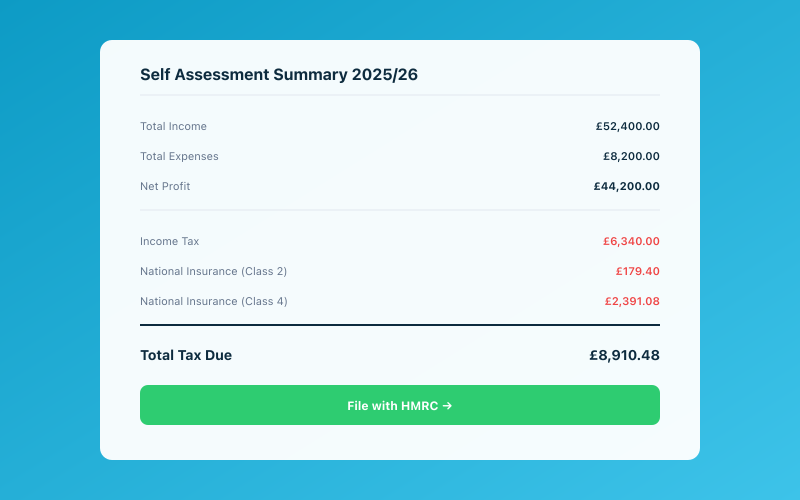 Your Accounted dashboard shows your real-time tax position
How CIS Works
When a contractor pays a subcontractor for construction work, they must deduct tax from the payment and send it directly to HMRC. The deduction rates are:
- 20% for subcontractors who are registered with CIS
- 30% for subcontractors who are not registered
These deductions are not an additional tax — they are advance payments towards your income tax and National Insurance bill. When you file your Self Assessment return at the end of the year, your CIS deductions are offset against your total tax liability. If you have overpaid, you will receive a refund.
This is why it is absolutely essential to register for CIS if you are a subcontractor. The difference between 20% and 30% deductions adds up quickly over a year. For a detailed walkthrough of the registration process, see our CIS subcontractors guide.
Gross Payment Status
If you have a good tax compliance history, you may qualify for Gross Payment Status (GPS). This means contractors pay you without making any deductions, and you handle your own tax payments directly to HMRC. To qualify, you generally need to have filed all tax returns on time, paid all tax due, and have a turnover above a certain threshold (£30,000 for sole traders).
GPS can significantly improve your cash flow, but it comes with responsibility — you need to be disciplined about setting aside money for your tax bill.
Are You a Contractor, a Subcontractor, or Both?
Many builders operate as both. If you take on a project and hire other tradespeople to help, you are a contractor for CIS purposes when paying them, and a subcontractor when you are being paid by the main contractor or client above you. You need to be registered in both capacities and must verify subcontractors, make deductions, and file monthly CIS returns with HMRC.
Income Tax and National Insurance for Builders
Whether or not you are in CIS, if you are self-employed you will pay income tax and National Insurance on your profits.
2025/26 Tax Rates
- Personal allowance: £12,570 — no tax on the first chunk of your income
- Basic rate: 20% on profits between £12,571 and £50,270
- Higher rate: 40% on profits above £50,270
National Insurance
- Class 2 NI: £3.45 per week (a flat rate paid by all self-employed earners above the Small Profits Threshold)
- Class 4 NI: 6% on profits between £12,570 and £50,270
Remember, CIS deductions you have already had taken from your pay count towards these liabilities. Many builders find they are owed a refund when they file their return — another good reason not to ignore your Self Assessment. Our guide to how much tax you will pay as a sole trader can help you estimate your bill.
Expenses Builders Can Claim
Claiming all your allowable expenses is one of the most effective ways to reduce your tax bill. Builders tend to have significant expenses, so getting this right matters.
Tools and Equipment
Hand tools, power tools, workwear (including safety boots, hard hats, and high-vis clothing), and small equipment are all deductible. For larger items like vans, generators, or scaffolding, you may be able to claim capital allowances through the Annual Investment Allowance.
Materials
If you purchase materials for a job and these costs are not reimbursed by the client, they are a deductible business expense. Keep all your receipts — builders' merchants, plumbing supplies, electrical wholesalers, even trips to the DIY store for specific project materials.
Vehicle Costs
Most builders rely heavily on their van. You have two options for claiming vehicle costs:
- Simplified mileage rate: 45p per mile for the first 10,000 business miles, 25p per mile thereafter. This is straightforward but requires you to keep a mileage log.
- Actual costs: Claim the actual costs of fuel, insurance, servicing, repairs, and a proportion of the purchase price (capital allowances). If your van is used solely for business, you can claim 100% of these costs.
For more on this, see our mileage and vehicle expenses guide.
Other Allowable Expenses
- Subcontractor costs (the gross amount, before CIS deductions)
- Public liability and professional indemnity insurance
- Skip hire and waste disposal
- Scaffold hire
- Phone and broadband (business proportion)
- Accountancy and bookkeeping fees
- Training courses related to your trade (e.g., CSCS card, asbestos awareness, first aid)
- Advertising and website costs
For the full list, check out our sole trader expenses guide.
VAT for Builders and Contractors
When to Register
You must register for VAT if your taxable turnover exceeds £90,000 in any rolling 12-month period. For busy builders, this threshold can be reached within the first year of trading.
Once registered, you charge VAT at 20% on most of your work and reclaim VAT on your business purchases. You will need to submit VAT returns — usually quarterly — and keep digital records under Making Tax Digital rules. Our VAT registration guide walks you through the process.
The Domestic Reverse Charge
Since March 2021, the VAT domestic reverse charge has applied to most construction services supplied between VAT-registered businesses within the CIS. Instead of the subcontractor charging VAT and paying it to HMRC, the contractor receiving the service accounts for the VAT.
This is a significant cash flow consideration. If you are a subcontractor, you no longer receive VAT payments on top of your invoices for CIS-reportable work to other VAT-registered contractors. You can still reclaim input VAT on your purchases, which may mean you are regularly in a VAT refund position.
The reverse charge does not apply to work done for end consumers (homeowners) or to contractors who are not VAT-registered.
Reduced Rate and Zero Rate Work
Some construction work benefits from reduced or zero-rated VAT:
- New-build residential dwellings are zero-rated
- Residential conversions and renovations may qualify for the reduced rate of 5%
- Work for charities and housing associations may also qualify for reduced rates
Getting these rates wrong can be costly, so it is worth seeking advice if you are unsure.
Should Builders Go Limited?
Many builders start as sole traders and consider incorporating once their profits reach a certain level. The main advantages of a limited company include:
- Tax efficiency: Paying yourself through a combination of salary and dividends can be more tax-efficient once profits exceed around £40,000–£50,000.
- Limited liability: Your personal assets are protected if the business runs into financial difficulty.
- Professional image: Some commercial clients and main contractors prefer to work with limited companies.
However, limited companies come with additional costs and paperwork — annual accounts, Corporation Tax returns, payroll, and Companies House filings. You will also need to understand the IR35 rules if you are working through a limited company for a single contractor, as HMRC may treat you as an employee for tax purposes.
For a full comparison, read our sole trader vs limited company guide.
Record-Keeping Tips for Builders
Good record-keeping does not need to be complicated, but it does need to be consistent.
What to Keep
- All invoices you issue and receive
- CIS payment and deduction statements (you will need these when filing your Self Assessment)
- Receipts for materials, tools, and other expenses
- Bank statements
- Mileage logs if claiming vehicle expenses
- Quotes and contracts for larger jobs
Going Digital
With Making Tax Digital expanding, digital record-keeping is becoming essential rather than optional. Using cloud-based bookkeeping software means your records are always accessible, backed up, and ready for quarterly submissions. Accounted makes this particularly painless — Penny, the AI assistant, can categorise your transactions automatically, so you spend less time on paperwork and more time on site.
How Long to Keep Records
HMRC requires you to keep your business records for at least five years after the 31 January filing deadline for the relevant tax year. For CIS records, contractors must keep records of all payments and deductions for at least three years after the end of the tax year they relate to.
Key Deadlines for Builders
- 5 April — End of the tax year
- 31 July — Second payment on account due
- 5 October — Deadline to register as self-employed for a new business
- 31 October — Paper Self Assessment deadline
- 31 January — Online Self Assessment deadline and first payment on account
- Monthly — CIS returns due by the 19th of each month (if you are a contractor)
Wrapping Up
Tax for builders and contractors has more moving parts than most self-employed trades, thanks to CIS, reverse charge VAT, and the dual contractor/subcontractor status many of you hold. But with solid record-keeping, a clear understanding of your allowable expenses, and the right software, it is entirely manageable.
The key is staying on top of things throughout the year rather than scrambling in January. Set aside money for tax regularly, keep your CIS deduction statements safe, and claim every expense you are entitled to.
Accounted helps UK sole traders stay on top of their bookkeeping and tax. Start your free 30-day trial at getaccounted.co.uk
Related reading:
- CIS for Subcontractors — A Complete Guide
- How Much Tax Will I Pay as a Sole Trader?
- The Complete List of Sole Trader Expenses You Can Claim
Related Reading
- CIS Tax Refunds — How to Claim Back Overpaid Tax
- Running a Construction Business — From Sole Trader to Contractor
- Mixed Contracts in CIS — When Some Work Is Excluded
For step-by-step guidance, see our article on How to Switch from CIS Employee to Self-Employed.
For step-by-step guidance, see our article on How to Register for Corporation Tax.
Related reading: CIS Penalties for Late Returns: What to Expect.
For step-by-step guidance, see our article on How to Register as a CIS Subcontractor with HMRC.
You may also find our CIS Tax Deductions Explained: 20% vs 30% Rates helpful.
For step-by-step guidance, see our article on How to Claim a CIS Tax Refund: Complete Guide.
View our pricing to see which plan includes full CIS management.
Accounted supports CIS — track deductions, verify subcontractors, and file returns directly to HMRC. See CIS support →
Tax & Compliance Specialists
Our tax specialists have decades of combined experience in UK sole trader and small business taxation, MTD compliance, and HMRC submissions. All content is reviewed against current HMRC guidance before publication and updated quarterly to reflect legislative changes.
Ready to try Accounted?
Join UK sole traders who are simplifying their bookkeeping and tax.
Start your 14-day free trial