Training Junior Accountants — A Practice Owner's Guide
Hiring junior accountants is one of the best investments a practice can make. They bring energy, fresh perspectives, and — with the right training — become the backbone of your team. But "with the right training" is doing a lot of heavy lifting in that sentence. Too many practices hire juniors, give them a desk and a login, and expect them to figure things out through osmosis. The result is frustrated juniors who don't feel supported, inconsistent work quality, and high staff turnover.
A structured training programme doesn't have to be elaborate or expensive. It just needs to be intentional. This guide covers how to design and deliver training that turns raw talent into capable, confident, and loyal team members.
Why Training Matters More Than Ever
The accounting profession is changing fast. Making Tax Digital, cloud-based software, AI-assisted bookkeeping, advisory services, and evolving client expectations mean that the skills required of a modern accountant are significantly different from those of a decade ago. Juniors coming out of university or completing their AAT qualifications have solid theoretical foundations, but the gap between theory and practice is real.
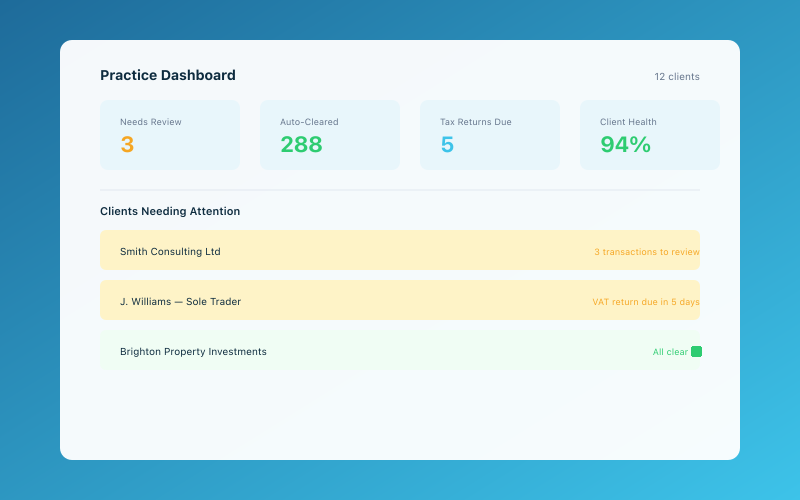 The Accounted practice dashboard — manage all your clients in one place
At the same time, the job market for qualified accountants is competitive. If your juniors don't feel they're developing their skills and progressing in their careers, they'll leave — and replacing them is expensive and disruptive. A good training programme isn't just about building capability; it's about retention.
The practices that invest in training consistently report lower staff turnover, higher client satisfaction (because the work is better), and a stronger pipeline of future managers and partners. It's not an overhead — it's a strategic advantage.
Structuring the First 90 Days
The first three months set the tone. Get them right and your junior will feel confident, capable, and committed. Get them wrong and you'll spend the next year trying to undo the damage.
Week 1: Orientation Don't throw them into client work on day one. Spend the first week on:
- Practice overview: who you are, what you do, who your clients are, what your values are
- Team introductions: who does what, who to ask for help
- Systems and software: practice management tools, accounting platforms, email, phone systems, document storage
- Compliance basics: confidentiality, data protection, AML obligations
- Administrative essentials: timesheets, holiday booking, dress code, office protocols
This sounds basic, but you'd be surprised how many practices skip it. A new hire who doesn't know where to find client files or how to book a meeting room is going to feel lost before they've even started.
Weeks 2-4: Shadowing and observation Pair the junior with an experienced team member and let them observe real work being done. This includes:
- Sitting in on client meetings
- Watching how a set of accounts is prepared from start to finish
- Observing how the team handles client queries
- Seeing how tax returns are reviewed and filed
The goal isn't for them to do the work yet — it's for them to understand the context. Why are we doing this? What does the client need? How does this piece of work fit into the bigger picture?
Weeks 5-8: Supervised practice Start giving them real work, but with close supervision. Begin with straightforward tasks:
- Bank reconciliations
- Bookkeeping and transaction categorisation
- Simple VAT returns
- Data entry and record preparation
Review their work carefully and provide constructive feedback. This is the stage where good habits are formed — accuracy, attention to detail, proper documentation. If you let sloppy work slide now, it becomes much harder to correct later.
For practices that use Accounted for their sole trader clients, this is a good time to get juniors familiar with the platform. Penny's AI-assisted categorisation means juniors can focus on reviewing and understanding the logic behind how transactions are classified, rather than spending hours on manual data entry.
Weeks 9-12: Increasing independence Gradually increase the complexity of the work and reduce the level of supervision. By the end of the first quarter, a junior should be able to:
- Prepare a basic set of sole trader accounts with minimal guidance
- Handle routine client queries
- Use the practice's software confidently
- Understand the firm's quality control processes
Building a Training Curriculum
Beyond the first 90 days, you need an ongoing training plan. This doesn't need to be a formal classroom-style programme — most of the best learning happens on the job — but it should be structured enough that there's a clear progression path.
Technical skills:
- Sole trader accounts preparation
- Partnership accounts
- Limited company accounts
- Corporation tax returns
- Self Assessment returns
- VAT returns and MTD submissions
- Payroll basics
- Capital allowances
- Tax planning fundamentals
Build these roughly in order of complexity, and tie them to your practice's workload. If January is Self Assessment season, that's a natural time to focus on Self Assessment training. If you're handling a lot of MTD submissions in the summer, use that as a training opportunity.
Software skills:
- Your primary accounting platform(s) — Xero, QuickBooks, Accounted, etc.
- Practice management tools — Karbon, Senta, or whatever you use
- Tax software — TaxCalc, Taxfiler, etc.
- Microsoft Excel (still essential for analysis and planning)
- HMRC's online services and agent portals
Our practice management software guide covers the main platforms, which can also help juniors understand the landscape.
Soft skills:
- Client communication (email etiquette, phone manner, meeting conduct)
- Time management and deadline handling
- Problem-solving and knowing when to escalate
- Working as part of a team
- Presenting information clearly
Technical skills can be taught relatively quickly. Soft skills take longer and require ongoing coaching. Don't neglect them — the ability to communicate clearly and manage client expectations is what separates a competent technician from a trusted adviser.
Mentoring and Feedback
Every junior should have a designated mentor — someone they can go to with questions, concerns, or ideas. Ideally, this is a mid-level team member (not the practice owner, unless you're a very small practice), because they're close enough in experience to remember what it's like to be new, but experienced enough to provide guidance.
Regular one-to-ones. Schedule a weekly or fortnightly catch-up between the junior and their mentor. Keep it informal — 20-30 minutes is enough. Use it to:
- Review work completed that week
- Discuss anything the junior found challenging or confusing
- Set goals for the coming week
- Provide praise for things done well
Structured reviews. In addition to informal catch-ups, conduct a formal review at the end of the probation period (typically three or six months) and then annually. Use these to:
- Assess progress against the training plan
- Identify areas for further development
- Discuss career aspirations and progression
- Agree on objectives for the next period
Real-time feedback. Don't save all feedback for formal reviews. If a junior does something well, tell them immediately. If they make a mistake, address it promptly — but constructively. The goal is to create an environment where feedback is normal and expected, not something to be feared.
Common Training Mistakes
Expecting them to "just pick it up." Some skills are learnable through observation, but many aren't. If you don't explicitly teach something, don't assume it's been learned. When reviewing work, ask the junior to explain their reasoning — this reveals gaps in understanding that wouldn't be apparent from the output alone.
Overloading them too quickly. There's a temptation to give juniors complex work as soon as they seem capable, especially when you're busy. Resist this. Jumping from simple bookkeeping to complex tax returns too quickly leads to errors, stress, and loss of confidence. Build complexity gradually.
Not giving them client exposure. Some practices keep juniors away from clients, handling all communication through senior staff. This is a mistake. Juniors need to learn how to interact with clients, and the sooner they start (in supervised settings), the more confident they'll become. Start with simple queries and work up to attending meetings and eventually leading them.
Inconsistent standards. If different team members review work differently — one insists on detailed working papers, another doesn't care — the junior gets conflicting signals. Agree on standards as a practice and apply them consistently.
Neglecting professional development. If your juniors are studying for professional qualifications (ACA, ACCA, AAT), support them. Provide study leave, pay for materials, and show genuine interest in their progress. This is one of the strongest retention tools you have.
Leveraging Technology in Training
Modern accounting software can actually accelerate training. When a junior uses a tool like Accounted with a sole trader client, they can see how Penny categorises transactions and learn from the logic behind those decisions. It's like having a teaching assistant that demonstrates correct categorisation in real time.
Similarly, practice management tools that standardise workflows give juniors a clear framework to follow. Instead of guessing what to do next, they can follow the established process, ask questions when they don't understand a step, and gradually internalise the workflow.
Cloud-based tools also make remote or hybrid training easier. A mentor can review a junior's work in real time, leave comments on specific transactions, and discuss issues via video call — all without needing to be in the same room.
Creating a Culture of Learning
The best training programmes exist within a broader culture of learning. That means:
- Senior staff model continuous learning. If the practice owner is always learning new things — attending conferences, reading industry updates, experimenting with new tools — juniors will absorb that attitude.
- Mistakes are treated as learning opportunities. Everyone makes mistakes, especially when they're learning. If errors are met with blame rather than coaching, juniors will hide their mistakes instead of learning from them.
- Knowledge sharing is encouraged. Regular team meetings where someone presents on a topic — a new tax rule, a software tip, a client case study — keep everyone learning and give juniors a chance to contribute.
- CPD is taken seriously. Allocate time and budget for continuing professional development. Don't treat it as an afterthought that gets squeezed out by client work.
For more on how MTD changes are creating new learning opportunities, see our article on the MTD opportunity for accountants.
The Return on Investment
Training juniors properly costs time and money, but the return is substantial. A well-trained junior who stays with your practice for five years is worth far more than a string of short-term hires who leave after 18 months because they didn't feel supported.
Think of it this way: if a junior costs you £25,000 in salary and you invest £2,000-£3,000 in training and development, that £28,000 buys you a team member who can handle a growing portfolio of clients, contribute to the practice's efficiency, and eventually mentor the next generation of juniors. That's an extraordinary return on investment.
The practices that struggle with recruitment and retention are often the ones that underinvest in training. The ones that are known for developing their people rarely have trouble attracting talent — because word gets around.
Related Reading
Learn about our free accountant portal and how it saves your practice time.
Accounted helps UK sole traders stay on top of their bookkeeping and tax. Start your free 30-day trial at getaccounted.co.uk.
Accounted gives accountants a free practice portal — manage all your clients, file to HMRC, and let Penny handle the routine work. See the accountant portal →
Editorial & Research
The Accounted editorial team covers software comparisons, technology, and the tools UK sole traders need to run their businesses efficiently. All software comparisons are based on independent research and publicly available pricing.
Ready to try Accounted?
Join UK sole traders who are simplifying their bookkeeping and tax.
Start your 14-day free trial