How to Onboard New Clients Efficiently as an Accountant
Winning a new client feels brilliant. There's the rush of knowing your marketing is working, the satisfaction that someone has chosen you over the competition, and — let's be honest — the welcome thought of extra revenue hitting the bank account next month.
But then reality sets in. You need engagement letters signed, anti-money laundering checks completed, agent authorisations filed with HMRC, records gathered, software access sorted, and a dozen other bits and pieces ticked off before you can actually start doing any accounting work. If you don't have a solid onboarding process, those first few weeks can feel chaotic — and first impressions matter enormously.
A clunky onboarding experience doesn't just waste your time. It makes new clients wonder whether they've made the right choice. On the other hand, a smooth, professional process reassures them immediately that they're in safe hands.
Let's walk through how to build an onboarding workflow that's efficient, thorough, and sets the tone for a great long-term relationship.
Why Onboarding Matters More Than You Think
It's tempting to treat onboarding as pure admin — just a series of boxes to tick before the real work begins. But research consistently shows that the first 90 days of any professional relationship are the most important for client retention. Get those weeks right and you'll keep clients for years. Get them wrong and you'll be dealing with complaints, scope creep, and early departures.
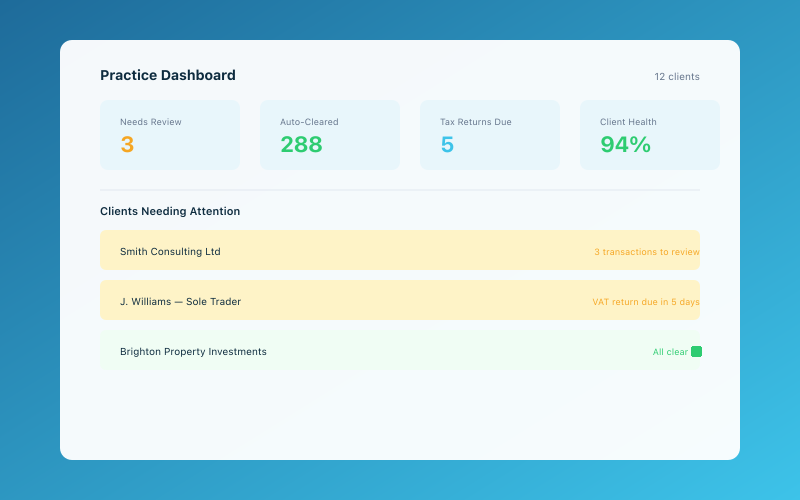 The Accounted practice dashboard — manage all your clients in one place
A well-structured onboarding process achieves several things at once:
- Sets expectations clearly so there are no misunderstandings about what's included in your fees
- Gathers everything you need upfront so you're not chasing documents for months
- Demonstrates professionalism that justifies your pricing
- Identifies potential problems early before they become expensive headaches
- Builds rapport and gives the client confidence in your practice
If you've ever had a client phone you six months in saying "I didn't realise that wasn't included," chances are the onboarding process was where things went wrong.
Building Your Onboarding Checklist
Every practice is different, but most accountants will need to cover the same core steps. The key is turning these into a repeatable checklist rather than trying to remember everything from scratch each time.
The Essential Steps
Here's a comprehensive list to work from. You can trim or expand it depending on your niche:
- Initial consultation — Understand the client's business, structure, and needs
- Proposal and pricing — Provide a clear quote with scope of work defined
- Engagement letter — Get this signed before doing any work whatsoever
- AML and identity checks — Verify identity documents and proof of address
- Agent authorisation — File 64-8 with HMRC (or use the online agent services)
- Companies House access — If applicable, set up WebFiling authentication
- Software setup — Add the client to your practice management and accounting software
- Record gathering — Collect bank statements, prior year accounts, VAT returns, and any outstanding correspondence from HMRC
- Previous accountant handover — Request professional clearance and obtain disengagement letter
- Welcome pack — Send a document explaining how your practice works, key contacts, and deadlines
- Kickoff meeting — Walk through the year ahead, confirm key dates, and answer questions
That's quite a list, and if you're handling it manually with emails and spreadsheets, it's easy for things to slip through the cracks. This is where good practice management habits really pay off.
Automating Where You Can
You don't need to automate everything, but the repetitive bits are worth systematising. Consider:
- Email templates for each stage of the process (welcome email, document request, engagement letter cover note)
- Digital signature tools like DocuSign or Adobe Sign for engagement letters
- Cloud storage folders with a standard structure created automatically for each new client
- Practice management software with built-in onboarding workflows and task tracking
- Online identity verification services that handle AML checks digitally
The goal isn't to remove the human touch — it's to free up your time so you can spend it on the parts that actually need a human, like having a proper conversation with your new client about their goals.
The Engagement Letter — Don't Skip This
It's astonishing how many accountants still start work without a signed engagement letter. We get it — when a new client is keen to get going, it feels awkward to insist on paperwork before lifting a finger. But this document is your safety net, and skipping it is a risk you simply don't need to take.
Your engagement letter should cover:
- Scope of work — Exactly what services you'll provide (and what you won't)
- Fees and payment terms — Including when fees might change
- Responsibilities — What the client needs to provide, and by when
- Deadlines — Key filing dates and what happens if information arrives late
- Complaints procedure — Required by most professional bodies
- Limitation of liability — As advised by your professional indemnity insurer
- Data protection — How you'll handle their personal and financial data
A good engagement letter protects both parties. It's not about being adversarial — it's about making sure everyone is on the same page from the start. If a client pushes back on signing one, that's actually a bit of a red flag.
Gathering Records Without the Headache
Ask any accountant what the most frustrating part of onboarding is, and they'll almost certainly say getting records from the client. Shoeboxes of receipts, incomplete bank statements, missing invoices, and the dreaded "I'll send that over next week" that stretches into next quarter.
Here are some strategies that actually work:
Make It Easy for Them
The harder you make it to provide records, the longer it'll take. Give clients a simple, specific list of exactly what you need — not a vague "please send your records." Break it down:
- Bank statements from 6 April 2025 to 5 April 2026 (all accounts)
- Sales invoices for the period
- Purchase receipts and invoices
- Payroll information (if applicable)
- Any HMRC correspondence received during the year
Set a Firm Deadline
Politeness is important, but so is clarity. Give a specific date and explain why it matters: "We'll need everything by 30 June so we can complete your accounts before the autumn rush. Late submission may delay filing and could result in additional fees."
Use Technology to Reduce Friction
If your clients use software like Accounted, they can share access to their records digitally — no more chasing paper. Bank feeds, categorised transactions, and uploaded receipts all in one place. It transforms the record-gathering process from weeks of back-and-forth into a few clicks.
For more on handling difficult situations with records, have a read of our piece on communicating effectively with clients.
The Welcome Pack — Your Secret Weapon
A welcome pack might sound old-fashioned, but it's one of the most effective onboarding tools available. It doesn't need to be a glossy printed brochure — a well-designed PDF or even a dedicated page on your website works perfectly.
What to Include
- How your practice works — Office hours, preferred contact methods, response times
- Key dates — A calendar of important tax deadlines relevant to their situation
- Your team — Who they'll be working with and how to reach them
- What you need from them — A summary of their responsibilities as a client
- FAQs — Common questions new clients ask (saves you answering the same queries repeatedly)
- Useful resources — Links to HMRC guidance, record-keeping tips, software tutorials
The welcome pack serves double duty. It educates the client about how the relationship will work, and it reduces the number of basic queries you'll field in those first few months. Time saved on both sides.
Handling the Handover From a Previous Accountant
If your new client is moving from another practice, professional clearance is a must. This isn't just courtesy — it's a requirement of most professional bodies, including ICAEW, ACCA, and AAT.
Write to the previous accountant as soon as the engagement letter is signed. Keep it straightforward:
- Confirm you've been appointed
- Request professional clearance
- Ask whether there are any reasons, professional or otherwise, why you should not accept the appointment
- Request copies of prior year accounts, tax computations, and any relevant working papers
Most handovers go smoothly, but occasionally you'll encounter a previous accountant who drags their feet — especially if the client left owing fees. Be patient but persistent, and document everything in case issues arise later.
What If There's No Previous Accountant?
If the client has been managing their own affairs (or not managing them at all), you'll need to piece things together from HMRC records and whatever the client can provide. This is common with sole traders and small limited companies. It takes more time upfront, but it's perfectly manageable with the right approach.
Measuring and Improving Your Process
Once you've established an onboarding workflow, don't just set it and forget it. Track how long onboarding takes for each new client and look for bottlenecks.
Common metrics worth monitoring:
- Average time from first contact to engagement letter signed — If this is more than two weeks, you might be losing prospects to faster competitors
- Average time to receive all client records — This one's partly out of your control, but you can still influence it
- Number of follow-up emails needed — Fewer is better
- Client satisfaction at 90 days — A quick survey or informal check-in tells you a lot
Every time you onboard a new client, make a note of what worked well and what didn't. Over time, you'll refine your process into something genuinely efficient. If you're looking to grow your practice more broadly, you might find our guide to growing your accountancy practice useful alongside these onboarding improvements.
Pulling It All Together
Great onboarding isn't about perfection — it's about consistency. Having a repeatable process means nothing falls through the cracks, every client gets the same professional experience, and you're not reinventing the wheel each time someone signs up.
Start by documenting your current process (even if it's a mess), identify the gaps, and build from there. You don't need to implement everything at once. Even small improvements — like a proper welcome email template or a standard document request list — can make a noticeable difference.
Your future self will thank you when December rolls around and you're not desperately chasing records from clients who joined six months ago.
Accounted helps UK sole traders stay on top of their bookkeeping and tax. Start your free 30-day trial at getaccounted.co.uk
Related reading:
- Accountant Client Onboarding Best Practices
- Accountant Client Communication Tips
- How to Grow Your Accountancy Practice in 2026
Related Reading
- How to Handle Clients Who Won't Provide Their Records
- Training Junior Accountants — A Practice Owner's Guide
Learn about our free accountant portal and how it saves your practice time.
Accounted gives accountants a free practice portal — manage all your clients, file to HMRC, and let Penny handle the routine work. See the accountant portal →
Editorial & Research
The Accounted editorial team covers software comparisons, technology, and the tools UK sole traders need to run their businesses efficiently. All software comparisons are based on independent research and publicly available pricing.
Ready to try Accounted?
Join UK sole traders who are simplifying their bookkeeping and tax.
Start your 14-day free trial