Famous People Who Started as Sole Traders
When you are a sole trader — sitting at your kitchen table, chasing invoices, and wondering whether HMRC will ever stop sending you letters — it can be hard to imagine that your little operation has anything in common with the world's biggest success stories.
But here is the thing: almost every major business in existence started small. Often very small. Many of the people we now regard as titans of industry, household names, and cultural icons began exactly where you are now — working alone, wearing every hat, and figuring things out as they went along.
Their stories are not just inspiring. They are genuinely instructive. Because the challenges they faced in those early days — irregular income, self-doubt, administrative chaos, and the constant temptation to give up — are the same challenges that sole traders face today.
Richard Branson: Records, Rebellion, and Receipts
Before Virgin Atlantic, Virgin Media, and Virgin Galactic, there was a teenager selling records out of the boot of his car. Richard Branson started his first business — a student magazine called Student — at the age of 16. He followed it up with a mail-order record business, run from the crypt of a church in London.
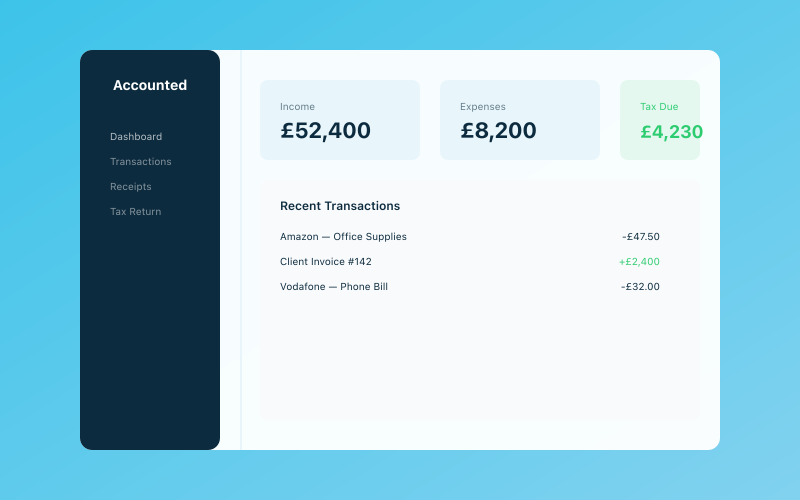 Your Accounted dashboard — income, expenses, and tax at a glance
Branson has been refreshingly honest about the chaos of those early years. He had no formal business training, no accountant (initially), and only the vaguest understanding of tax obligations. In his autobiography, he describes the panic of receiving his first substantial tax bill and not having the faintest idea how to pay it.
His early record business was, for all intents and purposes, a sole trader operation. He was the salesman, the marketer, the stock manager, and the delivery driver. The glamour came much later. The hustle was there from the start.
The lesson? You do not need to have everything figured out on day one. Branson certainly did not. But he kept going, learned from his mistakes, and was not too proud to ask for help when he needed it — including, eventually, hiring a proper accountant.
J.K. Rowling: The Freelance Writer Who Changed Literature
Before Harry Potter became a global phenomenon worth billions, J.K. Rowling was a single mother living on benefits in Edinburgh, writing in cafes during her daughter's naps. When she finished the first manuscript, she was rejected by twelve publishers before Bloomsbury finally said yes — and even then, she was advised to get a day job because children's books did not make much money.
Rowling's early writing career was, in tax terms, a classic sole trader setup. She was a self-employed author with irregular income, no pension, no sick pay, and a lot of uncertainty. Her first advance from Bloomsbury was reportedly £1,500. Hardly the stuff of financial independence.
What makes Rowling's story relevant to sole traders is not the fairy-tale ending (most of us will not sell 500 million books). It is the years of persistence through financial hardship, self-doubt, and rejection that preceded it. She kept working when there was no guarantee of success, no steady income, and every rational reason to stop.
For freelancers dealing with their own version of feast and famine, there is comfort in knowing that even the most spectacularly successful careers often have spectacularly unglamorous beginnings.
James Dyson: 5,127 Failed Prototypes
James Dyson spent fifteen years and over 5,000 prototypes developing his bagless vacuum cleaner. During that time, he was essentially a sole trader — a self-employed inventor working from a coach house, funding his research through remortgaging his home and surviving on his wife's teaching salary.
Every major manufacturer rejected his design. Hoover, Electrolux, and Miele all turned him down, often with the helpful suggestion that he should stop wasting his time. He eventually launched his own manufacturing operation and built a business that is now worth billions.
Dyson's story illustrates something that every sole trader knows instinctively: working for yourself requires a tolerance for failure that employed people rarely need. When you are the only person responsible for your business, every setback is personal. The ability to keep going despite repeated rejection — what psychologists call "grit" — is arguably more important than talent, connections, or capital.
It also illustrates the importance of keeping proper records. Dyson meticulously documented every prototype, every test, and every iteration. When legal disputes later arose over his patents, those records were invaluable. The same principle applies to your bookkeeping — keeping accurate, organised records is not just a tax requirement; it is protection for your business. Tools like Accounted make this far less tedious than it was in Dyson's coach house days.
Anita Roddick: A Kitchen Table Start-Up
Anita Roddick opened the first Body Shop in Brighton in 1976 with a £4,000 loan. She mixed the products herself in her kitchen, used the cheapest containers she could find, and handwrote the labels. The name "The Body Shop" was chosen partly because the neighbouring funeral directors objected to the association.
Roddick was, in the beginning, a sole trader in the most literal sense. She sourced ingredients, manufactured products, staffed the shop, and handled the accounts. She has spoken about the steep learning curve of understanding tax, VAT, and business regulations — and the many mistakes she made along the way.
What set Roddick apart was not a large starting budget or a brilliant business plan. It was a clear sense of purpose (ethical, sustainable beauty products) and a willingness to do everything herself until she could afford to delegate. The Body Shop eventually grew to over 3,000 stores in 66 countries, but it started with one woman, one shop, and a lot of homemade moisturiser.
Alan Sugar: Boiling Aerials in the Kitchen
Lord Sugar — now one of the UK's most recognisable business figures — started his first business at the age of 21, selling car aerials and electrical goods from a van he bought for £50. His "factory" was his kitchen, where he would boil the plastic coatings onto aerial components.
Sugar has never romanticised those early days. In interviews, he describes the relentless grind of buying, selling, delivering, and chasing payments — often from customers who had no intention of paying. He taught himself basic bookkeeping out of necessity and learned about tax obligations through trial and error (and, occasionally, through uncomfortable conversations with HMRC).
His company, Amstrad, eventually became a publicly listed electronics manufacturer worth hundreds of millions. But the skills that built Amstrad were the same skills that every sole trader develops: salesmanship, financial discipline, persistence, and the ability to solve problems with limited resources.
Sara Blakely: Selling Footless Tights From a Flat
Sara Blakely, the founder of Spanx, started her billion-dollar shapewear company with £3,000 in savings and no outside investment. She wrote her own patent (after researching how patents worked at her local library), designed the packaging herself, and sold the first products by personally visiting department stores and demonstrating them in the ladies' toilets.
For the first couple of years, Blakely ran Spanx as what would be classified in the UK as a sole trader operation. She was the only employee, handling everything from product development to customer service to, yes, bookkeeping.
Blakely has spoken about the importance of keeping her overhead low during those early years. She did not rent an office, did not hire staff, and did not spend money on anything that was not absolutely necessary. This financial discipline — born not from choice but from necessity — gave her the runway to grow the business without taking on debt or giving away equity.
The message for sole traders is clear: starting small is not a limitation. It is a strategy. Low overhead and financial discipline give you the freedom to take risks, make mistakes, and find your market without the pressure of loan repayments or investor expectations.
What These Stories Have in Common
Despite the diversity of industries and personalities, these success stories share some common threads:
They all started with nothing (or close to it). None of these people began with substantial capital, extensive business networks, or formal training. They started with an idea, a willingness to work, and not much else.
They all experienced rejection and failure. Branson was arrested. Rowling was rejected twelve times. Dyson failed over 5,000 times. Sugar had customers who would not pay. Rejection is not a sign that you are on the wrong path — it is a sign that you are on any path at all.
They all learned financial management the hard way. Tax bills, cash flow crises, and bookkeeping chaos feature prominently in every one of these stories. Today's sole traders have a significant advantage: tools like Accounted and its AI assistant Penny can handle much of the financial administration that these entrepreneurs had to figure out from scratch. Our guide on managing irregular income with smart budgeting would have been useful reading for all of them.
They all kept going. This is the simplest and most important commonality. They did not stop. Through financial hardship, self-doubt, rejection, and failure, they continued. Persistence is not glamorous, but it is the single most reliable predictor of long-term success.
They all eventually asked for help. None of these people built their businesses entirely alone. They eventually hired accountants, brought on partners, and built teams. Knowing when to stop doing everything yourself and start delegating is a crucial business skill — and one that many sole traders learn too late.
Your Story Is Not Over
If you are reading this as a sole trader — perhaps during a quiet period, perhaps while procrastinating on your bookkeeping, perhaps while wondering whether all the effort is worth it — remember this: every one of the people in this article had moments exactly like yours.
They sat at their kitchen tables. They worried about money. They wondered whether anyone would ever buy what they were selling. They felt like imposters. They made mistakes with their taxes. They considered giving up.
And then they did not.
Your business does not need to become a billion-pound empire to be a success. But whatever success looks like for you — financial independence, creative freedom, flexibility, impact — the path to it starts exactly where you are now.
Keep going. Keep records. And keep believing that what you are building matters — because it does.
Accounted helps UK sole traders stay on top of their bookkeeping and tax. Start your free 30-day trial at getaccounted.co.uk.
Related reading:
- Financial Anxiety as a Sole Trader
- How to Manage Irregular Income With Smart Budgeting
- Pricing Your Services — A Complete Guide
Related Reading
- Career Changers Going Freelance — A Complete Tax Starter Guide
- How to Start a Mobile Bar Business
- How to Start a Freelance Consulting Business
Starting out? Accounted is built for UK sole traders from day one — from £14/month. Get started →
Business & Operations Advisors
Our business advisors cover the practical side of running a UK sole trader business — from HMRC registration to managing growth. Content is written for real business owners in plain English, not accountants.
Ready to try Accounted?
Join UK sole traders who are simplifying their bookkeeping and tax.
Start your 14-day free trial