How to Manage Irregular Income — Budgeting for Freelancers
One month you earn £4,000. The next, £1,200. The month after that, £6,500. If this sounds familiar, welcome to the reality of freelance income — thrilling, unpredictable, and occasionally terrifying. The feast-and-famine cycle is one of the defining challenges of self-employment, and it makes traditional budgeting advice ("spend less than you earn each month") feel almost laughably simplistic.
But irregular income doesn't mean unmanageable income. Plenty of freelancers and sole traders have figured out how to smooth the highs and lows, cover their bills reliably, and even save consistently. The trick is to stop thinking about money on a monthly basis and start thinking about it as a system.
Here's how to build a budget that works when your income doesn't follow a pattern.
Why Traditional Budgeting Fails Freelancers
Most budgeting advice assumes a steady monthly salary. You earn £3,000 a month, you allocate £800 to rent, £300 to food, £200 to transport, and so on. Whatever's left goes to savings or discretionary spending. Neat and tidy.
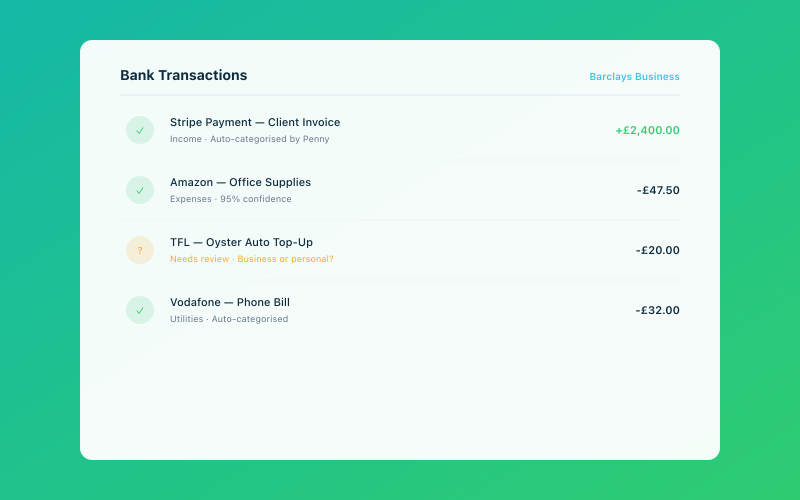 Penny auto-categorises your bank transactions with 95%+ accuracy
When you're freelancing, this model breaks down immediately. You can't allocate a fixed amount to rent if you're not sure whether you'll earn enough to cover it. You can't commit to a monthly savings target if some months you're barely scraping by.
The problem isn't a lack of discipline — it's that the tool doesn't fit the job. You need a different approach entirely. One that accounts for variability, builds in buffers, and gives you confidence even in the lean months.
Step 1: Know Your Baseline Number
Before you can budget, you need to know your absolute minimum monthly spending — the bare-bones amount you need to survive and keep your business running. This is your baseline.
To calculate it, list every essential cost:
Personal essentials:
- Rent or mortgage
- Council tax
- Utilities (gas, electric, water)
- Food (realistic, not aspirational)
- Insurance (home, car, health if applicable)
- Minimum debt repayments
- Phone contract
- Transport (fuel, public transport)
- Any other non-negotiable costs
Business essentials:
- Software subscriptions (including Accounted, of course)
- Professional insurance
- Phone and internet (business share)
- Essential supplies or materials
- Any contractual commitments
Add these up. That's your baseline — the minimum you need each month to keep everything ticking over. Everything else (meals out, clothes, entertainment, non-essential business spending) is discretionary.
Most freelancers find their baseline is lower than they think. Knowing this number is incredibly liberating because it tells you exactly how much you need to earn in a quiet month to stay afloat.
Step 2: Pay Yourself a Salary
This is the single most powerful technique for managing irregular income. Instead of spending whatever lands in your business account, decide on a fixed monthly "salary" and transfer it to your personal account on the same day each month.
Here's how to set it:
- Look at your last 12 months of income (or whatever history you have).
- Calculate your average monthly income after business expenses and tax savings.
- Set your salary at a conservative level — ideally at or slightly above your baseline. You can always give yourself a bonus in a good month.
For example, if your average monthly income after expenses is £3,200, you might set your salary at £2,500. The remaining £700 (on average) stays in your business account as a buffer.
The key is consistency. Pay yourself the same amount every month regardless of how much you earned. In boom months, the excess builds up in your business account. In lean months, you draw from that buffer. Over time, this smooths out the peaks and troughs and gives your personal life the same predictability as a regular salary.
Tracking this becomes much easier with Accounted, where you can see your running income and expenses in real time. Penny helps you stay on top of what's coming in and going out, so you always know whether your buffer is healthy or running low.
Step 3: Build a Buffer Fund
Your buffer fund is the reservoir that sits between your irregular income and your regular salary. It's what covers your salary in months when your earnings dip below your set amount.
How much buffer do you need? A good rule of thumb is two to three months of your salary. So if you're paying yourself £2,500 a month, aim for a buffer of £5,000 to £7,500 sitting in your business account.
This isn't the same as an emergency fund (which covers genuine crises). Your buffer fund is for expected variability — the natural ups and downs of freelance life. Think of it as a shock absorber.
Build it gradually:
- In any month where your income exceeds your salary, leave the excess in your business account.
- Once your buffer reaches your target, you can either increase your salary or start diverting the surplus to savings, investments, or business growth.
- If your buffer drops below your target, resist the urge to increase your salary until it's rebuilt.
Step 4: Use the Priority Stack for Variable Expenses
Once your essentials are covered by your regular salary, you need a system for everything else. This is where the priority stack comes in.
List your non-essential spending in order of importance to you. For example:
- Additional tax savings (topping up beyond the minimum)
- Emergency fund contributions
- Pension contributions
- Professional development or training
- Business investment (marketing, equipment upgrades)
- Personal discretionary spending (meals out, holidays, hobbies)
In a month where your income exceeds your salary, work down the list. Fund item 1, then item 2, then item 3, and so on until the surplus is allocated. In a month where your income only just covers your salary, nothing goes to these items — and that's fine.
This approach ensures that the most important financial goals get funded first, while less critical spending only happens when you can genuinely afford it.
Step 5: Manage Your Tax Savings Alongside Your Budget
Tax is one of the biggest financial risks for freelancers with irregular income. When you earn £6,000 in a month, it's tempting to feel wealthy — but a significant chunk of that belongs to HMRC.
The simplest approach is to transfer a fixed percentage of every payment you receive into a dedicated tax savings account. For most sole traders, 25–30% is a reasonable starting point (adjust based on your profit margins and tax band).
Do this before you do anything else with the money — before paying your salary, before building your buffer, before discretionary spending. Tax money isn't your money, and the sooner it's ringfenced, the less likely you are to spend it accidentally.
If you're not sure how much to set aside, our guide on planning for a big tax bill walks through the calculations in detail.
Step 6: Review and Adjust Quarterly
A budget for irregular income isn't something you set once and forget. It needs regular attention — and quarterly reviews work well because they align with natural business rhythms (and with Making Tax Digital quarterly submissions).
Every quarter, review:
- Total income received — is it broadly in line with your expectations?
- Buffer fund balance — is it at your target level, or has it been eroded?
- Tax savings balance — are you on track to cover your estimated bill?
- Salary level — is it still appropriate, or does it need adjusting?
- Spending patterns — are there areas where you're consistently over or under budget?
If your income has grown consistently, you might be able to increase your salary. If it's dropped, you might need to reduce it temporarily. The point is to stay proactive rather than reactive — spotting trends before they become problems.
Accounted makes these reviews straightforward. You can see your income trends, expense categories, and running profit at a glance, giving you the data you need to make informed decisions rather than gut-feel guesses.
Common Mistakes Freelancers Make With Money
Spending boom-month income as if it'll last. A great month doesn't mean every month will be great. Bank the surplus; don't upgrade your lifestyle.
Not saving for tax from day one. The number-one cause of financial anxiety among sole traders is an unexpected tax bill. Start saving from your very first invoice.
Ignoring quiet periods. If your business has a seasonal pattern, plan for it. If January is always quiet, make sure your December buffer is healthy enough to carry you through.
Mixing personal and business money. When everything goes through one account, it's impossible to tell whether you're profitable or just busy. Separate your finances — it takes an hour to set up and saves countless hours of confusion.
Not tracking invoices and payments. You can't budget around income you haven't chased. If clients owe you money, follow up promptly. Late payments are a controllable problem, and the sooner you address them, the healthier your cash flow.
Comparing yourself to salaried friends. They get paid the same amount every month, they don't worry about tax, and their employer contributes to their pension. It looks easier — and in some ways it is. But you chose self-employment for a reason. Build systems that give you the same financial stability, just through a different route.
Tools and Systems That Help
Beyond good habits, a few practical tools can make managing irregular income significantly easier:
- A dedicated business bank account — keeps business and personal spending separate and makes your financial picture clearer.
- Accounting software — Accounted is built for sole traders and freelancers, with Penny handling the categorisation and number-crunching so you don't have to.
- A simple spreadsheet — if you want to track your budget, salary, and buffer manually, a spreadsheet works. Just keep it updated.
- Automatic transfers — set up standing orders for your salary, tax savings, and buffer contributions so they happen without you having to remember.
- A cash flow forecast — even a basic one helps you anticipate quiet months and plan accordingly.
The goal isn't to eliminate income variability — that's the nature of freelancing. The goal is to build systems that absorb the variability so your personal finances feel stable even when your business income isn't.
Related Reading
Accounted helps UK sole traders stay on top of their bookkeeping and tax. Start your free 30-day trial at getaccounted.co.uk.
Related reading: Choosing Your Accounting Year End Date.
For more on this topic, read Common Tax Scams Targeting Self-Employed People.
Related reading: Identity Theft for Sole Traders: Prevention.
Related reading: Student Loan Repayments When Self-Employed.
Try Accounted free for 30 days — no credit card required.
Accounted makes bookkeeping simple — Penny categorises your transactions automatically so you don't have to. See how →
Tax & Compliance Specialists
Our tax specialists have decades of combined experience in UK sole trader and small business taxation, MTD compliance, and HMRC submissions. All content is reviewed against current HMRC guidance before publication and updated quarterly to reflect legislative changes.
Ready to try Accounted?
Join UK sole traders who are simplifying their bookkeeping and tax.
Start your 14-day free trial