Letting Agent Fees — Are They Tax Deductible for Landlords?
Using a letting agent can save you a tremendous amount of time and hassle as a landlord. From finding tenants and conducting viewings to handling maintenance calls at midnight, a good agent earns their fee. But when that fee shows up on your bank statement, the natural question is: can I offset this against my rental income for tax purposes?
The short answer is yes — letting agent fees are generally tax deductible for landlords. But as with most things tax-related, there are some nuances worth understanding to make sure you're claiming correctly and not missing anything.
What Counts as a Letting Agent Fee?
Letting agents offer a range of services, and the fees they charge can vary widely depending on the level of service you choose. The most common fee structures are:
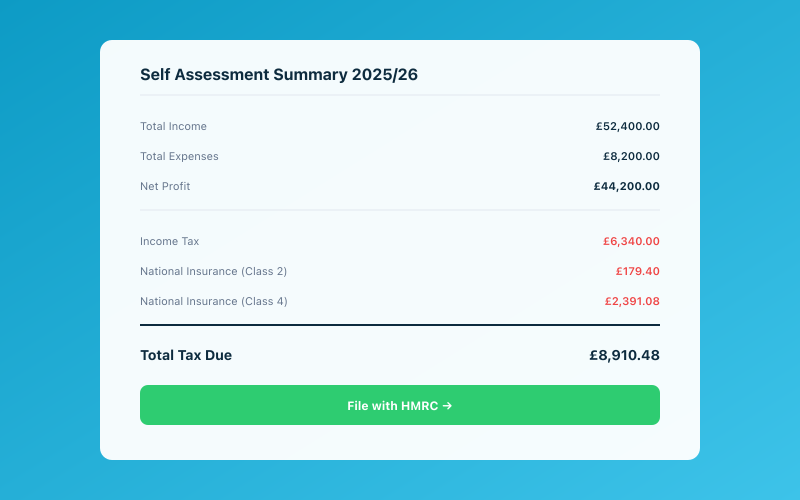 Your Accounted dashboard shows your real-time tax position
Tenant-find only: The agent advertises the property, conducts viewings, references potential tenants, and sets up the tenancy. Once the tenant moves in, the agent's involvement typically ends, and you manage the property yourself. Fees for this service usually range from four to eight weeks' rent (plus VAT).
Rent collection: The agent handles everything in the tenant-find service, plus collects the rent each month and passes it on to you (minus their fee). This typically costs around eight to twelve per cent of the monthly rent.
Full management: The agent takes care of everything — finding tenants, collecting rent, arranging maintenance and repairs, handling day-to-day queries, conducting inspections, and dealing with any issues that arise. Full management fees usually range from ten to fifteen per cent of the monthly rent, plus VAT.
Some agents also charge additional fees for specific services, such as:
- Inventory preparation
- Check-in and check-out inspections
- Serving legal notices (Section 21 or Section 8)
- Attending court hearings
- Handling deposit disputes
- Organising gas safety checks or electrical inspections
- Arranging EPC assessments
All of these are costs directly related to the letting and management of your property, and they're all potentially tax deductible.
The Tax Position — Revenue vs Capital
The golden rule for tax deductibility is that an expense must be "wholly and exclusively" incurred for the purpose of the property rental business. Letting agent fees tick this box comfortably — they're a direct cost of running your rental property.
HMRC treats letting agent fees as a revenue expense, meaning they're deductible in full against your rental income in the year they're incurred. There's no need to spread them over multiple years or treat them as capital expenditure.
This applies to all the fee types mentioned above:
- Monthly management fees — deductible
- Tenant-find fees — deductible
- Inventory fees — deductible
- Legal notice fees — deductible
- Inspection fees — deductible
The one area where you need to be slightly careful is if a letting agent charges you a fee that's partly for a capital purpose. For instance, if your agent arranges and manages a significant property renovation (not a repair), the agent's fee related to that capital work might not be fully deductible as a revenue expense. In practice, this is unusual, but it's worth being aware of if your agent is overseeing major improvement works.
How to Claim Letting Agent Fees
You claim letting agent fees on your Self Assessment tax return, in the property income section. If you complete the return yourself, you'll include them under "Property management" or "Legal, management, and professional fees" depending on which boxes your return provides.
If you're using Accounted to manage your rental property finances, you can categorise agent fees as they come through during the year. Penny can help you allocate them to the right property and the right category, so when January rolls around, everything is already organised and ready to go.
The key records you need to keep are:
- Invoices from your letting agent. Most agents provide monthly statements showing fees deducted from rent collected. Keep these — they're your evidence.
- The management agreement. This sets out the fee structure and what's included. It's useful background if HMRC ever asks questions.
- Bank statements. These should show the net rent received (after agent fees) or separate fee payments.
If your agent deducts their fees before passing you the rent — which is the most common arrangement — you need to declare the gross rent (before fees) as your rental income and then claim the agent fees as a separate expense. Don't just declare the net amount you received, or you'll understate your income and overstate your expenses, which can cause problems.
For example, if your tenant pays £1,000 per month in rent and your agent takes ten per cent, you receive £900. On your tax return, you declare £1,000 as income and £100 as a management expense. The net effect is the same, but HMRC wants to see both figures properly reported.
VAT on Letting Agent Fees
Most letting agents charge VAT on their fees. If you're not VAT-registered as a landlord — and most private landlords aren't, since residential rent is exempt from VAT — then the VAT element is simply part of your cost. You claim the gross amount (including VAT) as your expense.
So if your agent charges ten per cent of £1,000 rent (£100) plus VAT at twenty per cent (£20), your total deductible expense is £120.
If you are VAT-registered (which might apply if you also have commercial property or other VAT-able activities), the position is more complex. You'd need to consider whether you can recover the VAT on agent fees through your VAT return. For most residential landlords, this won't be relevant, but if you have a mixed property portfolio, it's worth taking advice.
Fees You Might Overlook
Beyond the obvious management and tenant-find fees, there are several related costs that landlords sometimes forget to claim:
- Referencing fees (where you pay them). Since the Tenant Fees Act 2019, landlords in England can no longer pass referencing costs on to tenants. If your agent charges you for referencing, that's a deductible expense.
- Professional photography and marketing. Some agents charge extra for professional photographs, floor plans, or premium portal listings. These are deductible.
- Tenancy agreement preparation. If your agent or a solicitor prepares the tenancy agreement, the cost is deductible.
- Renewal fees. Some agents charge a fee when a tenancy is renewed. This is deductible.
- Key cutting and locksmith fees. Often arranged through the agent and billed back to you. Deductible.
If you're not sure whether a particular charge from your letting agent qualifies, a good rule of thumb is to ask: is this cost directly related to the letting of my property? If the answer is yes, it's almost certainly deductible. For a comprehensive list, have a look at our guide to landlord allowable expenses.
Self-Managing vs Using an Agent — The Tax Perspective
Some landlords manage their own properties to save on agent fees. From a purely financial standpoint, that makes sense if your time is worth less than the agent's fee. But from a tax perspective, there are a few things to consider.
When you self-manage, you lose the agent fee deduction. However, you can still claim for other costs you incur in managing the property — things like advertising costs, mileage to and from the property for inspections or viewings, phone calls to tenants, and stationery. These tend to be much smaller than an agent's percentage fee, but they're still worth claiming.
If you use a mix of approaches — perhaps tenant-find only, then self-manage — you can claim the tenant-find fee and any ongoing self-management costs. There's no either-or restriction.
The real consideration is often time rather than tax. If you're running a business alongside your property portfolio, the hours spent dealing with tenants, maintenance, and admin might be better spent earning income from your main trade. This is particularly true if you have several properties. The agent fee is tax-deductible, and the time you save can be genuinely valuable.
Using a tool like Accounted to track your property income and expenses can also reduce the management burden. Even if you self-manage, having a clear picture of your finances means less time spent sorting through bank statements and receipts at year-end. You can read more about tracking property expenses in our guide to what expenses landlords can claim.
What About Letting Agent Fees for Holiday Lets?
If you let out a furnished holiday property — whether through an agent, a platform like Airbnb, or a holiday letting agency — the fees are also deductible. In fact, the tax treatment is broadly the same as for long-term lets, though holiday lets have their own specific rules around qualifying criteria and available reliefs.
Holiday letting agencies and booking platforms typically charge a commission on each booking, which might be fifteen to twenty-five per cent depending on the platform and level of service. These commissions are fully deductible against your holiday let income.
For more on the specifics of holiday letting, including the tax implications, take a look at our furnished holiday lettings guide.
Keeping It All Organised
The simplest way to ensure you claim all your letting agent fees correctly is to keep on top of your records throughout the year. Waiting until January to sort through twelve months of agent statements is a recipe for missed deductions and unnecessary stress.
Here's a practical approach:
- Set up a dedicated category for letting agent fees in your bookkeeping software.
- Record each fee as it's charged, ideally on a monthly basis.
- Keep digital copies of agent statements and invoices.
- Reconcile your records against your agent's annual statement (most agents provide one in April or on request).
- Review your total agent fees before completing your tax return to make sure nothing's been missed.
If you're managing multiple properties with different agents, this is especially important. It's easy for a fee here or a charge there to slip through the cracks, and over a year those missed deductions can add up to meaningful tax savings lost.
Related reading:
Accounted helps UK sole traders stay on top of their bookkeeping and tax. Start your free 30-day trial at getaccounted.co.uk.
Related Reading
Explore our property features built specifically for UK landlords.
Accounted includes built-in property management — track rental income, Section 24, and allowable expenses across multiple properties. See property features →
Tax & Compliance Specialists
Our tax specialists have decades of combined experience in UK sole trader and small business taxation, MTD compliance, and HMRC submissions. All content is reviewed against current HMRC guidance before publication and updated quarterly to reflect legislative changes.
Ready to try Accounted?
Join UK sole traders who are simplifying their bookkeeping and tax.
Start your 14-day free trial