How to Work From Home Productively (Real Tips, Not Clichés)
If you've ever searched for "how to work from home productively," you've probably encountered the same recycled advice: get dressed every morning, create a dedicated workspace, stick to a schedule. Which is fine, as far as it goes, but it doesn't go very far.
The reality of working from home — particularly when you're self-employed — is far messier than those tidy listicles suggest. You're not just working remotely for a company that provides structure. You are the company. You set the deadlines, manage the clients, handle the admin, and somehow resist the gravitational pull of the fridge. All from the same building where your bed is.
So let's skip the clichés and talk about what actually works.
Accept That Some Days Will Be Rubbish
This might seem like an odd place to start a productivity article, but it's the most important thing nobody says: not every day will be productive, and that's completely fine.
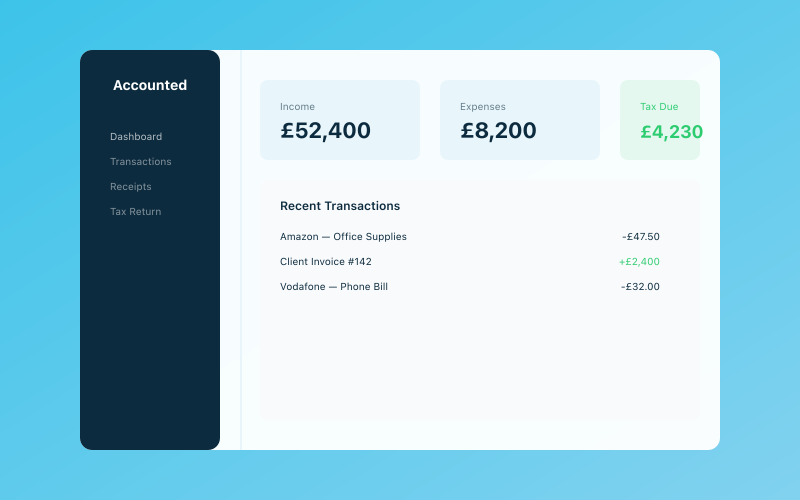 Your Accounted dashboard — income, expenses, and tax at a glance
When you work from home, there's no commute to create a mental transition. There's no boss walking past your desk to keep you accountable. There's no ambient office energy to carry you through the afternoon slump. Some days, the motivation simply isn't there.
The problem isn't the bad days themselves — it's the guilt spiral they create. You have a slow morning, then you feel bad about the slow morning, then the feeling bad makes the afternoon worse, and before you know it you've written off the entire day and are stress-eating biscuits at four o'clock.
Instead, try this: accept the slow start, do one small task to break the inertia, and move on. A short day where you accomplish two meaningful things is infinitely more valuable than a long day spent punishing yourself for not being a productivity machine.
Work In Blocks, Not Hours
The eight-hour workday was designed for factories, not for knowledge work done from your kitchen table. When you're self-employed and working from home, clocking in and out at set times often does more harm than good.
Instead, try working in focused blocks. The Pomodoro Technique (25 minutes on, 5 minutes off) gets mentioned a lot, and it works well for some people, but you might find longer blocks — 60 or 90 minutes — suit you better. The key is having a defined start and end, with a proper break in between.
During your focused block, close everything that isn't related to the task at hand. Email, social media, your phone — all of it. You're not being productive if you're checking Instagram every seven minutes, no matter how many hours you sit at your desk.
Between blocks, actually step away. Make a cup of tea. Go outside for five minutes. Let your brain reset before the next round. Your best ideas often arrive in the gaps between focused work, not during it.
Handle Your Admin In Batches
One of the biggest productivity killers when working from home is the constant trickle of small tasks. An invoice to send here, a receipt to file there, a bank transaction to check. Individually, they take minutes. Collectively, they fragment your entire day.
The solution is batching. Set aside a specific time — maybe the last hour of your workday, or a dedicated slot on Friday mornings — and do all your admin in one go. Invoicing, bookkeeping, emails, scheduling: batch it together and get it done.
Better yet, automate the bits you can. Tools like Accounted make bookkeeping almost invisible — Penny, our AI assistant, categorises your transactions, tracks your expenses, and keeps your records HMRC-ready without you having to think about it. That's one less batch to worry about.
If admin is your particular nemesis, we've got a whole piece on how to stop procrastinating on your admin that's worth a look. You're not alone in this — it's the number one thing sole traders tell us they struggle with.
Create Transitions, Not Just Routines
Everyone tells you to create a morning routine, and that's decent enough advice. But what's more important is creating transitions — moments that signal to your brain that you're shifting from one mode to another.
When you worked in an office, the commute did this for you. The act of travelling from home to work created a psychological boundary between "off" and "on." Working from home removes that boundary entirely, which is why so many people struggle to start work in the morning and, equally, struggle to stop in the evening.
You need to create your own transitions. It doesn't have to be elaborate. A short walk around the block before you start. A specific playlist you only listen to while working. Making your coffee in a particular way. Closing your laptop and putting it away at the end of the day.
These small rituals might seem silly, but they give your brain the cues it needs to switch gears. Without them, work and life blur into one grey, exhausting soup — and that way lies burnout. If you're already feeling the pull of never-ending work hours, our guide on how to stop working evenings and weekends has some practical strategies.
Manage Your Energy, Not Just Your Time
Here's a genuinely useful reframe: stop trying to manage your time and start managing your energy.
Everyone has natural peaks and troughs throughout the day. Some people are sharp in the morning and useless after lunch. Others don't really get going until the afternoon. When you work from home, you have the extraordinary luxury of working with your energy rather than against it.
Pay attention to when you do your best work. Schedule your most demanding tasks — the creative stuff, the complex problems, the things that require deep focus — during your peak energy hours. Save the easier, more mechanical tasks for your low-energy periods.
This sounds simple, but it's transformative. Instead of fighting your own biology by trying to do hard thinking at three in the afternoon when your brain has turned to porridge, you do it at ten in the morning when you're firing on all cylinders. The same work takes half the time and feels a fraction as draining.
And for the love of everything, stop skipping lunch. Eating a proper meal in the middle of the day isn't a luxury — it's a basic requirement for your brain to function. Step away from your desk. Eat something that isn't from a packet. Your afternoon self will thank you.
Set Boundaries With The People You Live With
If you live with a partner, children, flatmates, or anyone else, you need to have an explicit conversation about boundaries. It feels awkward, but it's non-negotiable.
Working from home doesn't mean you're available. It doesn't mean you can put the washing on, accept deliveries for the neighbours, or have a twenty-minute chat about what to have for dinner. Those interruptions seem minor, but they demolish your focus. Research suggests it takes an average of 23 minutes to fully regain concentration after an interruption. Three interruptions in a morning and you've essentially lost the entire session.
Have the conversation. Be kind but clear: when you're working, you're working. Set specific times when you're available and specific times when you're not. If you don't have a room with a door, invest in noise-cancelling headphones — they're worth their weight in gold.
This extends to clients, too. Just because you work from home doesn't mean you're available 24/7. Set working hours and communicate them. Respond to emails during work time, not during dinner. Setting boundaries with clients is a skill, and it's one worth developing early.
Make Your Environment Work For You
You don't need a Pinterest-worthy home office to be productive. You do, however, need an environment that doesn't actively work against you.
Good lighting matters. Natural light is ideal, but if your workspace is dim, a decent desk lamp makes a surprising difference to your mood and focus. A comfortable chair matters too — your back will not forgive you for spending eight hours on a kitchen stool.
Temperature matters. Noise levels matter. The tidiness of your space matters, at least to some degree. You don't need perfection, but you need to remove the obvious friction points that drain your energy without you realising.
Also, consider whether you need to leave the house sometimes. Working from home every single day can become claustrophobic. A morning at a coffee shop, a day at a coworking space, or even just working from a friend's dining table can break the monotony and reignite your focus.
If you're thinking about sorting out your workspace on a budget, have a read of our piece on setting up a home office without spending a fortune — there's plenty you can do without breaking the bank. And don't forget that some of these expenses may be claimable — check our guide on working from home expenses for 2025-26 to see what you can offset against your tax bill.
The Real Secret Nobody Mentions
The real secret to working from home productively isn't any single hack or technique. It's self-knowledge.
What works for your friend, your favourite podcaster, or the person who wrote that viral Twitter thread might not work for you. And that's fine. The whole point of working for yourself, from home, is the freedom to figure out what actually suits you.
Experiment. Try different routines, different environments, different approaches. Keep what works, discard what doesn't. Be honest with yourself about your weaknesses — and equally honest about your strengths.
And when the admin piles up despite your best efforts, remember that you don't have to do everything yourself. Accounted exists specifically to take the bookkeeping burden off your plate, so you can spend your energy on the work that matters. Penny handles the numbers; you handle the rest.
Related reading:
- How to Stop Working Evenings and Weekends
- Setting Boundaries with Clients — A Complete Guide
- Working From Home Expenses 2025-26
Accounted helps UK sole traders stay on top of their bookkeeping and tax. Start your free 30-day trial at getaccounted.co.uk.
Related Reading
- Work-Life Balance When Your Office Is Your Living Room
- Inbox Zero for Sole Traders — Managing Email Overwhelm
Start your free trial and see how Accounted simplifies your bookkeeping.
Business & Operations Advisors
Our business advisors cover the practical side of running a UK sole trader business — from HMRC registration to managing growth. Content is written for real business owners in plain English, not accountants.
Ready to try Accounted?
Join UK sole traders who are simplifying their bookkeeping and tax.
Start your 14-day free trial