How to Create Recurring Revenue in Your Accountancy Practice
There's a fundamental problem with the way most accountancy practices bill their clients: it's unpredictable. You do a chunk of work in January, invoice in February, get paid (if you're lucky) in March. The next quarter is busy, so revenue spikes. Then summer hits, things slow down, and you're watching your bank balance with one eye closed.
This feast-or-famine cycle isn't just stressful — it makes it nearly impossible to plan, invest, or grow with any confidence. You can't hire staff if you don't know what next month's revenue looks like. You can't invest in marketing if your cash flow is a rollercoaster.
The solution is recurring revenue — predictable, regular income that arrives every month regardless of where you are in the compliance cycle. And the good news is that the accountancy profession is uniquely well-suited to subscription models. Your clients need ongoing support, they have regular deadlines, and the work follows a predictable annual pattern.
Here's how to make the shift.
Why Recurring Revenue Changes Everything
Before we get into the practicalities, let's talk about why recurring revenue is so transformative.
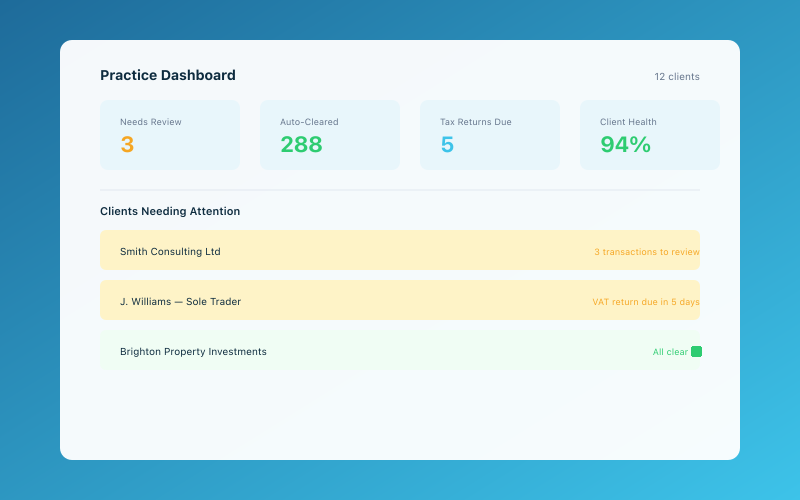 The Accounted practice dashboard — manage all your clients in one place
Predictability. When 80% of your revenue is recurring, you know at the start of each month roughly what you'll earn. You can plan your capacity, your costs, and your investments with far greater confidence.
Cash flow. Monthly payments smooth out the cash flow spikes that plague traditional practices. No more chasing large invoices or waiting months for payment.
Client retention. Subscription clients are stickier than project-based clients. Once someone is paying you monthly and receiving regular value, the switching cost (both financial and emotional) goes up significantly.
Valuation. If you ever want to sell your practice, recurring revenue dramatically increases its value. Buyers love predictable income streams. A practice with £200,000 in recurring annual revenue is worth significantly more than one with £200,000 in ad-hoc billing.
Better client relationships. When you're in regular contact with clients throughout the year, you understand their business better, spot problems earlier, and provide more valuable advice. Compare this to the traditional model where you might only speak to a client twice a year.
Designing Your Subscription Packages
The foundation of recurring revenue is the subscription package. This is where you bundle your services into monthly plans that clients pay for on an ongoing basis.
The most effective approach is tiered packaging — typically three levels that cater to different client needs and budgets.
Tier 1: Compliance Essentials This is your entry-level package covering the basics:
- Year-end accounts preparation
- Self-assessment tax return filing
- Basic email/phone support
- MTD quarterly submissions
Price this to be accessible and competitive. It's your foot-in-the-door offering.
Tier 2: Growth Everything in Tier 1, plus:
- Bookkeeping review (monthly or quarterly)
- Regular check-in calls
- Tax planning advice
- Priority support
This is where most clients should land. It offers genuine ongoing value and justifies a meaningful monthly fee.
Tier 3: Premium Everything in Tier 2, plus:
- Full bookkeeping service
- Monthly management reporting
- Unlimited advisory support
- Annual tax planning review
- Proactive recommendations
This tier is for clients who want a true partnership with their accountant. Price it to reflect the significant value and time commitment involved.
The beauty of tiered pricing is that it gives clients choice while gently nudging them towards the middle tier (which is usually where you want them). It also creates a natural upgrade path — as a client's business grows, they move up the tiers.
For a deeper dive into pricing strategies, take a look at our guide on fixed vs hourly pricing for accountancy services.
Calculating Your Prices
Pricing your packages requires a balance of cost analysis, market awareness, and confidence.
Start by understanding your costs. For each tier, estimate:
- The total time you'll spend on that client over a year (compliance work, support queries, meetings, admin)
- Your target effective hourly rate (what you need to earn per hour to cover costs and generate profit)
- Multiply the two to get your minimum annual fee, then divide by 12 for the monthly price
Then apply a value adjustment. If a service saves a client significant time or money (tax planning, for instance), you should charge more than your cost calculation suggests. The client is paying for the outcome, not just your time.
Don't forget to factor in the tools and software you use on each client's behalf. If you're covering the cost of their accounting software, cloud storage, or filing fees, build those into your package price.
As a rough benchmark, sole trader subscription packages in the UK typically range from £75–£150/month for a compliance-focused service, £150–£300/month for a mid-tier offering, and £300–£500+/month for premium, full-service packages. But these vary significantly by location, niche, and the specific services included.
Transitioning Existing Clients
Moving existing clients from ad-hoc billing to subscriptions is the trickiest part of the process. You're asking people to change how they pay you, which can feel risky.
Here's a phased approach that works:
Step 1: Start with new clients. Every new client from today onwards goes on a subscription package. This is the easy part — they don't know any different.
Step 2: Identify your best existing clients. Look for clients who already pay you regularly, who value your advice, and who have a good relationship with you. Approach them first.
Step 3: Frame it as an upgrade. Don't say "we're changing how we bill you." Say "we're introducing a new service model that gives you more support, more proactive advice, and predictable monthly costs." Focus on what they gain, not what changes.
Step 4: Offer a transition incentive. A small discount for the first three months, or a free advisory session, can ease the switch. Make it feel like a positive step.
Step 5: Be patient with the rest. Some clients will take longer to come round, and a few might prefer to stay on ad-hoc billing. That's fine — forced transitions damage relationships. Over time, as they see other clients benefiting from the subscription model, most will come round.
Reducing Churn
Recurring revenue is only valuable if it actually recurs. Client churn — the rate at which clients leave — is the single biggest threat to a subscription model.
The average accountancy practice loses 5–15% of its clients each year. Even a few percentage points reduction in churn can have a dramatic impact on revenue over time.
Key strategies for reducing churn:
Deliver consistent value. This sounds obvious, but it's the most important factor. If clients feel they're getting good value every month — not just at tax time — they'll stick around.
Communicate regularly. Don't disappear between deadlines. Monthly newsletters, quarterly check-ins, proactive tips and reminders — regular touchpoints reinforce the value of the relationship.
Respond quickly. When a client reaches out with a question, speed matters. A quick, helpful response builds loyalty. A three-day delay erodes it.
Ask for feedback. Regularly check in with clients about their experience. What's working? What could be better? This not only helps you improve but makes clients feel heard.
Spot warning signs early. A client who stops opening your emails, misses payments, or becomes unresponsive may be thinking about leaving. Reach out proactively rather than waiting for the cancellation email.
Our guide on reducing client churn in accounting practices goes into much more detail on this critical topic.
Adding Value Beyond the Core Package
Once you've established your subscription model, look for ways to add value that don't significantly increase your costs but do increase perceived value (and justify your fees).
Content. A monthly email with relevant tax tips, deadline reminders, and business advice. It takes an hour to write but reaches every client simultaneously.
Templates and tools. Invoice templates, expense trackers, budget spreadsheets, tax deadline calendars. Create them once, share them with every client.
Community. A private group (LinkedIn, Facebook, or similar) where your clients can ask questions, share experiences, and support each other — with you as the trusted expert in the room.
Technology recommendations. Helping clients choose and set up the right tools is a quick win. For sole traders, recommending something straightforward like Accounted — where Penny handles much of the day-to-day bookkeeping and categorisation — can massively reduce the admin burden on both the client and you.
Webinars and workshops. Quarterly sessions on topics like tax planning, MTD preparation, or business finances. They position you as an expert, deliver value to clients, and can even attract new prospects.
Measuring Success
Track these metrics to understand how your recurring revenue model is performing:
- Monthly Recurring Revenue (MRR): Your total subscription revenue each month
- Annual Recurring Revenue (ARR): MRR multiplied by 12
- Client churn rate: The percentage of clients who cancel each month/quarter
- Revenue churn rate: The revenue lost to cancellations (more important than client count, because losing a £500/month client hurts more than losing a £75/month one)
- Average Revenue Per Client (ARPC): Your total recurring revenue divided by client count
- Upgrade rate: The percentage of clients moving to a higher tier
Review these monthly and look for trends. Rising ARPC and low churn? You're doing it right. Flat ARPC and rising churn? Something needs attention.
The shift to recurring revenue isn't instant — it typically takes 12–18 months to transition most of a practice's client base. But the practices that make the effort consistently report that it's one of the best strategic decisions they've ever made.
For broader growth strategies, our guide on how to grow your accountancy practice in 2026 is packed with practical ideas that complement a recurring revenue model perfectly.
Related Reading
Accounted helps UK sole traders stay on top of their bookkeeping and tax. Start your free 30-day trial at getaccounted.co.uk
Accounted gives accountants a free practice portal — manage all your clients, file to HMRC, and let Penny handle the routine work. See the accountant portal →
Editorial & Research
The Accounted editorial team covers software comparisons, technology, and the tools UK sole traders need to run their businesses efficiently. All software comparisons are based on independent research and publicly available pricing.
Ready to try Accounted?
Join UK sole traders who are simplifying their bookkeeping and tax.
Start your 14-day free trial