HMRC's Making Tax Digital Penalties — The New Points-Based System
A Completely New Penalty Regime
If you have been filing Self Assessment returns for a while, you will be familiar with HMRC's old penalty system — miss the deadline, get a flat £100 fine, and it escalates from there. That system is being replaced by something quite different.
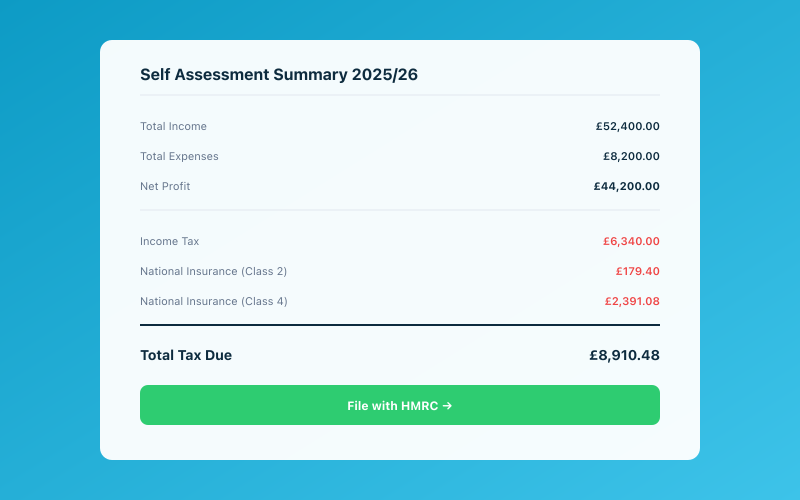 Your Accounted dashboard shows your real-time tax position
The new points-based penalty regime applies to Making Tax Digital for Income Tax Self Assessment (MTD for ITSA), and it works more like a driving licence. You accumulate penalty points for late submissions, and once you reach a threshold, financial penalties start kicking in. The idea is to be more forgiving of occasional lapses while cracking down on persistent non-compliance.
Understanding how this system works is essential if you want to avoid unnecessary penalties. So let us walk through it properly.
How the Points System Works
Earning Points
Every time you miss a submission deadline, you receive one penalty point. It does not matter why you missed it or by how much — a submission that is one day late earns the same point as one that is three months late.
The submissions that can earn you points include:
- Quarterly updates under MTD for Income Tax
- The end-of-period statement (EOPS)
- The final declaration (which replaces the traditional Self Assessment return)
- VAT returns (for those already under MTD for VAT)
Points Thresholds
The number of points you can accumulate before penalties apply depends on how frequently you are required to submit:
| Submission frequency | Points threshold | |---------------------|-----------------| | Annual | 2 points | | Quarterly | 4 points | | Monthly | 5 points |
For most sole traders under MTD for ITSA, you will be making quarterly submissions plus an end-of-period statement and final declaration. The quarterly element means your threshold is 4 points.
This means you can miss up to three quarterly deadlines without receiving a financial penalty. On the fourth miss, you hit the threshold, and from that point onwards, every late submission triggers a £200 financial penalty.
What Happens Once You Hit the Threshold
Once you reach your points threshold:
- You receive a £200 penalty for the submission that took you to the threshold
- Every subsequent late submission also attracts a £200 penalty
- Points and penalties continue to accumulate until you achieve a period of compliance
So if you have been consistently late with your quarterly submissions and you have hit 4 points, you could be looking at £200 for every late submission going forward. Over a year with four quarterly submissions, that is potentially £800 in penalties on top of whatever tax you owe.
Resetting Your Points — The Period of Compliance
The good news is that your points are not permanent. You can reset your points total back to zero by achieving a "period of compliance." This means:
- You must submit all returns on time for a continuous period (typically 24 months for quarterly submissions)
- You must have no outstanding submissions — any overdue returns must be filed before the period of compliance can begin
Once you have completed the period of compliance, your points reset to zero and you effectively start fresh.
This is designed to reward people who get back on track. One bad patch does not haunt you forever, provided you sort yourself out.
Period of Compliance by Submission Frequency
| Submission frequency | Period of compliance | |---------------------|---------------------| | Annual | 24 months of on-time submissions | | Quarterly | 24 months of on-time submissions | | Monthly | 24 months of on-time submissions |
Late Payment Penalties — A Separate System
The points-based system covers late submissions. Late payments are handled separately under a new two-stage system that replaces the old surcharge regime.
Stage 1: Initial Late Payment Penalty
If your tax payment is overdue by more than 15 days, you will be charged a penalty of 2% on the amount outstanding at day 15.
If it is still unpaid after 30 days, an additional 2% is charged on the amount outstanding at day 30. So the maximum first-stage penalty is effectively 4% of the overdue amount.
Stage 2: Ongoing Late Payment Penalty
If any amount remains unpaid after 30 days, a second penalty starts accruing at a rate of 4% per year on the outstanding balance. This is calculated daily and charged periodically.
Interest on Late Payments
On top of the late payment penalties, HMRC charges interest on overdue tax. The late payment interest rate is set at the Bank of England base rate plus 2.5%. As rates have been elevated recently, this can add up quickly.
Example
Suppose you owe £5,000 in tax and you do not pay it for 60 days:
- Day 15: 2% of £5,000 = £100 penalty
- Day 30: Additional 2% of £5,000 = £100 penalty (total £200)
- Days 31-60: 4% per year on £5,000 = approximately £16 for 30 days
- Interest: Bank of England base rate + 2.5% on £5,000 for 60 days
The total cost of paying 60 days late would be over £230 in penalties and interest. And that is on a relatively modest tax bill.
How to Appeal
If you believe a penalty has been issued unfairly, you can appeal. Valid grounds for appeal include:
- Reasonable excuse — Something unexpected and beyond your control prevented timely submission or payment (serious illness, bereavement, fire or flood, HMRC system failures)
- HMRC error — A mistake by HMRC contributed to the late submission
- Digital exclusion — You are digitally excluded and should not be required to file digitally
What does not count as a reasonable excuse:
- Being too busy
- Finding the software confusing
- Not knowing about the deadline
- Relying on someone else (such as an accountant) who missed the deadline — though this can sometimes be a reasonable excuse depending on circumstances
To appeal, you can write to HMRC or use the online appeal service. Include your UTR number, the penalty reference, the reasons for your appeal, and any supporting evidence.
If HMRC rejects your appeal, you can ask for a review by a different HMRC officer or escalate to the First-tier Tribunal.
Comparison With the Old Penalty Regime
The old Self Assessment penalty system was more binary:
| Old system | New system | |-----------|-----------| | £100 immediate penalty for late filing | 1 penalty point per late submission | | Daily penalties of £10/day after 3 months | No daily penalties | | 5% surcharge on late payments at 30 days | 2% at 15 days + 2% at 30 days | | Additional 5% at 6 months and 12 months | 4% per annum ongoing from day 31 | | No "forgiveness" mechanism | Points reset after period of compliance |
The new system is generally more lenient for occasional lateness but more punishing for persistent non-compliance. If you are usually on time and have one bad quarter, the points system is kinder. If you are consistently late, the accumulating penalties can be more expensive than the old fixed fines.
How Accounted Helps You Stay Compliant
The simplest way to avoid penalties is to never miss a deadline. That sounds obvious, but when you are running a business, deadlines have a way of sneaking up on you.
Penny, the AI bookkeeper within Accounted, helps by keeping your records up to date continuously, so you are not scrambling to prepare quarterly submissions at the last minute. When your books are already in order, meeting a deadline is a five-minute task rather than a three-day panic.
Here are some practical steps to stay on top of things:
Set Up Calendar Reminders
Put your quarterly submission deadlines in your calendar with reminders set for one week and three days before each deadline.
Reconcile Regularly
Do not let your bank transactions pile up. Reconciling weekly or fortnightly means your records are always close to submission-ready.
Automate What You Can
Bank feeds, automatic categorisation, and digital receipt capture all reduce the manual work involved in keeping your records current.
Know Your Deadlines
Under MTD for ITSA, your quarterly periods typically follow the standard quarters:
- Quarter 1: 6 April to 5 July — submission due by 7 August
- Quarter 2: 6 July to 5 October — submission due by 7 November
- Quarter 3: 6 October to 5 January — submission due by 7 February
- Quarter 4: 6 January to 5 April — submission due by 7 May
The end-of-period statement is due by 31 January following the end of the tax year, and the final declaration is also due by 31 January.
Planning Ahead
The new penalty system is designed to encourage consistent, timely compliance. If you build good habits now — regular record-keeping, prompt submissions, and awareness of your deadlines — the system should never trouble you.
But if you do slip up, knowing how the system works means you can act quickly to minimise the damage and start your period of compliance as soon as possible.
Accounted is built to make MTD compliance as painless as possible. With real-time record-keeping and straightforward submission tools, you can focus on running your business rather than worrying about penalty points.
Related reading
- Making Tax Digital — Your Complete 2026 Guide
- Self Assessment Tax Return — Your Complete Guide
- National Insurance Changes in 2026
Related Reading
See how Accounted handles MTD and start your free trial.
Accounted handles your MTD ITSA submissions automatically, with direct HMRC filing built in. See how MTD works in Accounted →
Tax & Compliance Specialists
Our tax specialists have decades of combined experience in UK sole trader and small business taxation, MTD compliance, and HMRC submissions. All content is reviewed against current HMRC guidance before publication and updated quarterly to reflect legislative changes.
Ready to try Accounted?
Join UK sole traders who are simplifying their bookkeeping and tax.
Start your 14-day free trial