How to Close Your Self Assessment Account with HMRC
Why Would You Close Your Self Assessment Account?
Life changes. Maybe you've landed a full-time PAYE job and your side hustle days are behind you. Perhaps you've retired, or your freelance income has dried up completely. Whatever the reason, if you no longer need to file a Self Assessment tax return, you can — and should — tell HMRC.
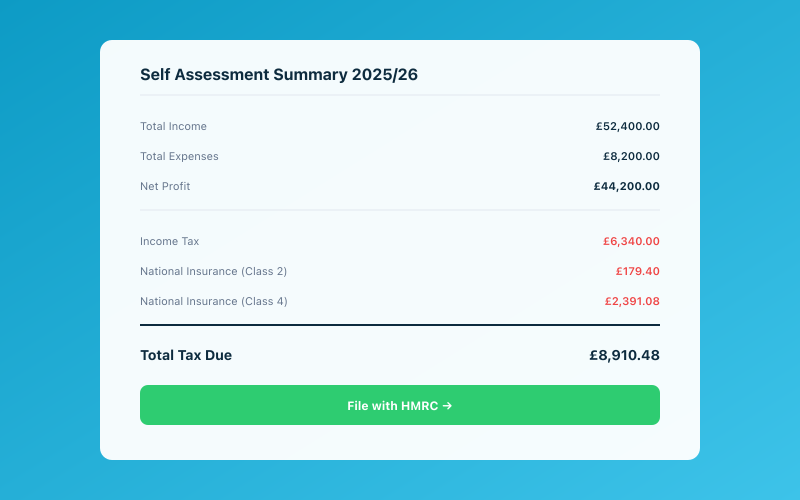 Your Accounted dashboard shows your real-time tax position
But here's the thing: closing your Self Assessment account isn't always as straightforward as ticking a box. Get the timing wrong, and you could end up with unexpected penalties or a tax bill you weren't expecting. Get it right, and you'll free yourself from the annual January scramble forever (or at least until your next venture).
Let's walk through everything you need to know.
When Can You Actually Close Your Self Assessment Account?
You can ask HMRC to close your Self Assessment account when you no longer meet the criteria that required you to register in the first place. The most common reasons include:
- You've stopped being self-employed — no more trading income at all
- Your total income is now taxed entirely through PAYE — and there's no untaxed income to declare
- You've stopped receiving rental income — you've sold your buy-to-let or stopped letting
- Your untaxed income has fallen below £1,000 — meaning the trading allowance covers it
- You've retired and no longer have any income that requires a Self Assessment return
It's worth noting that even if you've stopped self-employment, you might still need to file if you have other untaxed income — savings interest above your Personal Savings Allowance, for example, or capital gains above the annual exempt amount.
How to Notify HMRC
There are three main ways to tell HMRC you want to close your Self Assessment account, and the best option depends on your situation.
Option 1: Online Through Your Government Gateway Account
This is the quickest route for most people. Log in to your HMRC online account, navigate to your Self Assessment section, and look for the option to "stop self-employment" or notify HMRC of a change in circumstances. You'll need to provide the date you stopped trading.
Option 2: Phone HMRC Directly
Call the Self Assessment helpline on 0300 200 3310. Be prepared for a wait (we've all been there), but speaking to an adviser can be helpful if your situation is complicated — for instance, if you're stopping self-employment but still have rental income.
Option 3: Form CWF1
If you registered as self-employed using form CWF1, you can use the same process in reverse. You'll need to write to HMRC or complete the cessation section of the form. This is less common nowadays, but it's still an option if you prefer paperwork.
Whichever method you choose, make sure you keep a record of the date you notified HMRC and any reference numbers they give you.
Your Final Tax Return — Don't Skip This
Here's where people often trip up. Closing your Self Assessment account doesn't mean you can ignore your final tax return. If HMRC has already issued a return for the current tax year, you must file it, even if you stopped trading partway through the year.
Your final return should include:
- All your income up to the date you stopped trading
- Any outstanding expenses you haven't yet claimed
- Details of any allowable business expenses from your final period of trading
- Capital gains from selling any business assets
If you stopped trading on, say, 15th September 2025, your final Self Assessment return for the 2025/26 tax year (due by 31st January 2027) should include your trading income from 6th April 2025 to 15th September 2025.
Overlap Relief
If you started your business before 2023/24 and have overlap profits, your final return is your last chance to claim overlap relief. This could reduce your final tax bill significantly, so don't overlook it. The transition to the tax year basis in 2024/25 changed how this works, but if you have any residual overlap relief, make sure it's claimed. Check out our Self Assessment guide for more detail on this.
Timing Considerations — Don't Close Too Early
This is crucial. Don't rush to close your Self Assessment account the moment you stop trading. Here's why:
Outstanding invoices. If clients still owe you money, that income counts as trading income in the year you receive it (if you use cash basis accounting) or the year you invoiced it (if you use accrual accounting). Closing your account before this income is declared could cause problems.
Payments on account. If you've been making payments on account, closing your account prematurely could mean HMRC doesn't properly reconcile what you owe versus what you've paid. You might be due a refund — and you'll want to make sure you get it.
Post-cessation expenses. Some costs arise after you stop trading — like accountancy fees for preparing your final return, or the cost of storing business records. These can sometimes be claimed as post-cessation expenses, but only if handled correctly.
The general rule? File your final return first, make sure any tax owed is paid and any refund received, and then ask HMRC to close the account.
What Happens to Your UTR?
Your Unique Taxpayer Reference (UTR) is yours for life. Even after you close your Self Assessment account, HMRC keeps your UTR on file. Think of it like a National Insurance number — it doesn't expire or get reassigned.
This is actually useful because if you ever need to register for Self Assessment again (more on that below), you'll use the same UTR. It makes the re-registration process faster.
One thing to be aware of: your UTR is sensitive information. Even after closing your account, keep it somewhere safe and don't share it unnecessarily.
Re-registering If You Start Again
Decided to go freelance again? Started a new side hustle? You'll need to re-register for Self Assessment, but the good news is it's usually quicker the second time around.
You'll use your existing UTR, and HMRC already has your personal details on file. You still need to register within three months of starting your new self-employment (technically, by 5th October following the end of the tax year in which you started trading, but don't leave it that long).
If your new venture is different from your old one, make sure you update your trade classification. And if you're unsure whether your new activity counts as trading, have a read of our guide on hobby versus business tax implications to understand where the line is.
Class 2 National Insurance Implications
When you close your Self Assessment account and stop being self-employed, you'll stop paying Class 2 National Insurance contributions (currently £3.45 per week in 2025/26). You'll also stop paying Class 4 NI, which is charged at 6% on profits between £12,570 and £50,270, and 2% above that.
But here's something worth thinking about: Class 2 NI contributions count towards your State Pension entitlement. If you've been self-employed for a while and then move to a job where you're not building up NI credits (or you take a career break), you might have gaps in your NI record.
You can check your NI record online through your Government Gateway account and, if necessary, make voluntary contributions to fill gaps. At £3.45 per week, Class 2 NI is one of the cheapest ways to protect your State Pension.
Common Mistakes When Closing Your SA Account
Having helped thousands of sole traders manage their finances, we see the same mistakes crop up time and again:
Closing before filing the final return
HMRC will still expect that return. If you don't file it, you'll get a £100 late filing penalty, followed by daily penalties, and eventually a tax determination where HMRC estimates what you owe. Not ideal.
Forgetting about payments on account
If you paid towards the current year's tax bill via payments on account but earned less than expected, you might be due a refund. Make sure you claim it before closing up shop.
Not keeping records
Even after you close your Self Assessment account, HMRC requires you to keep your business records for at least five years from the 31st January filing deadline. So if your final return is for 2025/26, filed by 31st January 2027, you need to keep records until at least 31st January 2032.
Ignoring post-cessation receipts
If a client pays you after you've closed your account and filed your final return, that payment might still be taxable. These are called post-cessation receipts, and HMRC expects you to declare them.
Step-by-Step: Closing Your Self Assessment Account
Let's bring it all together into a clear process:
- Stop trading and note the exact date
- Collect any outstanding payments from clients
- Gather all records for your final period of trading
- File your final Self Assessment return by the deadline
- Pay any tax owed (or claim your refund)
- Wait for HMRC to process your return and confirm your tax position
- Notify HMRC that you want to close your Self Assessment account
- Keep your records for at least five years after the filing deadline
- Store your UTR safely in case you need it in the future
Let Accounted Help You Wrap Things Up
Closing your Self Assessment account might be the end of a chapter, but it doesn't have to be stressful. If you're still in your final year of trading and want to make sure everything is tracked properly, Accounted and Penny, our AI bookkeeper, can help you stay on top of your income, expenses, and tax position right up until the end. That way, when it's time to file your final return, everything is already organised and ready to go.
Related Reading
- A Complete Guide to Self Assessment Tax Returns
- Tax Deductions Every Sole Trader Should Know About
- Hobby to Business — Understanding the Tax Implications
- How to Calculate Your Class 4 National Insurance Accurately
- How Long Does an HMRC Investigation Take?
Accounted files your Self Assessment directly to HMRC, with your return pre-populated from your records. See Self Assessment filing →
Tax & Compliance Specialists
Our tax specialists have decades of combined experience in UK sole trader and small business taxation, MTD compliance, and HMRC submissions. All content is reviewed against current HMRC guidance before publication and updated quarterly to reflect legislative changes.
Ready to try Accounted?
Join UK sole traders who are simplifying their bookkeeping and tax.
Start your 14-day free trial