How to Calculate Your Class 4 National Insurance Accurately
National Insurance — The Tax That Is Not Called a Tax
If income tax is the headline act of your Self Assessment bill, National Insurance is the support act that quietly adds a significant chunk to what you owe. For self-employed sole traders, Class 4 National Insurance is the main NI contribution, and understanding exactly how it is calculated helps you plan your finances and avoid any January surprises.
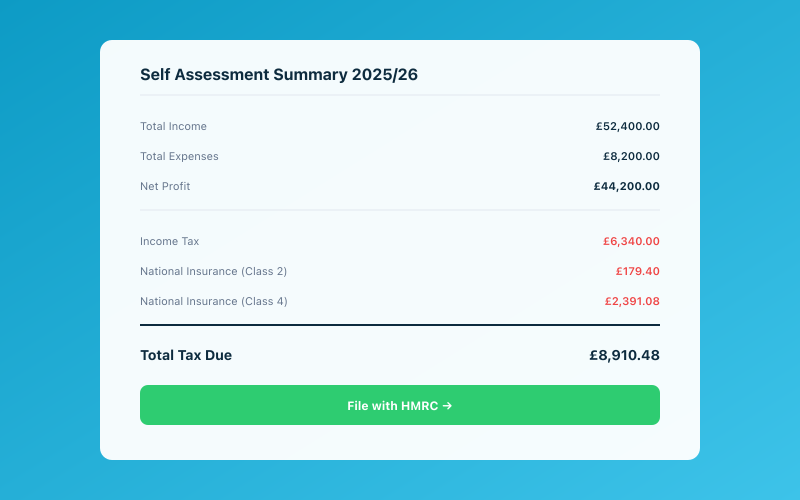 Your Accounted dashboard shows your real-time tax position
Let us break it down step by step, in plain English, with real numbers.
The Two Classes of Self-Employed NI
As a self-employed person, you potentially pay two types of National Insurance:
Class 2 National Insurance
Class 2 is a flat-rate contribution of £3.45 per week (2025/26 rate). You pay this if your self-employed profits exceed the small profits threshold, which is currently £6,725 per year.
Class 2 contributions count towards your State Pension entitlement and eligibility for certain benefits. At just £179.40 per year, it is remarkably cheap insurance for your future pension.
Even if your profits are below the threshold, you can choose to pay Class 2 voluntarily. This is often a very sensible decision if you have gaps in your National Insurance record, as it is the cheapest way to build qualifying years for the State Pension.
Class 4 National Insurance
Class 4 is the bigger contribution and is calculated as a percentage of your self-employed profits. This is what we are focusing on in this article.
Class 4 Rates and Thresholds (2025/26)
The Class 4 rates for the 2025/26 tax year are:
| Profit band | Rate | |------------|------| | Below £12,570 (lower profits limit) | 0% | | £12,570 to £50,270 (between lower and upper profits limits) | 6% | | Above £50,270 (upper profits limit) | 2% |
So you pay nothing on your first £12,570 of profit, 6% on the next £37,700 (from £12,570 to £50,270), and 2% on everything above £50,270.
Notice that the lower profits limit aligns with the income tax personal allowance of £12,570. This is not a coincidence — they are deliberately aligned to simplify the system (slightly).
Step-by-Step Calculation
Let us work through some examples to make this concrete.
Example 1: Profits of £30,000
- First £12,570 = £0 (below the lower profits limit)
- Next £17,430 (from £12,570 to £30,000) at 6% = £1,045.80
- Nothing above £50,270
Total Class 4 NI: £1,045.80
Plus Class 2 at £3.45/week x 52 = £179.40
Total NI bill: £1,225.20
Example 2: Profits of £50,000
- First £12,570 = £0
- Next £37,430 (from £12,570 to £50,000) at 6% = £2,245.80
- Nothing above £50,270
Total Class 4 NI: £2,245.80
Plus Class 2: £179.40
Total NI bill: £2,425.20
Example 3: Profits of £80,000
- First £12,570 = £0
- Next £37,700 (from £12,570 to £50,270) at 6% = £2,262.00
- Next £29,730 (from £50,270 to £80,000) at 2% = £594.60
Total Class 4 NI: £2,856.60
Plus Class 2: £179.40
Total NI bill: £3,036.00
The Maximum at the 6% Band
The maximum Class 4 you can pay at the 6% rate is £2,262.00 (6% x £37,700). Once your profits exceed £50,270, you only pay the additional 2% on the excess. This is similar to how income tax works with the basic and higher rate bands, although the NI rates are obviously different.
How Profits Are Calculated for NI Purposes
The profits figure used for Class 4 NI is your taxable self-employment profits — the same figure used for income tax purposes. This means:
- Start with your total business income
- Deduct all allowable business expenses
- Deduct capital allowances
- The result is your taxable profit
If you use the cash basis, your profit is calculated as income received minus expenses paid. If you use accrual accounting, it is income earned minus expenses incurred, regardless of when money actually changed hands.
What Is NOT Deducted
Your personal allowance (£12,570) is not deducted from your profits before calculating Class 4 NI. The Class 4 calculation uses its own lower profits limit, which happens to be the same figure. But they are technically separate — the personal allowance reduces your income tax, while the lower profits limit is the starting point for Class 4 NI.
Similarly, pension contributions reduce your income tax liability but do not reduce your profits for Class 4 NI purposes. This is a commonly misunderstood point.
If You Are Both Employed and Self-Employed
Many people have a job and run a business on the side. If you are employed and self-employed simultaneously, both your employer and you are paying National Insurance, which can create a situation where you pay more NI than necessary.
How It Works
Your employer deducts Class 1 NI from your salary through PAYE. Meanwhile, you pay Class 4 NI on your self-employment profits through Self Assessment. In theory, you could end up paying NI on a much larger combined income than the system intended.
The Maximum NI Cap
There is a maximum annual NI contribution. If your combined Class 1 and Class 4 contributions exceed the maximum, you may be entitled to a refund or adjustment. HMRC calculates this automatically through your Self Assessment return.
Deferment
If you know in advance that your combined employed and self-employed income will push you over the maximum, you can apply to HMRC to defer your Class 4 contributions. This prevents you from overpaying and waiting for a refund.
To apply for deferment, you need to write to HMRC's National Insurance Contributions Office before the start of the tax year. You will need to provide evidence of your expected employment income alongside your estimated self-employment profits.
If you defer and it turns out you actually owed the full amount, HMRC will collect the difference through your Self Assessment.
Practical Tip
If your employment salary is above the Upper Earnings Limit (£50,270) and you also have self-employment profits, you will only pay Class 4 NI at 2% on your self-employment profits (rather than the 6% main rate). This is because you have already "paid your way" through the main rate via your employment.
Penny, the AI bookkeeper within Accounted, tracks your self-employment income separately, which makes it easy to see your self-employment profits clearly even when you have other income sources.
Over State Pension Age — The Exemption
If you have reached State Pension age, you are exempt from Class 4 National Insurance. You do not pay it at all, regardless of how much your self-employment profits are.
You are also exempt from Class 2 NI once you reach State Pension age.
This can make a meaningful difference to your tax bill. Someone with £50,000 of self-employment profits who is over State Pension age saves over £2,400 per year compared to someone under pension age.
How to Claim the Exemption
The exemption is not always automatic. You should:
- Tick the relevant box on your Self Assessment return indicating you were over State Pension age
- Ensure HMRC has your correct date of birth on record
- If filing through software, check that the age-related exemption is being applied
If you have been paying Class 4 NI after reaching State Pension age, you may be able to claim a refund for overpaid contributions. Contact HMRC's National Insurance helpline.
Class 4 and Payments on Account
Class 4 NI is collected through Self Assessment, not through PAYE. This means it forms part of your payments on account.
If your Self Assessment bill (including Class 4 NI) was more than £1,000 in the previous year, HMRC will ask you to make payments on account — two advance payments towards next year's bill. Each payment is 50% of the previous year's total liability.
This is important for cash flow planning. Your Class 4 NI is not a separate payment — it is wrapped into your overall Self Assessment payments on account, due on 31 January and 31 July.
Voluntary Class 2 — Filling Gaps
If your profits are below the small profits threshold (£6,725), you can still choose to pay Class 2 voluntarily. At £3.45 per week, it is the cheapest way to build qualifying years for the State Pension.
You need 35 qualifying years for the full new State Pension. If you have gaps in your record — perhaps from periods of low income, travel, or career breaks — voluntary Class 2 contributions can fill those gaps at a fraction of the cost of voluntary Class 3 contributions (which cost £17.45 per week).
Check your National Insurance record on the government website (gov.uk) to see whether you have any gaps and how many qualifying years you have.
Reducing Your Class 4 Bill Legitimately
Since Class 4 is calculated on your taxable profits, anything that legitimately reduces your profits also reduces your Class 4 bill:
- Claim all allowable expenses — Every legitimate expense reduces your profit and your NI
- Use capital allowances — The Annual Investment Allowance lets you deduct up to £1 million of qualifying capital expenditure
- Consider the cash basis — If you are eligible, the cash basis may result in different profit timing that could affect your NI
- Timing of income and expenses — While you should not artificially manipulate your accounts, being aware of how timing affects your profit can help with planning
What does not reduce your Class 4 bill:
- Pension contributions (these only reduce income tax)
- Gift Aid donations (again, income tax only)
- Personal allowance (this is an income tax concept)
Putting It All Together
Here is a complete picture of the NI obligations for a sole trader with £45,000 profit in 2025/26:
| Contribution | Calculation | Amount | |-------------|------------|--------| | Class 2 | £3.45 x 52 weeks | £179.40 | | Class 4 (main rate) | 6% x (£45,000 - £12,570) = 6% x £32,430 | £1,945.80 | | Class 4 (additional rate) | N/A (below £50,270) | £0.00 | | Total NI | | £2,125.20 |
Add this to the income tax on the same profits:
| Tax | Calculation | Amount | |-----|------------|--------| | Income tax | 20% x (£45,000 - £12,570) = 20% x £32,430 | £6,486.00 |
Total tax + NI: £8,611.20 on £45,000 profits — an effective combined rate of about 19.1%.
Stay on Top of Your Numbers
The best way to avoid NI surprises is to know your numbers throughout the year, not just at Self Assessment time. Accounted gives you real-time visibility of your profits, which means you can estimate your Class 4 NI liability at any point and set aside money accordingly. No spreadsheets, no guesswork — just a clear picture of what you owe and when.
Related reading
- National Insurance Changes in 2026
- Self Assessment Tax Return — Your Complete Guide
- Tax Deductions Every Sole Trader Should Know About
Related Reading
Start your free trial and let Penny handle your bookkeeping automatically.
Accounted files your Self Assessment directly to HMRC, with your return pre-populated from your records. See Self Assessment filing →
Tax & Compliance Specialists
Our tax specialists have decades of combined experience in UK sole trader and small business taxation, MTD compliance, and HMRC submissions. All content is reviewed against current HMRC guidance before publication and updated quarterly to reflect legislative changes.
Ready to try Accounted?
Join UK sole traders who are simplifying their bookkeeping and tax.
Start your 14-day free trial